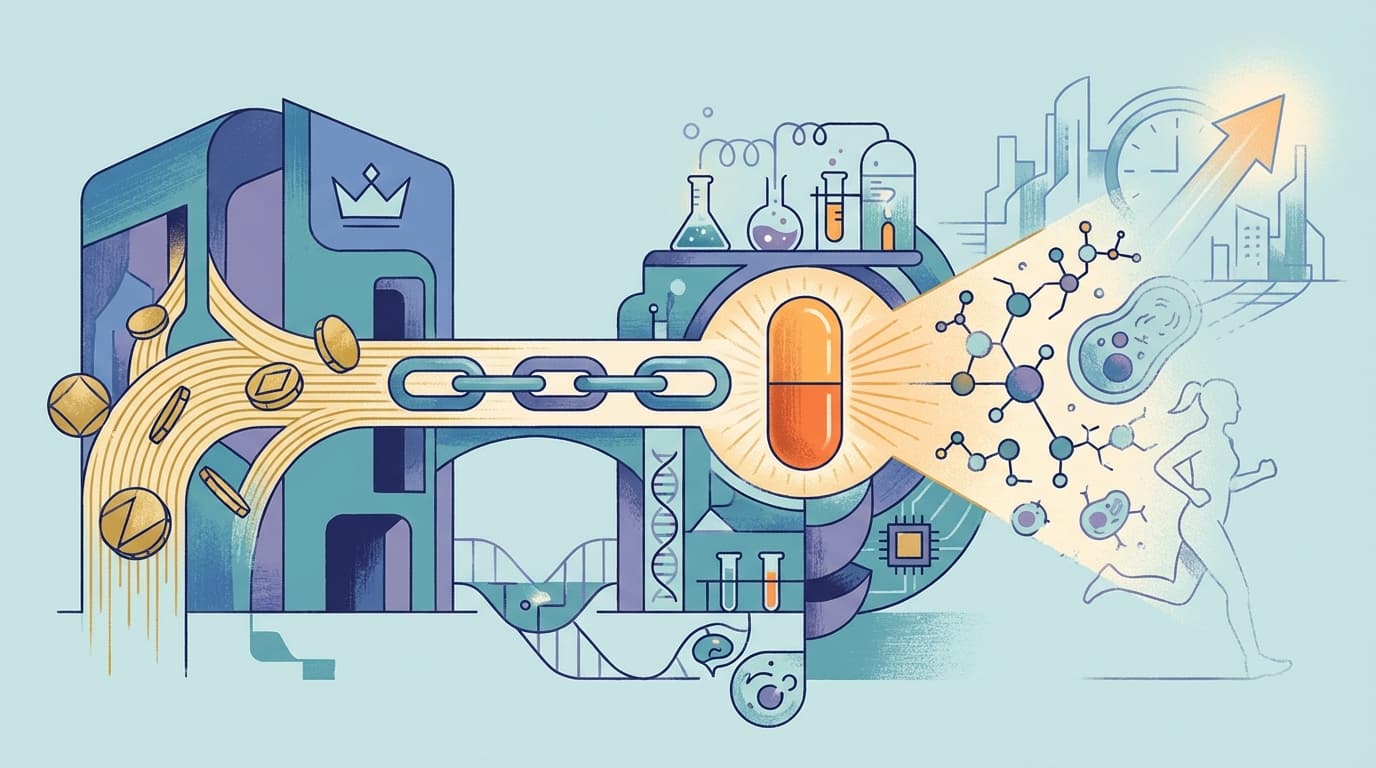
Novo Nordisk's $2.1B Bet That the Future of Weight Loss Is a Pill
Novo Nordisk just dropped $2.1 billion on a tiny MIT spinout to crack oral biologic delivery for obesity drugs. With Eli Lilly's oral GLP-1 already beating Novo's in head-to-head trials, this might be the most important bet the Danish pharma giant has ever made.
Most people hate needles. Novo Nordisk is betting $2.1 billion that this simple fact could reshape the entire obesity drug market.
The Danish pharma giant just partnered with Vivtex, a small MIT spinout most people have never heard of, to develop next-generation oral biologic medicines for obesity and diabetes. The goal: turn injectable drugs, the kind that made Ozempic and Wegovy household names, into pills you can swallow with your morning coffee.
It sounds straightforward. It is anything but.
The Problem With Swallowing a Biologic
To understand why this deal matters, you need to understand why most biologic drugs come in needles in the first place. Biologics are made from proteins and peptides, delicate, complex molecules that your digestive system treats like a steak dinner. Your stomach acid breaks them down. Enzymes chop them to pieces. And whatever survives that gauntlet still has to cross the intestinal wall to reach your bloodstream.
Imagine trying to mail a sandcastle through the postal system. That's roughly what happens when you try to deliver a biologic drug through the gut. By the time it arrives, there's almost nothing left.
Novo already launched the world's first oral GLP-1 pill, Rybelsus, back in 2019 for type 2 diabetes. But Rybelsus has always been the underperformer of the GLP-1 family. Its 2025 sales actually declined 5%, landing around $3.2 billion. Respectable for most drugs, but a rounding error compared to Ozempic's injectable dominance.
The problem isn't demand; it's biology. Current oral formulations just can't deliver enough drug into the body to compete with a direct injection. Novo needs a better mousetrap.
Enter Vivtex: The MIT Lab You've Never Heard Of
Vivtex was founded in 2018 by three scientists with serious pedigrees. Its core technology was developed during postdoctoral work at MIT. The co-founders include Robert Langer, the legendary MIT professor who co-founded Moderna, and Giovanni Traverso, an MIT engineering professor specializing in the GI tract.
Get tomorrow's biotech intelligence before your competitors.
Join thousands of biotech professionals who start their day with our free, daily briefing.
The company's secret weapon is its screening platform. Vivtex can test thousands of drug formulations per day using pig tissue models that mimic the human gut, paired with AI analytics and computational simulations. The company claims near-perfect correlation to actual human intestinal absorption. If that holds up, it could dramatically accelerate the usually glacial process of figuring out how to get a biologic past the stomach alive.
Vivtex had been operating under the radar since its founding: no splashy funding rounds, no press tours. Then Novo showed up with a deal worth up to $2.1 billion in milestones, royalties, and research funding. For a startup that most of biotech hadn't heard of, that's one hell of a coming-out party.
Under the deal, Vivtex handles early research and formulation work. Novo takes over for clinical development, manufacturing, regulatory filings, and commercialization. Classic big pharma–startup playbook: you bring the science, we bring the scale.
Why Novo Needs This More Than You Think
Novo Nordisk isn't making this bet from a position of pure strength. The company has been taking punches lately.
Its next-generation obesity drug CagriSema, which was supposed to be the Wegovy successor, lost a head-to-head clinical trial against Eli Lilly's Zepbound. That stung. CagriSema was Novo's big swing at leapfrogging the competition, and it came up short.
Meanwhile, Lilly isn't just winning the injectable race. It's also gunning for oral supremacy. Lilly's orforglipron, an oral GLP-1 that's a small molecule, not a peptide, beat Novo's oral semaglutide convincingly in a head-to-head Phase 3 trial. Patients on orforglipron saw 2.2% A1C reduction versus 1.4% for oral semaglutide. Weight loss? Nearly double: 9.2% versus 5.3%.
That's not a close race; that's getting lapped.
Orforglipron has another advantage that makes pharma chemists jealous. Because it's a small molecule rather than a peptide, it sidesteps the whole sandcastle-through-the-mail problem entirely. Small molecules survive the gut just fine. Novo's challenge is harder: it needs to make actual peptides and proteins survive oral delivery, something that's never been done well at scale.
What Wall Street Thinks (Spoiler: They're Skeptical)
Analysts greeted the Vivtex deal with the enthusiasm of someone receiving socks for Christmas. Acknowledging it was nice, sure, but not exactly what they were hoping for.
Barclays cut its Novo price target from DKK 340 to DKK 270. Citi trimmed its target to DKK 309. Morgan Stanley maintained an "underweight" rating.
Morgan Stanley acknowledged that the Vivtex partnership and some promising early-stage data on a triple-agonist compound (showing about 19.7% mean weight loss) were positives. But those positives aren't enough to offset the CagriSema disappointment and Lilly's growing lead.
The market isn't punishing Novo for doing this deal. It's punishing Novo because this deal feels like a long-term play when the company needs short-term answers.
The Bigger Picture: Pills vs. Needles Is a $150 Billion Question
Zoom out, and the stakes become clearer. The oral peptide therapeutics segment alone is growing at roughly 18% annually through 2035. Whoever cracks convenient, effective oral delivery of weight-loss biologics will own a massive slice of that pie.
Patient preference overwhelmingly favors pills. That's not speculation, it's human nature. If you could choose between a weekly injection and a daily pill that works just as well, you'd pick the pill. Everyone would.
But "just as well" is the operative phrase. Right now, oral GLP-1 formulations can't match their injectable cousins on efficacy. The Vivtex partnership is Novo's attempt to close that gap, not just incrementally, but fundamentally. If Vivtex's platform can crack the code on getting larger, more potent doses of peptides through the gut intact, Novo could leapfrog the current generation of oral drugs entirely.
A Bet on the Long Game
This deal won't produce a product next quarter, probably not next year either. Oral biologic delivery is one of the hardest problems in pharmaceutical science, and Vivtex's technology, however promising, is still early-stage.
But Novo is playing a game it knows well. The company spent decades as the dominant force in diabetes before GLP-1s turned it into an obesity juggernaut. It understands that the biggest wins in pharma come from patient, compounding bets on platform technologies.
The question is whether the market will give Novo the time. With Lilly's orforglipron potentially reaching approval soon and CagriSema stumbling, the window for Novo to maintain its GLP-1 throne is narrowing.
Two billion dollars says a pill can save it. We'll see if the gut agrees.
4 min read
Half a Billion for a Pill That Doesn't Exist Yet
Boehringer Ingelheim just dropped $500 million on a preclinical pill from a tiny Oxford biotech, and it's not the only massive immunology deal they've inked lately. The race to replace autoimmune injections with oral therapies is getting very expensive, very fast.