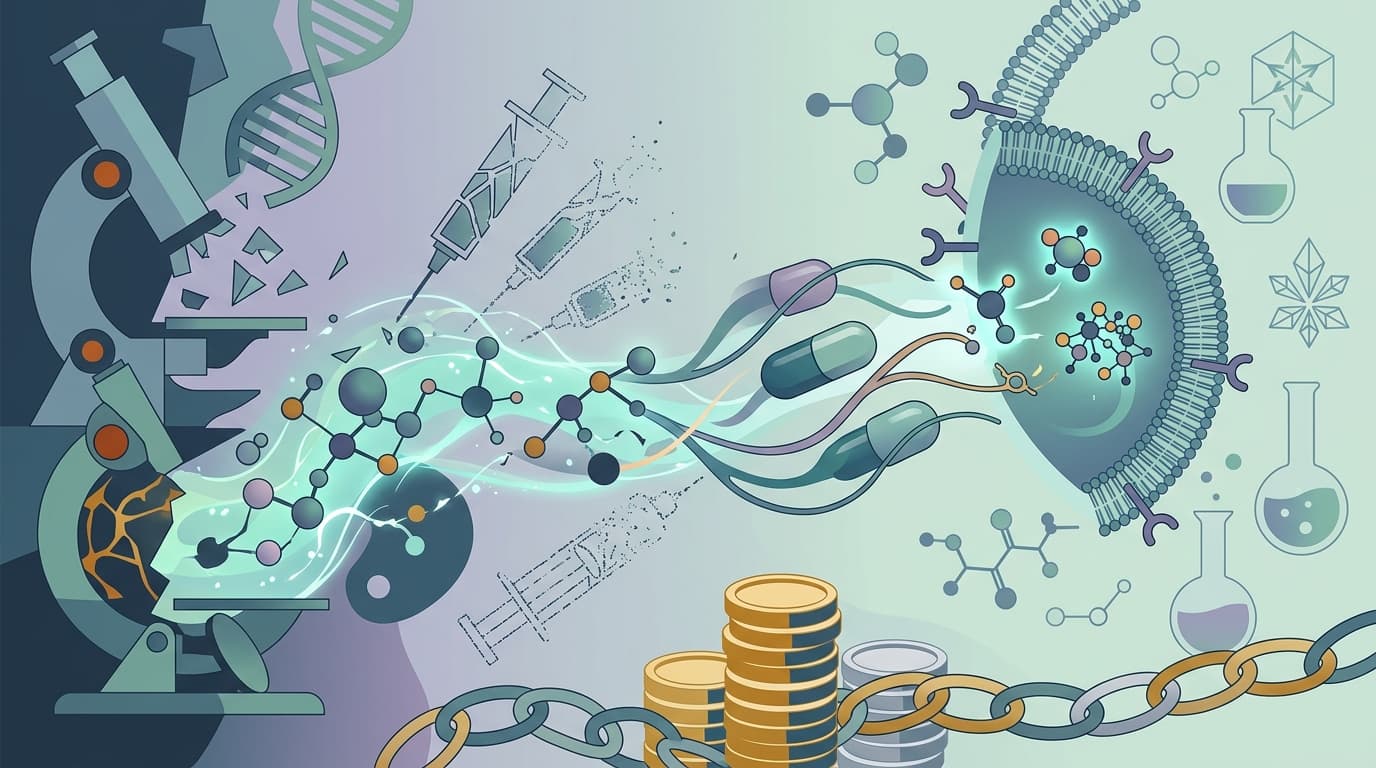

Novo Nordisk just dropped up to $1.3 billion on a tiny Swedish company's atom-by-atom coating technology. The goal: turning weekly GLP-1 shots into monthly or quarterly injections, which could reshape the entire obesity and diabetes market.
Imagine getting an injection once every three months instead of once a week. Same drug. Same results. Just 90% fewer needle sticks per year.
That's the pitch Novo Nordisk just bought for up to $1.3 billion. The Danish pharma giant signed an exclusive license and collaboration deal with Nanexa, a tiny Swedish drug-delivery company most people have never heard of, to get its hands on a technology called PharmaShell. The goal: turn Novo's weekly injectable peptides (think semaglutide, the molecule behind Ozempic and Wegovy) into monthly or even quarterly shots.
In a market where convenience is king, that's not just a nice-to-have. It could be the single biggest competitive advantage in obesity and diabetes treatment.
Nanexa isn't a household name. The company was founded in 2007, born out of materials-science research at Uppsala University in Sweden. For years it was a niche player in atomic-level coating technology. Then it figured out how to apply that tech to medicine, and everything changed.
PharmaShell works like this: imagine wrapping each tiny drug particle in an ultra-thin shell, just 30 nanometers thick in some cases. That's about 3,000 times thinner than a human hair. The shell is made from a slow-dissolving inorganic material, applied one atomic layer at a time using a process called Atomic Layer Deposition (ALD).
When you inject the coated particles, they form a depot (essentially a little drug reservoir) under the skin. The coating dissolves gradually, releasing the medication into your bloodstream over days, weeks, or months. Think of it like a time-release capsule, except instead of a plastic pill shell, it's an atom-by-atom engineered coating that lets you dial in exactly how long the drug takes to release.
The beauty of the system is its tunability. By adjusting the coating thickness and composition, Nanexa can control whether the drug trickles out over four weeks or twelve. And because the coating is so thin, you can pack a , which matters a lot for patient comfort.

Viatris, one of the world's biggest generics companies, is paying $1.65 billion in cash for Pacira BioSciences and its non-opioid pain portfolio. The deal says as much about the future of generics as it does about pain management.

Join thousands of biotech professionals who start their day with our free, daily briefing.

The deal's headline number is up to €1.165 billion (roughly $1.3 billion), but the money flows in stages. About €615 million covers upfront payments plus development and regulatory milestones. The remaining €550 million is tied to sales milestones, meaning Nanexa only sees that cash if the products actually succeed commercially. On top of all that, Nanexa earns low single-digit royalties on global net sales.
The collaboration covers up to five development programs across obesity, type 2 diabetes, and other cardiometabolic conditions. That's not a one-product bet; it's a platform play. Novo isn't licensing PharmaShell for a single molecule. It's locking up the technology across its entire metabolic portfolio.
For context, the relationship isn't new. Novo previously paid Nanexa $4 million for an exclusivity period and another $425,000 for evaluation work. Consider that the appetizer before a very expensive main course.
Novo Nordisk's current semaglutide lineup runs on two tracks. There's the weekly injectable side: Ozempic for diabetes, Wegovy for weight loss. And there's the daily oral side: Rybelsus, with a higher-dose 25 mg oral version now approved for obesity.
Both formats work. Both sell incredibly well. But neither solves the fundamental friction of chronic disease treatment: people stop taking their medications. The industry calls it adherence, and it's the silent killer of otherwise great drugs. Missing weekly shots is easy. Forgetting daily pills is even easier.
A monthly or quarterly injection changes the math entirely. Instead of 52 shots a year, you'd need 12. Or just four. That's not just more convenient; it fundamentally shifts how patients and doctors think about long-term treatment.
Novo's main rival, Eli Lilly, is charging hard in the obesity space with its own GLP-1 therapies. The competitive landscape increasingly rewards companies that make treatment less burdensome, not just more effective. If Novo can offer the same efficacy in a fraction of the doses, that's a moat competitors can't easily cross.
This deal fits a broader trend that's been building throughout 2025 and 2026. Big pharma is spending serious money on drug-delivery platforms, not just new molecules. Merck signed a $493 million deal with Cyprumed for oral peptide delivery technology. Avixgen closed a $360 million licensing agreement for its cell-penetrating peptide platform. DelSiTech licensed its silica-based controlled-release system for over $200 million in milestones.
Novo's Nanexa deal dwarfs all of them. At up to $1.3 billion, it's the largest delivery-technology licensing deal in recent memory for the metabolic space. The message from pharma boardrooms is clear: when the drugs already work, the next frontier is how you deliver them.
It's a little like the smartphone wars. Once every phone had a good camera, companies started competing on battery life, screen quality, and ecosystem. The underlying technology was table stakes. The user experience became the differentiator.
PharmaShell has reached clinical testing (Nanexa's own programs, NEX-18 and NEX-20, have entered human trials), but the technology hasn't yet been proven in large-scale pivotal studies. Coating peptide molecules atom by atom and scaling that process to commercial manufacturing is genuinely hard. Nanexa partnered with Applied Materials to build out GMP-classified production capabilities, and the company holds a GMP certificate from Sweden's Medical Products Agency. Still, the jump from pilot plant to global supply chain is where many promising technologies stumble.
There's also the question of whether patients and payers will value longer dosing intervals enough to justify premium pricing. The clinical data on PharmaShell with Novo's specific molecules doesn't exist yet. This deal is fundamentally a bet on the platform's versatility across five programs, and not every one of those bets will pay off.
Novo Nordisk isn't struggling. Its semaglutide franchise is one of the most successful drug platforms in history. But the company is clearly thinking several moves ahead. Weekly injections won Novo the first round of the GLP-1 wars. Monthly or quarterly injections could win the next one.
By paying $1.3 billion for a coating technology invented in a Swedish university lab, Novo is making a statement: in the future of metabolic medicine, how often you take the drug matters almost as much as the drug itself. For the millions of patients who dread their weekly shot, that future can't come soon enough.
Roche signed a deal worth up to $1 billion with Defand Therapeutics, a two-year-old Chinese startup with zero clinical trials, to discover molecular glue cancer drugs. It's Roche's fourth China partnership since August, and it signals a radical shift in how big pharma thinks about drug discovery.