Novartis Tested a Cancer Drug on 30 Patients. None of Them Responded.
Novartis pulled the plug on cancer candidate QEQ278 after it failed to shrink tumors in any of the 30 patients who received it. The zero-for-30 result is a stark reminder of oncology's brutal attrition rates, but it also reveals a lot about how Novartis is reshaping its pipeline.
A Batting Average of Zero
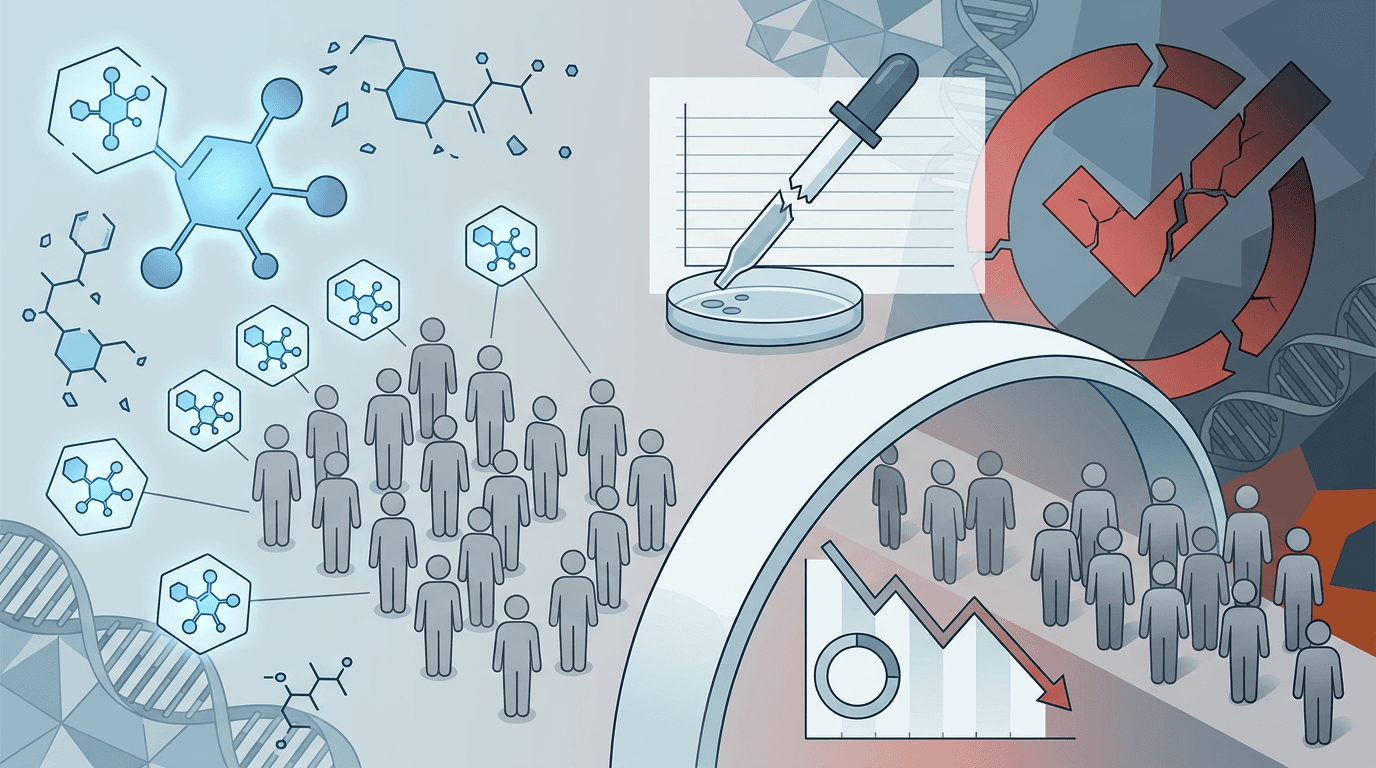
Imagine stepping up to the plate 30 times and never making contact with the ball. Not a single foul tip. Not even a bunt that dribbles fair. That's essentially what happened to Novartis's cancer candidate QEQ278: the company tested it in 30 patients with advanced solid tumors, and not one of them saw their tumor shrink.
Zero for 30. A perfect record of futility.
Novartis has now pulled the plug on QEQ278, removing it from the pipeline entirely. The decision wasn't about safety problems or manufacturing headaches. The drug simply didn't work.
What QEQ278 Was Supposed to Do
The idea behind QEQ278 was clever, at least on paper. Your immune system has natural killer cells (NK cells) that are built to hunt and destroy cancer. But tumors fight back. They shed molecular decoys called NKG2D ligands into the bloodstream, essentially throwing up smoke screens that confuse NK cells and help cancer hide in plain sight.
QEQ278 was designed as a fusion protein that would neutralize those decoys and flag tumor cells for destruction. Think of it like giving your immune system's search party both a smoke-clearing fan and a spotlight.
Novartis tested it across several tough cancer types: non-small cell lung cancer, esophageal cancer, kidney cancer, and HPV-related head and neck cancer. These were patients with advanced disease who had already exhausted standard treatments. The Phase 1 trial enrolled about 30 patients in a dose-escalation design, gradually increasing the dose to find the sweet spot between safety and activity.
The safety part checked out fine. The activity part? Nowhere to be found.
26 Out of 30 Patients Got Worse
The numbers tell a bleak story. Of the 30 patients treated, 26 discontinued early because their disease progressed. That means the vast majority of patients actually got worse while on the drug. The objective response rate (the percentage of patients whose tumors meaningfully shrank) was a flat zero percent.
Novartis reviewed the data internally in 2024 and made the call to discontinue. The company was explicit that the decision "was not based on any safety concern" but purely on lack of efficacy. The trial is now listed as terminated, and QEQ278 has been scrubbed from the pipeline.
Get tomorrow's biotech intelligence before your competitors.
Join thousands of biotech professionals who start their day with our free, daily briefing.
It's a clean kill, and honestly, that's the right call.
Why This Isn't Actually Surprising
If you're thinking this sounds like a catastrophic failure, zoom out for a second. In oncology drug development, failure isn't the exception; it's the overwhelming norm. Only about 5% of cancer drugs that enter Phase 1 trials ever make it to FDA approval. That means 19 out of every 20 candidates die somewhere along the way.
And QEQ278 was playing on hard mode. NKG2D-targeting approaches haven't exactly been lighting up the scoreboard across the industry. Analysts who track NK-cell engager programs have grouped QEQ278 among several terminated candidates in this space, suggesting the biology just isn't translating from lab benches to hospital beds.
For context, consider the cautionary tale of IGF-1R inhibitors: an entire class of oncology drugs that spawned 183 clinical trials, enrolled over 12,000 patients, burned through an estimated $1.6 billion in development costs, and produced zero approved drugs. Compared to that kind of industry-wide faceplant, one Phase 1 candidate washing out is barely a footnote.
Novartis Is Getting Good at Saying "No"
What's more interesting than the failure itself is the pattern it fits into. Novartis has been on a deliberate pruning spree, cutting early-stage programs that don't clear an increasingly high bar.
In late 2025 alone, the company axed six Phase 1 oncology programs, including a next-generation radioligand therapy for prostate cancer, a Werner helicase inhibitor, and a trispecific T-cell engager for blood cancers. At the same time, it added two new Phase 1 candidates it considered more promising.
The company's stated philosophy is blunt: advance "only the highest value medicines with transformative potential for patients." That's corporate-speak, sure, but the actions back it up. Novartis says it still has roughly 99 projects in clinical development, with more than 30 assets it considers high-value.
CEO Vas Narasimhan has been reshaping the portfolio around four core therapeutic areas, and oncology programs targeting tumors that aren't company priorities are being shown the door. Solid tumor projects took the biggest hit in recent pipeline reviews, dropping from 42 active projects to 32 in one update.
Where Novartis Is Actually Betting Big
If QEQ278 represents the kind of program Novartis is willing to walk away from, the programs it's doubling down on tell you where the real conviction lies.
Kisqali (ribociclib), the breast cancer blockbuster, just had its peak sales target raised to $10 billion or more. Scemblix (asciminib) for chronic myeloid leukemia is now targeting $4 billion-plus in peak sales. Pluvicto, the radioligand therapy for prostate cancer, anchors an entire platform strategy that Novartis considers a core competitive advantage.
And the company recently agreed to acquire Pikavation Therapeutics for $2 billion upfront (plus up to $1 billion in milestones) to grab a portfolio of PI3Kα inhibitors for breast cancer, deepening its position in a tumor type it clearly considers a priority.
The message is clear: Novartis would rather concentrate firepower on a handful of shots it believes can be transformative than spread resources across dozens of moonshots.
The Bigger Picture
For Wall Street, QEQ278's demise barely registered. Analysts weren't modeling it as a value driver, and the cut doesn't change 2026 guidance. The real conversation around Novartis centers on navigating its largest patent cliff ever (hello, Entresto generics) while betting that its late-stage pipeline can bridge the gap to sustained growth through 2029.
But for anyone watching the broader biotech landscape, QEQ278 is a useful reminder of two things. First, the gap between elegant science and clinical reality remains enormous, especially in solid tumors. A mechanism that makes beautiful sense on a whiteboard can fall completely flat in a patient's body.
Second, the companies that win in this game aren't necessarily the ones with the most programs. They're the ones willing to kill their darlings fast and redirect resources to where the data actually points. Novartis tested QEQ278, got its answer, and moved on. In an industry where 95% of Phase 1 cancer drugs never reach patients, knowing when to fold is a skill worth more than most people realize.
Clinical & Regulatory
5 min read
Sarepta's Worst Week: A Black Box Warning and 500 Pink Slips
Sarepta slapped a black box warning on its flagship gene therapy Elevidys after fatal liver failures in young patients, then cut 36% of its workforce in the same breath. The moves signal a company (and an industry) at a crossroads.