
The NIH killed funding for 383 clinical trials and $1.81 billion in grants in 2025, leaving 74,000 patients in limbo. Now the entire playbook for how trials get designed, funded, and run is being rewritten, and execution quality is the new currency investors care about most.
Imagine training for a marathon for two years. You've done the miles, dialed in your nutrition, bought the shoes. Then, three weeks before race day, someone cancels the marathon. No refund. No explanation that makes sense. That's roughly what happened to 383 clinical trials in 2025, except instead of a race, we're talking about studies with real patients, real diseases, and real consequences.
The NIH pulled the rug out from under them. And now the entire architecture of how clinical trials get designed, funded, and run is being rebuilt from the ground up.
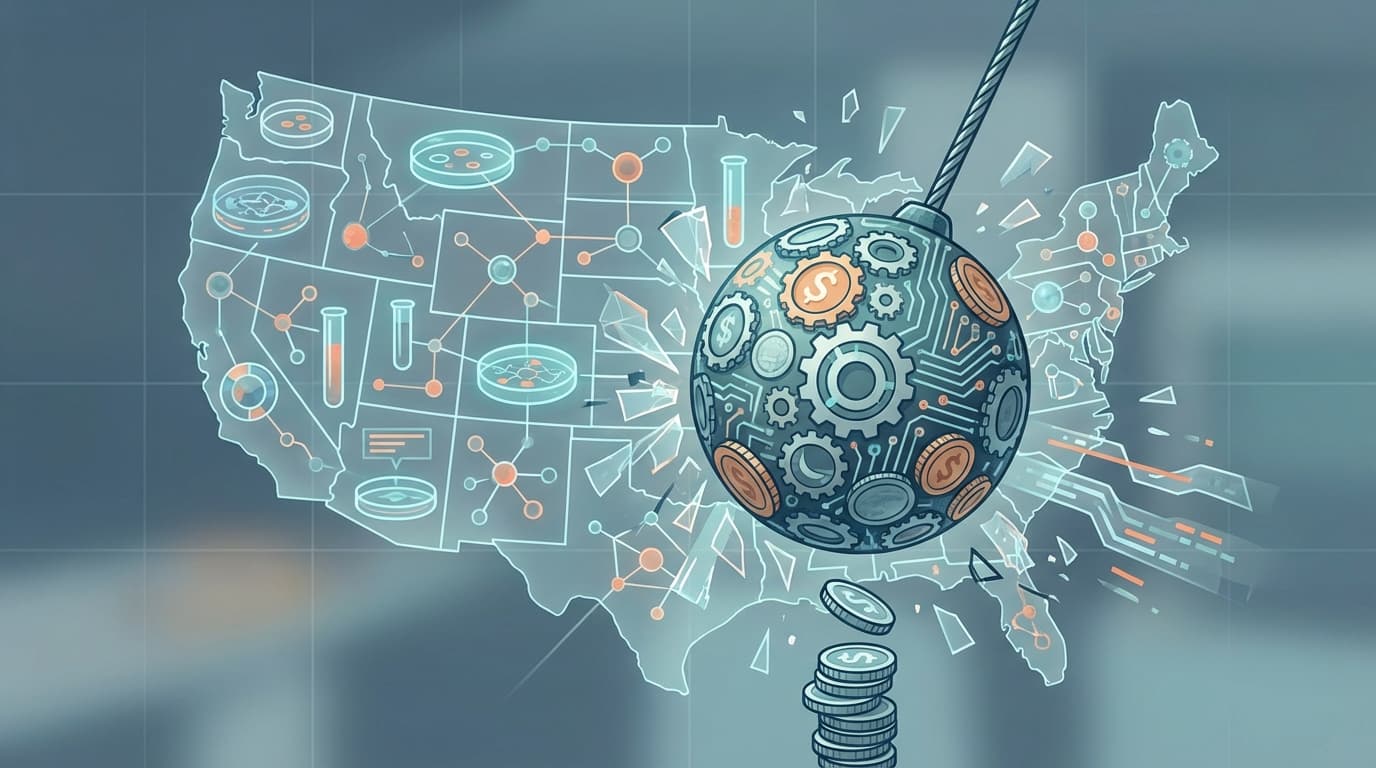
Between late February and mid-August 2025, the NIH terminated 694 grants worth $1.81 billion. That's not a typo. The cuts were part of the second Trump administration's push to downsize government, with the Department of Government Efficiency driving much of the effort. The NIH framed it as a "strategic realignment" toward "high-impact, high-urgency science."
Translation: they decided some research no longer fit the agenda.
Of the 11,008 NIH-funded interventional trials active during that period, 383 lost their funding, roughly 1 in 30. Those trials weren't studying obscure topics in a vacuum. They covered cancer, infectious diseases, cardiovascular disease, mental health, sickle cell disease, and lung cancer. Over 74,000 patients were enrolled across those studies.
Let that sink in. Seventy-four thousand people who volunteered their bodies for science, some getting experimental treatments, some enduring side effects, all trusting the process, and the process just stopped.
Infectious disease trials got hit hardest, with a 14.4% disruption rate in that category alone. The National Institute of Allergy and Infectious Diseases saw the largest funding cut at $506 million. The National Institute of Mental Health had the most individual terminations: 128 grants gone.
Columbia University alone lost 157 grants. Massachusetts, the beating heart of American biotech, saw in NIH funding evaporate by September.

Gilead is paying $7.8 billion for a CAR-T therapy the FDA hasn't approved yet, a 68% premium that looks less like confidence and more like a rescue mission. With its existing cell therapy business shrinking, the company is betting everything on a drug that oncologists already prefer over the competition.


Join thousands of biotech professionals who start their day with our free, daily briefing.

Harvard's Dr. Anupam B. Jena called the number of affected gold-standard randomized trials "surprisingly high" and warned of "avoidable waste." He's being polite. Stopping a trial mid-enrollment isn't just wasteful; it breaks promises to patients, exposes them to risks that now generate zero scientific knowledge, and makes future volunteers think twice about signing up.
Former NIH director Francis Collins had previously noted that every dollar the NIH spent in 2024 generated $2.46 in economic returns within a year. We're not just losing science. We're torching the investment.
So what happens when the money can vanish overnight? You redesign the whole playbook.
Cromos Pharma CEO Vlad Bogin has been beating this drum since JPM 2026: execution quality now matters as much as the science itself when investors value an asset. It's no longer enough to have a promising molecule. You need to prove your trial can survive a funding earthquake.
Think of it like building a house in a hurricane zone. You don't just pick nice countertops. You engineer the foundation to withstand 150-mph winds. That's what "resilience by design" means for clinical trials in 2026. Sponsors are building contingency plans for funding continuity directly into their protocols. Milestone discipline, hitting your targets on time and on budget, has become a make-or-break factor.
The industry is shifting from running lots of trials and hoping some work, to running fewer, higher-quality programs with zero tolerance for protocol errors, recruitment delays, or weak endpoints. Especially in later-stage Phase II and Phase III trials, where a stumble can crater an entire company's valuation.
The redesign goes beyond just padding the budget for rainy days. Biotech companies are fundamentally rethinking how trials operate.
Adaptive trial designs let you adjust a study mid-flight, changing doses, dropping treatment arms that aren't working, or expanding enrollment, based on incoming data. It's like a GPS that reroutes you around traffic instead of making you sit in it.
Decentralized clinical trials are booming. Over 90% of sponsors plan to adopt decentralized elements within two years, using remote monitoring tools and diverse trial sites to speed enrollment and improve access. When your funding might disappear, speed isn't a luxury; it's a survival strategy.
And then there's the global pivot. Companies are running hybrid strategies that tap emerging markets in Asia and Africa for faster approvals, broader patient diversity, and reduced dependence on any single country's political whims. If the U.S. government decides your research doesn't align with its priorities, having sites in six other countries looks pretty smart.
AI is the thread weaving it all together. About 66% of large sponsors now prioritize AI-powered scenario modeling to predict bottlenecks, simulate "what-if" outcomes, and optimize protocols before a single patient is enrolled.
The FDA isn't sitting this one out. The agency has rolled out agentic AI capabilities (think AI that can handle complex, multi-step workflows semi-autonomously) across its centers. This builds on the internal deployment of "Elsa," a generative AI tool powered by Anthropic's Claude that 70% of FDA staff were already using by mid-2025.
The goal: speed up protocol reviews, pre-market evaluations, and post-market surveillance. The FDA has also finalized guidance on Predetermined Change Control Plans for AI-enabled devices, which let developers update their algorithms after approval without going through the full submission process every time.
In January 2026, the FDA and EMA jointly published harmonized AI principles for drug development, a rare moment of transatlantic regulatory alignment. And with the Trump administration's executive order easing barriers to AI innovation, the regulatory environment is tilting toward faster deployment.
But there's a catch. Agentic AI for regulatory review is still new territory. No comprehensive framework specifically governs how autonomous AI handles clinical trial protocols. The risk-based credibility assessment framework the FDA introduced covers AI-generated data in drug approvals, but experts have flagged gaps around novel errors, algorithmic bias, and transparency in high-stakes decisions.
We're watching a tectonic shift in how biotech gets done. The old model (get an NIH grant, run your trial, publish your paper) assumed the money would be there. That assumption is dead.
States are already scrambling to fill the gap, testing new research funding models. R01 awards (the NIH's bread-and-butter research grants) dropped only 1.6% in fiscal year 2025, suggesting some resilience in the system. But the psychological damage runs deeper than the numbers. Researchers now treat federal funding as a variable, not a constant.
For investors, the calculus has shifted decisively. Capital is flowing toward late-stage assets in oncology, neurology, and cardiometabolic disease, programs with strong endpoints, tight timelines, and teams that can execute under pressure. The tolerance for clinical risk has cratered.
The biotech companies that thrive in this environment won't necessarily have the best science. They'll have the best operations. The trials that survive won't be the ones with the most elegant hypotheses. They'll be the ones built to weather the storm.
Moderna handed Recordati the commercial rights to a potentially first-in-class rare disease therapy for just $50 million upfront. Leerink analysts called it a "garage sale," and the math backs them up.