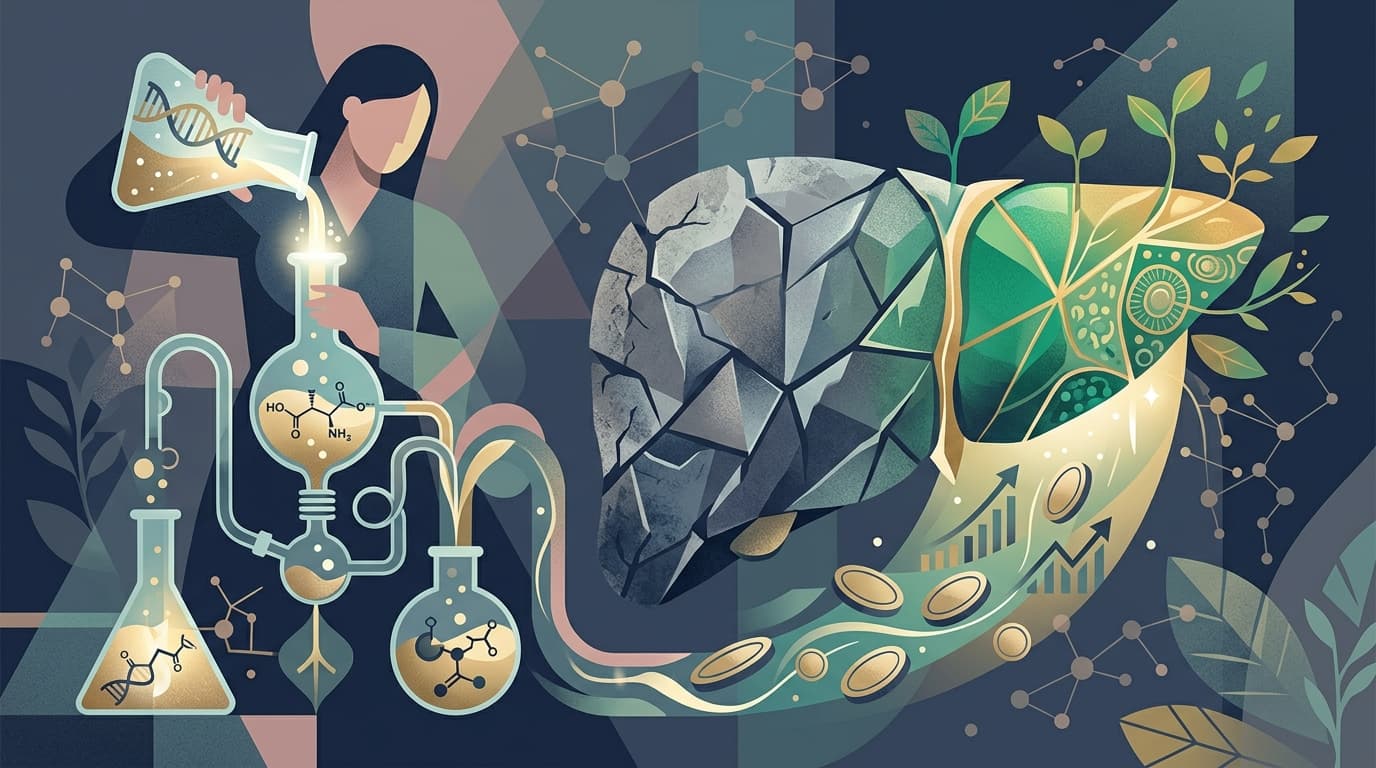

Coinbase co-founder Brian Armstrong's anti-aging biotech just raised $435 million at a $3.1 billion valuation, and it hasn't treated a single human patient yet. The plan: reprogram old liver cells to act young again, starting clinical trials next year.
Brian Armstrong built Coinbase into a crypto empire. Now he's betting that the same cells in your body that got old can be taught to act young again. His biotech startup, NewLimit, just raised $435 million in a Series C round, valuing the company at roughly $3.1 billion.
That's more than triple its valuation from just a year ago. And the company hasn't treated a single human patient yet.
So either some very smart investors have lost their minds, or something genuinely wild is happening in the science of aging.
NewLimit's core idea sounds like science fiction, but it's grounded in real biology. Every cell in your body carries an "epigenome," which is basically a set of instructions telling your genes what to do and when. As you age, those instructions get messy. Genes that should be active go quiet. Genes that should stay off start firing. Your cells don't break; they just forget how to do their jobs well.
NewLimit wants to hit the reset button. Using specific combinations of proteins called transcription factors, the company aims to reprogram old cells back to a younger state, without changing what the cell is. Think of it like restoring a vintage car's engine to factory specs rather than swapping it for a new one.
The scientific term is "epigenetic reprogramming." The plain English version: make old cells act young again.
Founders Fund, Peter Thiel's venture firm, led the round. New investors include Thrive Capital and Greenoaks, while returning backers like Kleiner Perkins and Eli Lilly's venture arm doubled down. That last name matters. When a pharma giant's investment wing shows up for a second bite, it signals more than curiosity.
NewLimit's fundraising trajectory has been steep. The company raised $130 million in its Series B in early 2025 at an $810 million valuation. Then it grabbed another later that year. Now this. In roughly 18 months, the valuation jumped nearly fourfold.

Legend Biotech just showed it can build CAR-T cells inside a patient's body with a single injection, no factory required. The early data are stunning, the implications are enormous, and the race to replace today's six-week manufacturing nightmare just got very real.

Join thousands of biotech professionals who start their day with our free, daily briefing.
The catalyst? CEO Jacob Kimmel (a computational biologist who co-founded the company alongside Armstrong and former Google Ventures partner Blake Byers) reportedly said a compound "jumped out" of their data sooner than anyone expected, accelerating the timeline toward human trials.
NewLimit isn't trying to cure "aging" as its first act. That would be a regulatory nightmare, since the FDA doesn't recognize aging itself as a treatable condition. Instead, the company is going after alcohol-related liver disease, framing it as a case of accelerated aging in a specific organ.
The preclinical data is intriguing. In animal models, NewLimit's transcription factor cocktails helped old liver cells regain their ability to process fat and alcohol. Old mice given the treatment handled booze more like their younger counterparts. (College students everywhere just perked up.)
The plan is to start a phase 1 clinical trial (a first-in-human safety test) next year, initially in patients with alcohol-related liver disease. The delivery method: monthly IV infusions, with a long-term goal of less frequent dosing.
Beyond the liver, NewLimit has two more programs in early preclinical work. One targets T cells (key players in your immune system that weaken with age), and another focuses on endothelial cells (the lining of your blood vessels). Chronic kidney disease is on the radar as a potential vascular application.
The anti-aging biotech space has attracted enormous capital in recent years, but it's been concentrated in a few headline-grabbing bets. Altos Labs launched with a staggering $3 billion back in 2022. Retro Biosciences, backed heavily by Sam Altman, raised $1 billion in a single Series A in early 2025.
NewLimit's $435 million doesn't match those numbers, but it lands in rarefied air. For context, BioAge Labs' $170 million Series D was the largest longevity-focused venture round of 2024. NewLimit's raise is more than double that.
The investor composition also tells a story about where longevity is headed. This isn't just tech billionaires playing with house money anymore. The presence of Eli Lilly Ventures alongside pure tech investors like Thrive Capital suggests the longevity space is inching toward pharmaceutical legitimacy.
For all the excitement, the risk here is real and worth staring at directly. NewLimit is valued at $3.1 billion with zero approved products and zero completed human trials. The entire field of epigenetic reprogramming, while scientifically compelling, has never produced a single therapy that's been tested and proven in people.
The core challenge is precision. Reprogramming factors are powerful tools; they can literally turn an adult cell back into an embryonic-like stem cell. That's what the famous Yamanaka factors (a set of four proteins discovered in 2006) do. But go too far with reprogramming and cells lose their identity entirely. Worse, they can become cancerous. NewLimit's whole bet is that it can find the sweet spot: enough reprogramming to rejuvenate, not so much that things go sideways.
Mouse data has been encouraging. One study using a related approach (three of the four Yamanaka factors delivered via gene therapy) showed a 109% increase in median remaining lifespan in very old mice. Epigenetic clocks confirmed their heart and liver tissue looked younger. But mice are not people. The history of drug development is littered with therapies that worked beautifully in rodents and face-planted in human trials.
NewLimit is one of the most interesting bets in biotech right now, precisely because the upside is so enormous and the risk is so high. If epigenetic reprogramming works in humans the way it works in mice, the implications go far beyond liver disease.
The next 18 to 24 months will be defining. Phase 1 data from the liver program will either validate the thesis or send investors scrambling. There's very little middle ground when you're trying to reverse aging in a human organ for the first time.
NewLimit has the money, the team, and the scientific foundation to take a credible shot. Whether biology cooperates is the $3.1 billion question.
Intellia just delivered the first successful Phase 3 trial for an in vivo CRISPR therapy, cutting hereditary angioedema attacks by 87% with a single infusion. The results could reshape how we think about treating genetic diseases forever.