Neumora's Depression Drug Went 0-for-3. Now It's a Penny Stock.
Neumora's depression drug navacaprant failed all three Phase 3 trials with a combined effect size of essentially zero, sending the stock from $11 to under $1 and forcing 35% staff cuts. Now the company is betting its survival on early-stage programs in Alzheimer's, schizophrenia, and obesity.
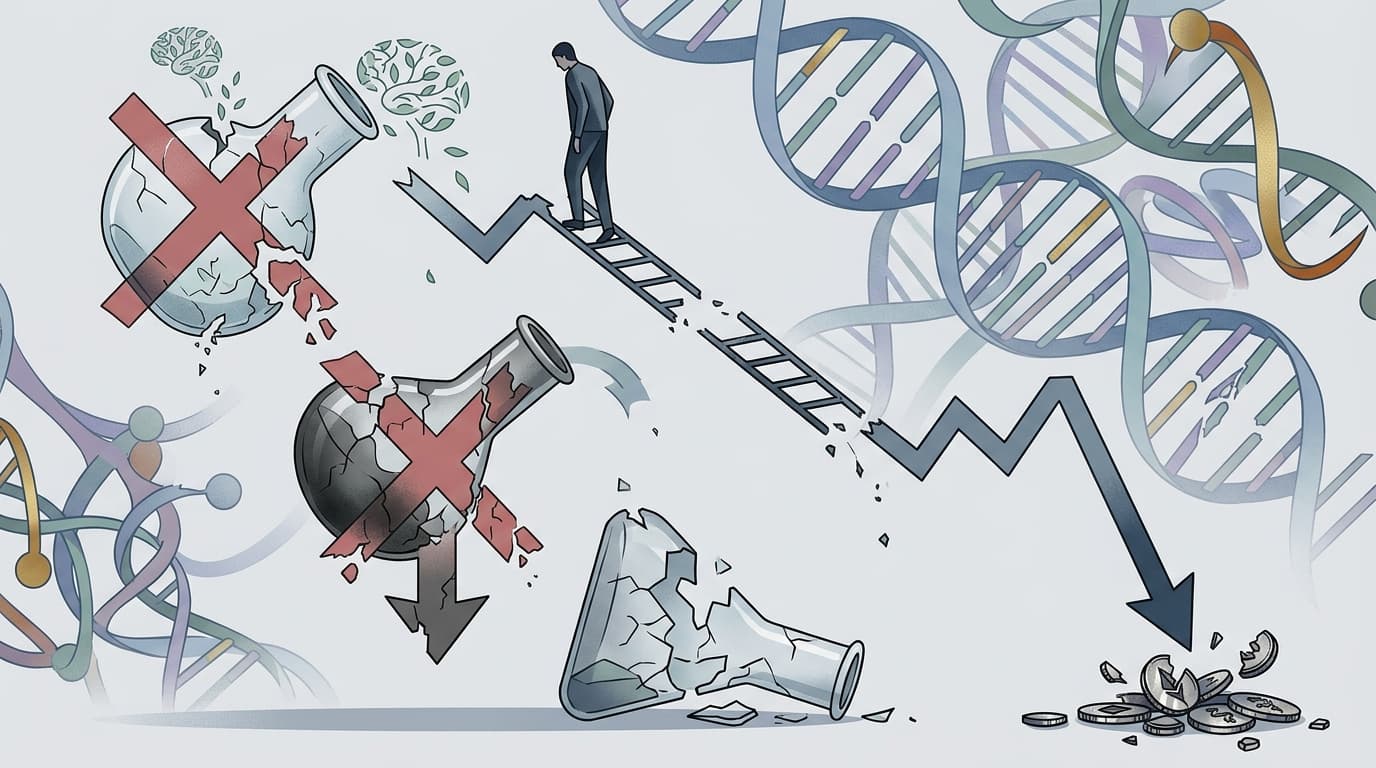
Imagine spending years building a house, only to discover the foundation was sand. That's roughly what happened to Neumora Therapeutics, whose lead depression drug just failed its third consecutive Phase 3 trial. The stock is now trading under a dollar, a third of the staff is gone, and the company is scrambling to convince investors it still has a reason to exist.
The drug is called navacaprant, and it was supposed to treat major depressive disorder (MDD) through a novel mechanism: blocking a specific receptor in the brain's stress and reward pathways. The idea was biologically elegant. The data, unfortunately, were not.
A Hat Trick Nobody Wanted
Neumora ran three large Phase 3 trials, collectively called the KOASTAL program, each testing navacaprant against a sugar pill in hundreds of adults with depression. The main question was simple: after six weeks, did patients on the drug feel meaningfully better than those on placebo?
The answer, all three times, was no.
In KOASTAL-1 (about 383 patients), the drug improved depression scores by 12.5 points. Placebo? Also 12.5 points. The difference was literally zero, with a p-value of 0.993. For context, a p-value that close to 1.0 is like flipping a coin a thousand times and getting exactly 500 heads. It's almost impressively neutral.
KOASTAL-2 (430 patients) wasn't much better: a 0.3-point edge for the drug, with a p-value of 0.813. And KOASTAL-3 (422 patients) was arguably worse, because placebo actually outperformed the drug by 0.7 points. When your sugar pill beats your medication, that's not a close call. That's a verdict.
The Rescue Attempt That Didn't Work
After KOASTAL-1 flopped in January 2025, Neumora didn't give up. The company spotted a faint signal in women (who improved about 2.6 points more than placebo, though even that wasn't statistically significant) and redesigned the next two trials to try to capture it. They made "protocol optimizations," tweaking enrollment criteria and study design to reduce the notoriously high placebo response that plagues depression research.
Get tomorrow's biotech intelligence before your competitors.
Join thousands of biotech professionals who start their day with our free, daily briefing.
It's a reasonable strategy in theory. Depression trials fail about 50% of the time, largely because placebo responses are so strong. When patients improve just from being in a clinical trial (getting attention, taking a pill they believe might help), it becomes incredibly hard for a real drug to show a detectable edge.
But even Neumora's carefully selected "post-optimization" cohort of 426 patients showed a 0.0-point difference versus placebo (p = 0.976). As one analysis put it, the results were "unambiguously negative across every population examined." The drug didn't work in the broad group. It didn't work in the enriched group. It didn't work in women. It simply didn't work.
Wall Street's Two-Part Meltdown
The market punished Neumora in stages, like a horror movie with a sequel.
When KOASTAL-1 failed in early 2025, shares cratered more than 80% in a single day, falling from around $11 to just over $2. RBC Capital Markets called it a "worst-case scenario for the program." Stifel said investors would "remain very skeptical."
Then came the June 2026 announcement that KOASTAL-2 and KOASTAL-3 had also failed, and that Neumora was killing the navacaprant program entirely. The stock dropped another roughly 45%, landing around $0.98. From $11 to pocket change in roughly 18 months.
Cutting Deep to Stay Alive
Alongside the navacaprant termination, Neumora announced it would cut approximately 35% of its workforce, a reduction that began June 12, 2026, and is expected to wrap up by the end of Q3. The layoffs should save about $10 million per year at a one-time cost of roughly $2 million.
With the restructuring, the company says it has enough cash to operate into Q3 2027. That's about 15 months of runway, which in biotech terms is the equivalent of living paycheck to paycheck. Every dollar now has to count.
The Pivot: Three New Bets
Neumora isn't shutting down. It's pivoting hard, redirecting its remaining resources toward three earlier-stage programs in very different diseases.
Alzheimer's disease agitation is the most advanced bet. The drug is called NMRA-511, a V1a receptor antagonist (it blocks a signaling molecule involved in stress and aggression). A small Phase 1b study showed what the company calls "clinically meaningful" effect sizes and a clean safety profile, with no somnolence or sedation. That matters because existing treatments for agitation in Alzheimer's patients often knock people out. Neumora plans to run a larger Phase 2 study starting in early 2027.
Schizophrenia is the second play. NMRA-898 is an M4 positive allosteric modulator (think of it as a volume knob that turns up a specific brain receptor involved in psychosis, without hitting the dopamine system that causes many side effects of current antipsychotics). It's in Phase 1 now, with data expected in the second half of 2026.
Obesity rounds out the trio. NMRA-215 is a brain-penetrant NLRP3 inhibitor (it targets inflammation pathways linked to metabolic dysfunction) that Neumora envisions as both a standalone treatment and a companion to GLP-1 drugs like Ozempic. It's still in preclinical stages, with first-in-human trials targeted for Q1 2026.
Can a Sub-Dollar Stock Stage a Comeback?
Analyst opinion is genuinely split. Mizuho maintained an "Outperform" rating with a $6 price target, arguing the selloff was excessive and that the remaining pipeline has real value. William Blair called the termination a "clearing event" that lets investors focus on what's left. On the other side, RBC downgraded Neumora to Sector Perform, and plenty of observers see a classic busted-lead-asset story with limited visibility on what comes next.
The bull case is straightforward: at under $1, the market is pricing Neumora's three remaining programs at close to zero. If any of them produce even modestly encouraging data, there's room for a significant re-rating. The bear case is equally simple: early-stage CNS programs fail all the time, the company has 15 months of cash, and management just whiffed on their flagship drug three times in a row.
The Bigger Picture for Depression Drug Development
Navacaprant's triple failure is disappointing, but it's not surprising in the context of CNS drug development. Phase 2 and Phase 3 CNS trials combined fail at roughly 85%, and depression is one of the hardest indications in all of medicine. The disease is biologically heterogeneous (meaning different patients likely have different underlying causes), the clinical scales used to measure improvement are subjective, and placebo responses routinely swamp real drug effects.
Neumora's results effectively "close the door on kappa opioid receptor antagonism as a near-term treatment approach for MDD," as one analysis concluded. With near-zero effect sizes across more than 1,200 patients in three well-powered trials, there's no subgroup to rescue and no design tweak that plausibly changes the outcome.
For the millions of people living with depression who don't respond to existing treatments, the search for new mechanisms continues. It just won't include this one.
5 min read
Adaptive Biotech Is Breaking Up With Itself
Adaptive Biotechnologies is splitting its profitable cancer diagnostics business from its early-stage drug discovery platform into two separate companies. The move follows a growing industry trend of corporate breakups designed to let fundamentally different businesses attract the right investors.