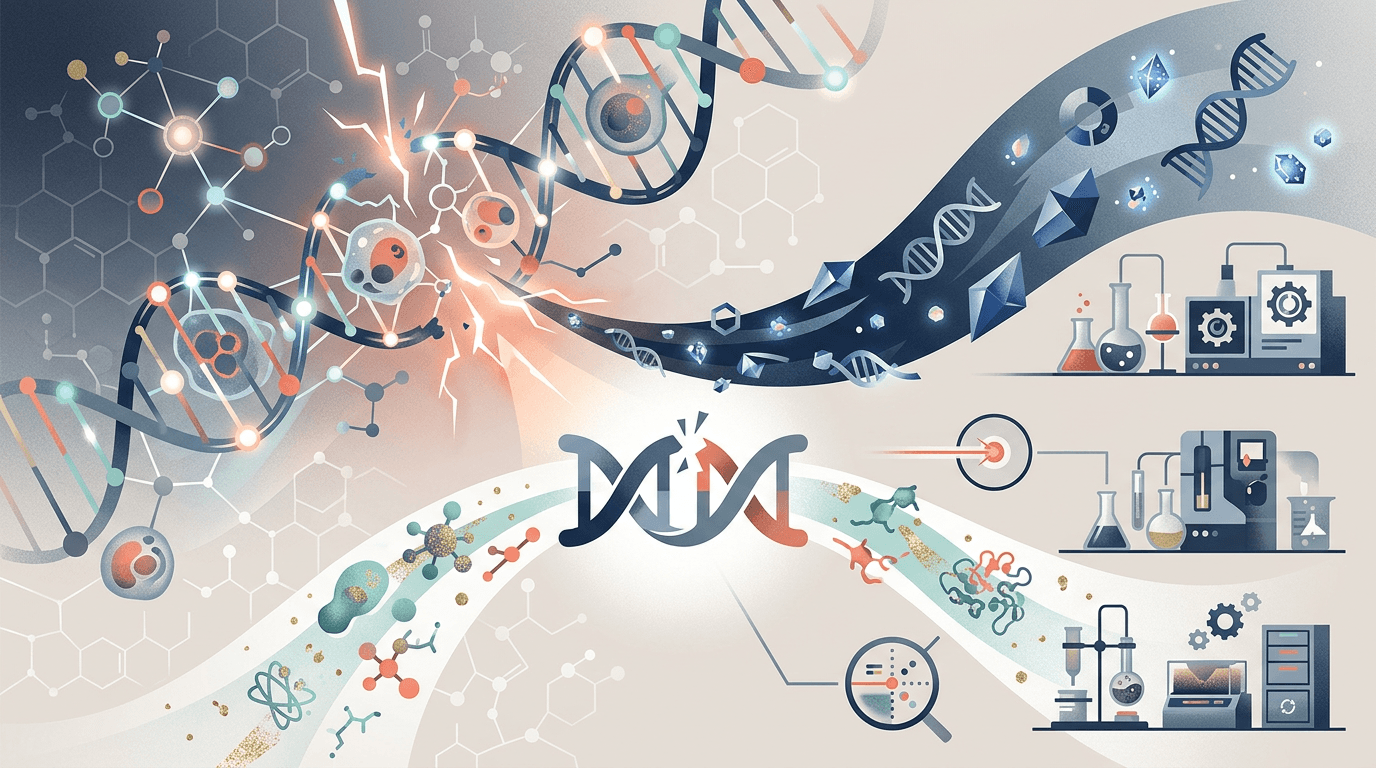
Adaptive Biotechnologies is splitting its profitable cancer diagnostics business from its early-stage drug discovery platform into two separate companies. The move follows a growing industry trend of corporate breakups designed to let fundamentally different businesses attract the right investors.
Imagine a couple that's been together for years. One wants to settle down and build a stable income. The other wants to backpack through Southeast Asia and "find themselves." Eventually, someone has to say it: maybe we're better off apart.
That's basically what Adaptive Biotechnologies just announced. On June 15, the Seattle-based company said it plans to split its profitable cancer diagnostics business from its more speculative drug discovery arm into two separate entities. It's a corporate breakup, and both sides think they'll be happier single.
Two Businesses That Never Really Fit in the Same House
Adaptive has always been a company with an identity crisis. On one side, there's the MRD (minimal residual disease) diagnostics business, anchored by clonoSEQ, a test that detects tiny traces of cancer left behind after treatment. Think of it as the smoke detector of blood cancers: it catches what the human eye can't see. This business is growing fast, profitable, and beloved by Wall Street.
On the other side sits Immune Medicine, a platform that maps immune system receptors using AI and massive datasets. It feeds drug discovery partnerships with Genentech (T-cell therapies for cancer) and Amgen (antibodies for COVID-19). It also powers a long-running collaboration with Microsoft to build essentially a Google Maps of the human immune system. Cool? Absolutely. Profitable? Not even close.
Adaptive had already separated these into two internal segments back in 2024. Now they're making it official. The company says it expects to finalize a preferred separation structure by the end of 2026, though the exact form (spin-off, sale, joint venture, IPO carve-out) hasn't been decided yet. Management was careful to note there's "no assurance the strategic review will result in a particular transaction."
Translation: we're filing the paperwork, but we haven't picked a lawyer yet.
The Diagnostics Side Is the One Paying Rent
clonoSEQ is genuinely one of biotech's better growth stories right now. It's the for multiple myeloma, B-cell acute lymphoblastic leukemia (B-ALL), and chronic lymphocytic leukemia (CLL). That regulatory moat matters.
Get tomorrow's biotech intelligence before your competitors.
Join thousands of biotech professionals who start their day with our free, daily briefing.
only FDA-cleared NGS-based MRD test
The numbers back it up. MRD revenue hit $212 million in 2025, up 46% year over year. Test volumes reached roughly 105,600, a 39% jump. And the momentum carried into 2026: first-quarter MRD revenue grew 53% year over year, prompting management to raise full-year MRD guidance to $260–$270 million.
More than half of U.S. hematologist-oncologists now order clonoSEQ. The number of ordering clinicians grew 43% in Q1 2026 alone, to about 5,000. Community oncologists (not just big academic centers) are adopting it too, now accounting for 35% of tests.
Sequencing gross margins are expected to exceed 70% in 2026, with a path toward 75% by year end. For a diagnostics business, those are the kind of margins that make investors salivate. The company estimates its total addressable market in U.S. clinical MRD testing at roughly $1.8 billion, meaning Adaptive has captured maybe 10–15% so far. Plenty of runway left.
The Drug Discovery Side Is the One With Big Dreams and No Income
Immune Medicine is a different animal entirely. It generated $64.6 million in 2025 revenue, but $41.3 million of that came from a Genentech agreement that has now been fully amortized. Strip that out and you're looking at a much thinner stream. By Q1 2026, the segment contributed just $3.8 million in revenue against MRD's $67.1 million. That's 5% of the quarter's total.
The platform itself is legitimately impressive. Adaptive claims to hold the largest clinically linked immune receptor dataset in existence, and the Microsoft partnership gives it serious computational firepower (they once processed 500 million TCR sequences in a matter of weeks). The Genentech collaboration aims to turn disease-specific T-cell receptors into engineered cell therapies for cancer. The Amgen partnership focuses on discovering neutralizing antibodies.
But none of these programs have produced an approved product. The TCR therapy work with Genentech remains early-stage, with no publicly disclosed late-stage clinical milestones. Adaptive doesn't even provide revenue guidance for this segment.
When you're a profitable diagnostics company dragging along an early-stage drug discovery unit, investors don't know what multiple to give you. That's the core problem this split is designed to solve.
The Breakup Playbook Everyone's Running
Adaptive isn't inventing this strategy; it's borrowing from an increasingly popular playbook. BD (Becton Dickinson) is doing essentially the same thing, splitting its diagnostics and biosciences arm from its MedTech core, with a decision on structure expected in fiscal 2026. Illumina already spun off cancer-detection company Grail. When Illumina announced the move, its stock popped nearly 6%.
The logic is straightforward: a diagnostics business attracts investors who want steady growth, recurring revenue, and expanding margins. A drug discovery platform attracts investors who want moonshots. Forcing both groups to buy the same stock satisfies neither.
Moody's has noted this trend is accelerating across medtech, with companies increasingly using spin-offs and sales to sharpen focus and improve financials.
What the Market Thinks (So Far)
Adaptive's stock has been on a tear. Shares are up roughly 70% over the past 12 months and about 36% in the last month alone, trading in the $16–$17 range with a market cap around $2.8–$3.0 billion.
Analysts are largely on board. Across multiple platforms, the consensus sits at Buy or Strong Buy, with price targets clustering between $17 and $20. That implies 5–16% upside from current levels; not a screaming bargain, but a vote of confidence in the direction.
Alongside the separation announcement, Adaptive proposed $250 million in convertible notes due 2031 (with a $37.5 million option), partly to repay existing OrbiMed debt and fund up to $25 million in share buybacks. The convertible structure introduces some future dilution risk, though capped call transactions are meant to soften that blow.
The stock did dip about 6–7% intraday around the announcement, likely a mix of profit-taking and investors digesting the debt details. But the broader trend line still slopes sharply upward.
The Real Question
The interesting part isn't whether this split makes strategic sense. It does. Two fundamentally different businesses with different risk profiles, capital needs, and investor bases shouldn't share one stock ticker forever.
The real question is what Immune Medicine is worth on its own. With minimal standalone revenue, no approved therapies, and a story built on partnerships and potential, it could look like a lot of things to a lot of buyers: a bargain for a pharma company wanting an AI-powered immune discovery engine, or a money pit for public market investors expecting near-term returns.
Adaptive has until the end of 2026 to figure that out. The diagnostics business will almost certainly land on its feet. The drug discovery arm? That's the one with everything to prove.
5 min read
Spyre Just Dropped the Best Report Card in UC's Hottest Drug Class
Spyre's experimental antibody SPY002 just posted what may be the strongest histologic improvement data in the anti-TL1A class for ulcerative colitis. Analysts are pounding the table with price targets up to $115, but the real test is still a year away.