Moderna Just Bet $2.6 Billion That mRNA Can Kill Cancer
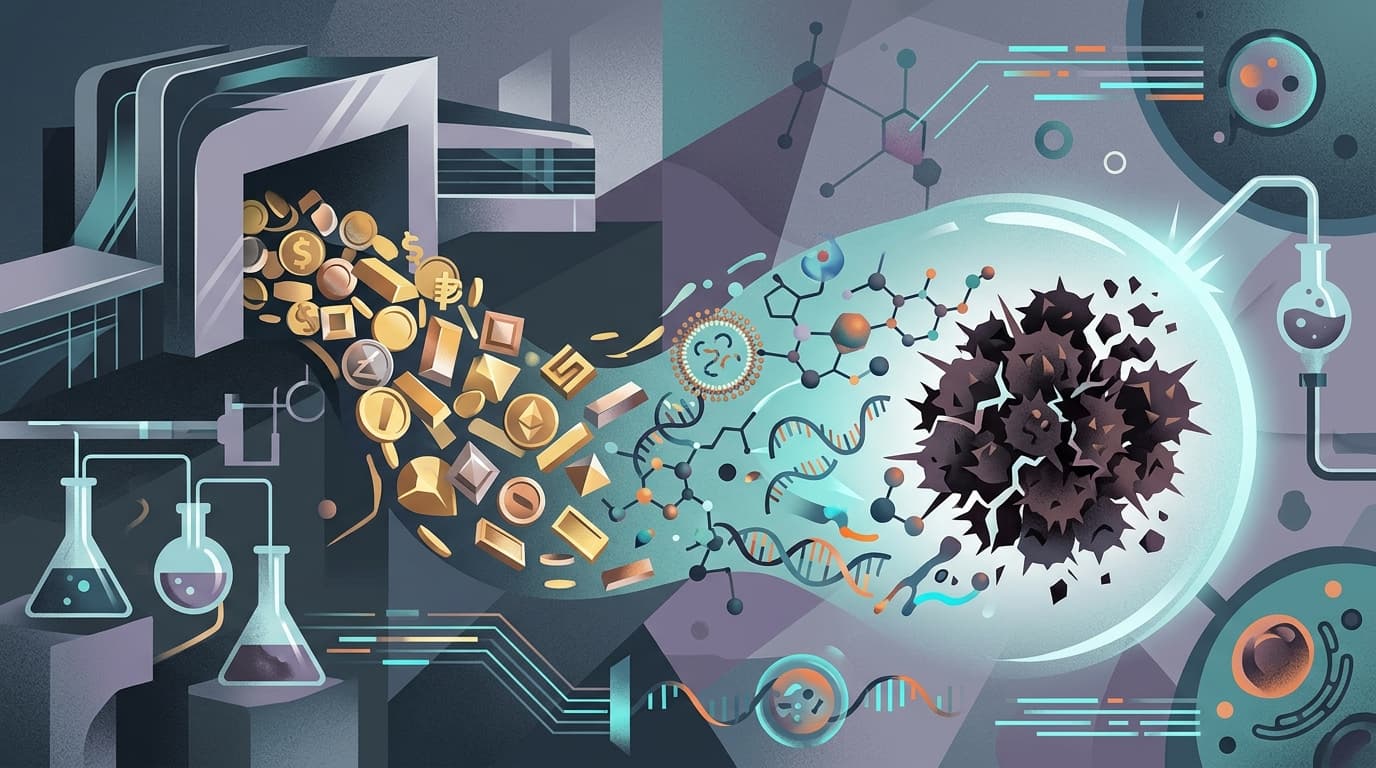
Moderna raised $2.6 billion in zero-interest convertible debt to fund its aggressive pivot from COVID vaccines to cancer. With Phase 3 data proving its personalized mRNA cancer vaccine works in melanoma, the company is betting its future on oncology.
Two years ago, Moderna was the COVID vaccine company. The pandemic darling. The stock that made retail investors feel like geniuses in 2021 and fools by 2023.
Now Moderna just raised $2.6 billion in debt and told the world, essentially: we're an oncology company now.
That's not a subtle pivot. That's a company grabbing the steering wheel with both hands and yanking it in a completely new direction. And the wildest part? The terms of the deal suggest Wall Street actually bought the story.
Zero Percent Interest. Yes, Really.
Moderna priced $2.6 billion in convertible senior notes on August 28, and the terms read like something out of a borrower's fantasy. The interest rate is 0.00%. Not low. Not below market. Zero.
These notes don't mature until March 1, 2032, giving Moderna nearly six years of runway. The notes are convertible into stock at about $210.58 per share, and Moderna gets to choose whether it pays out in cash, shares, or a mix when holders convert. There's also an option for initial purchasers to grab another $400 million in notes on top of the $2.6 billion.
For anyone not fluent in Wall Street plumbing: a 0% coupon convertible is essentially an interest-free loan where investors are betting the stock goes up enough to make the conversion worthwhile. It's like lending your friend $100 with no interest, but they promise to pay you back in concert tickets if the band gets famous. The investors are saying they believe Moderna's stock will eventually trade above $210.
The stock market was less enthusiastic in the short term. Shares dropped about 6% after the announcement, as investors digested the potential dilution. When a company says it might issue new shares down the road, existing shareholders get nervous. That math is straightforward: more shares in the pie means each slice gets thinner.
The COVID Cash Engine Is Sputtering
To understand why Moderna is borrowing billions, you need to understand what's happening to its revenue.
Get tomorrow's biotech intelligence before your competitors.
Join thousands of biotech professionals who start their day with our free, daily briefing.
Moderna pulled in about $1.9 billion in 2025 revenue. That sounds like a lot until you realize it was down 40% from 2024. And 2024 was already way down from the COVID gold rush. The pandemic vaccine business isn't dead, but it's normalizing fast, like a restaurant that had a line around the block during a food trend and is now settling back into regular dinner service.
The company still has a solid cash cushion: roughly $8.1 billion in cash and investments at the end of 2025. But that number has been ticking down throughout the year, from $8.4 billion in March to $7.5 billion in June to $6.6 billion in September, before a credit facility draw bumped it back up at year-end. Cash going out faster than it comes in isn't a crisis yet, but it's a trend that needs a solution.
Moderna's own projections show it expects to end 2026 with $4.7 billion to $5.2 billion in cash and investments. The company has been aggressively cutting costs (about $1.5 billion in annual savings targeted by 2027), and it's aiming for cash breakeven around 2028. But breakeven only works if the revenue side of the equation cooperates.
That's where cancer comes in.
A Vaccine That Fights Tumors, Not Viruses
Moderna's big oncology bet centers on a product called mRNA-4157, also known as intismeran autogene or V940. If those names are a mouthful, the concept is actually elegant: it's a personalized cancer vaccine built using the same mRNA technology behind the COVID shots.
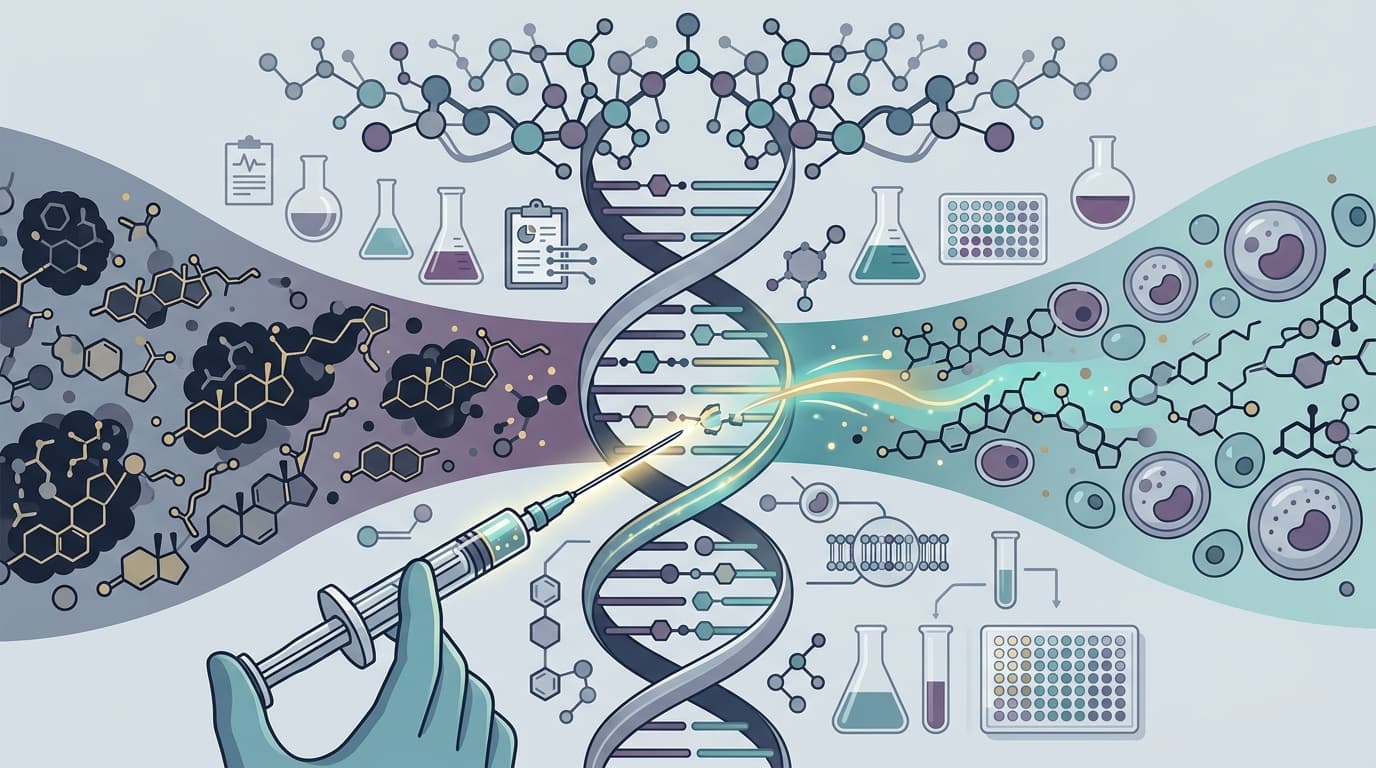
Think of it like this. Traditional cancer drugs are like carpet-bombing a city to hit a single building. A personalized cancer vaccine is more like programming a GPS-guided missile. Moderna sequences a patient's tumor, identifies the unique mutations (called neoantigens) on its surface, then builds a custom mRNA vaccine that teaches the immune system to hunt down cells carrying those specific mutations.
The vaccine is being developed in partnership with Merck and is designed to work alongside Keytruda (pembrolizumab), Merck's blockbuster immunotherapy. The collaboration dates back to 2016, but the results are just now hitting their stride.
And what results they are.
The Data That Launched a $2.6 Billion Bet
In the Phase 2b KEYNOTE-942 trial, patients with resected melanoma (meaning their tumors had been surgically removed) received either the personalized vaccine plus Keytruda or Keytruda alone. At about three years of follow-up, the combination cut the risk of cancer recurrence or death by 49% compared to Keytruda alone. The risk of distant metastasis (cancer spreading to other parts of the body) dropped by 62%.
Those numbers held up. At five-year follow-up, the 49% recurrence reduction was still there, showing the benefit was durable, not a flash in the pan.
But Phase 2 data, no matter how impressive, is an appetizer. The main course is Phase 3, where drugs either prove themselves or fall apart under the weight of larger, more rigorous trials. Biotech is littered with promising Phase 2 results that crumbled in Phase 3.
Moderna's Phase 3 trial, called INTerpath-001, tested the vaccine-plus-Keytruda combo in patients with completely resected stage IIB to IV melanoma who hadn't received prior systemic therapy. And in August 2026, the companies announced the trial met its primary endpoint for recurrence-free survival and its key secondary endpoint for distant metastasis-free survival.
No new safety signals were observed. The FDA had already granted Breakthrough Therapy Designation based on the Phase 2b data, and regulatory filings are now being pursued. Overall survival data, the ultimate measure, is still being tracked with an estimated completion date around 2030.
For a field where personalized cancer vaccines have been a "someday" technology for decades, this is a genuine inflection point.
Beyond Melanoma: The Bigger Picture
Melanoma is the lead program, but Moderna and Merck aren't stopping there. The partnership has launched INTerpath-009, a Phase 3 trial testing the personalized vaccine in non-small cell lung cancer (NSCLC) patients after surgery and neoadjuvant Keytruda plus chemotherapy. Additional studies are underway or planned in bladder cancer and renal cell carcinoma.
If the mRNA vaccine platform works across multiple tumor types, you're not looking at a single product; you're looking at a platform that could generate a new, customized drug for every patient. That's the kind of vision that gets investors to lend you $2.6 billion at zero percent interest.
But "if" is doing a lot of heavy lifting in that sentence. Melanoma is one of the most immunogenic cancers (meaning the immune system is already somewhat primed to fight it), so success there doesn't guarantee success in harder-to-treat tumors. The lung cancer and other trials will be the real stress test.
The Reinvention Playbook
Moderna is running a corporate transformation playbook that's familiar in pharma: use cash flows from a declining franchise to fund the next growth engine. It's the same logic that drove Pfizer's post-COVID acquisition spree, though Moderna is building internally rather than buying.
The company has been reshuffling its portfolio aggressively. It's deprioritizing some lower-return programs (like its adult flu/COVID combination vaccine for ages 18 to 49) and concentrating resources on respiratory vaccines, oncology, and rare disease. Operating expenses are being trimmed, with cash costs targeted at roughly $4.0 billion for 2026.
The goal: keep the seasonal vaccine franchise productive enough to fund the oncology pipeline until those cancer programs start generating their own revenue. Think of it as a restaurant using its reliable lunch crowd to finance a complete dinner menu overhaul.
The Bull Case and the Bear Case
The bull case is compelling. Moderna has Phase 3 data proving a personalized cancer vaccine works in melanoma, a platform that could extend to multiple tumor types, a partnership with Merck (which brings Keytruda and massive commercial infrastructure), and six years of interest-free capital to execute. If intismeran earns approval and expands to lung cancer and beyond, Moderna could become one of the most important oncology companies in the world.
The bear case is equally real. Revenue is declining. The company is burning cash. The $2.6 billion in new debt adds to the balance sheet, and if the stock doesn't recover above $210, those convertible notes become a straightforward liability that needs to be repaid. Oncology timelines are long; overall survival data from INTerpath-001 won't be mature until 2030. And the personalized vaccine model, where each dose is custom-made for a single patient, raises serious manufacturing and pricing questions that haven't been fully answered.
Then there's the broader market skepticism. Moderna's stock dropping 6% on the deal announcement tells you that not everyone is convinced the pivot will work. Some investors see a company reaching for its next act; others see a company that needs to raise capital because its core business is shrinking.
What Happens Next
The convertible note sale is expected to close on September 1, 2026. From there, Moderna will deploy the proceeds toward capped call transactions (financial hedges that limit dilution from the convertible notes) and general corporate purposes, including its oncology investments.
The regulatory clock is now ticking on the melanoma filing. Merck and Moderna will need to compile and submit the INTerpath-001 data to the FDA, a process that typically takes months. If approved, it would be the first personalized mRNA cancer vaccine to reach the market.
Moderna is making the biggest bet in its history: that the same technology platform which helped end a pandemic can also help beat cancer. The science is working. The money is in the bank. Now they have to execute.
For a company that went from obscure biotech to household name in the span of a single pandemic, reinvention isn't unfamiliar territory. But this time, the stakes are higher, the timeline is longer, and the competition is fierce. The COVID vaccine was a sprint. Oncology is a marathon.
Moderna just laced up its running shoes and borrowed $2.6 billion to cover the entry fee.
Clinical & Regulatory
4 min read
The Heart Drug That Just Crashed a Party It Wasn't Invited To
Cytokinetics' aficamten just proved it works in non-obstructive HCM, a condition affecting hundreds of thousands of patients with zero approved targeted therapies. The ACACIA-HCM trial hit both primary endpoints, and the NEJM published the data the same day it was presented at ESC 2026.