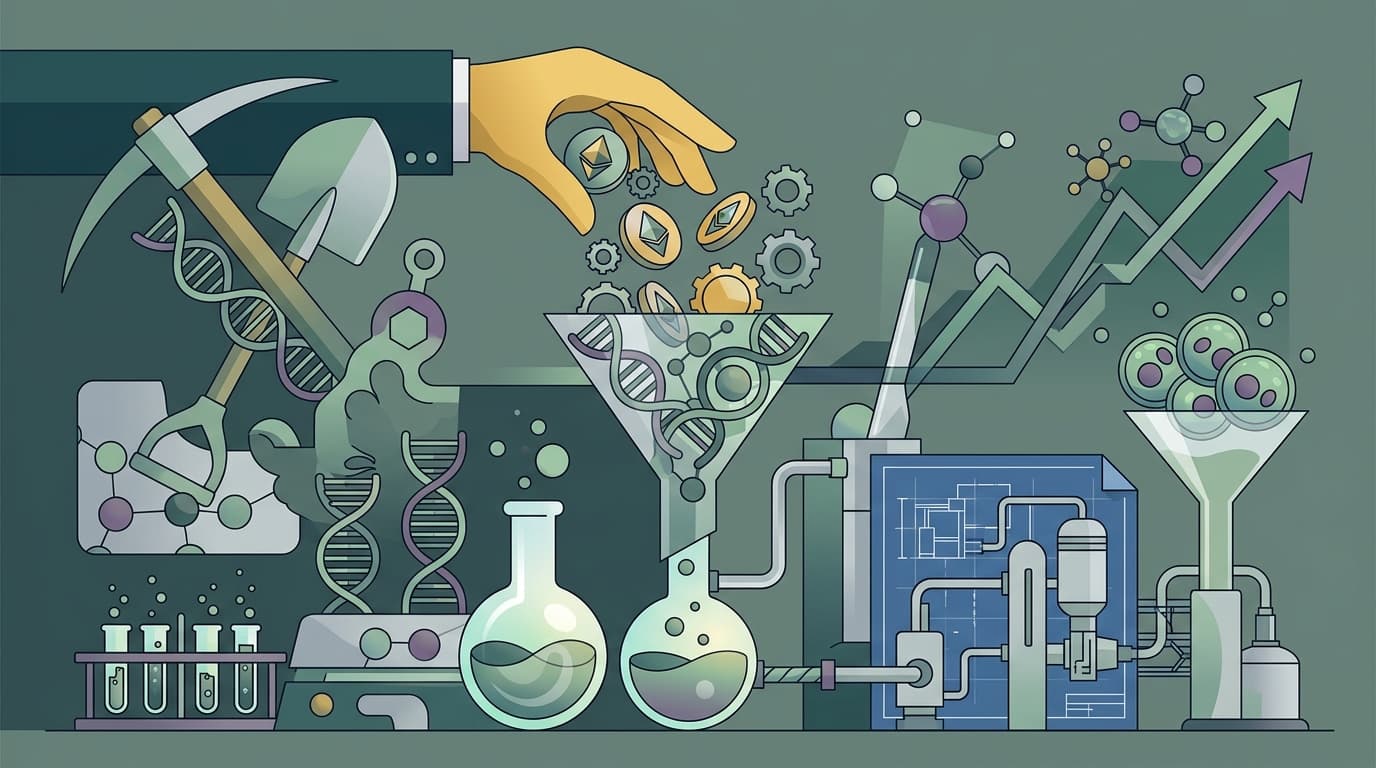

Merck KGaA is dropping $11.3 billion on Bio-Techne, a company that doesn't make drugs but makes the tools everyone needs to discover them. It's the biggest life science tools deal in years, and analysts can't decide if it's genius or expensive hubris.
During the California Gold Rush, the people who got richest weren't the miners. They were the ones selling pickaxes, shovels, and denim jeans. Merck KGaA just applied that same logic to biotech.
The German science and technology conglomerate (not to be confused with its American cousin, Merck & Co.) agreed to buy Bio-Techne for $11.3 billion in all cash. It's paying $73 per share, a 36% premium over Bio-Techne's one-month average trading price, with shares closing at $58.88 on the last trading day before the agreement.
This is Merck KGaA's biggest acquisition in over a decade. And it tells you something important about where the smart money thinks biotech is heading.
Bio-Techne doesn't make drugs. It makes the tools that help other companies discover, develop, and manufacture them. Think of it as the company that builds the kitchen equipment for every restaurant in town.
The business breaks into two segments. Protein Sciences is the big one, generating $870 million in fiscal 2025 revenue (about 72% of the total). This segment supplies the proteins, antibodies, and reagents that researchers use every single day in labs around the world. The second segment, Diagnostics and Spatial Biology, brought in $346 million and covers spatial biology (mapping where molecules sit inside tissues), liquid biopsy, and molecular diagnostics.
All together, Bio-Techne pulled in roughly $1.2 billion in total revenue in both fiscal 2025 and 2026. Revenue was essentially flat year over year, which raises an obvious question: why pay a 36% premium for a company that isn't growing?
Merck KGaA isn't buying Bio-Techne for what it is today. It's buying it for what the combined platform becomes tomorrow.
Rewind to 2014, when Merck KGaA announced its acquisition of Sigma-Aldrich for $17 billion, a deal that was completed in 2015. That deal transformed its life science division into a global powerhouse for lab chemicals and research supplies. Before that, in 2010, the company bought , which gave it filtration and purification technology. The pattern is clear: Merck KGaA has spent the last 15 years assembling a toolkit for modern science, piece by piece.

Half of relapsed multiple myeloma patients stayed cancer-free for five years after a single CAR-T infusion, with no maintenance therapy. Legend Biotech's latest CARVYKTI data is fueling talk of something oncologists rarely dare to whisper: a potential cure.


Join thousands of biotech professionals who start their day with our free, daily briefing.
Bio-Techne fills in the gaps. It adds capabilities in spatial biology, cell and gene therapy tools, multi-omics, and precision diagnostics. (Multi-omics, for the uninitiated, is the practice of studying multiple types of biological data simultaneously; think of it as reading every chapter of a book at once instead of just the introduction.) These are exactly the areas where drug development is heading, especially as biologics and advanced therapies become a larger share of the pharmaceutical pipeline.
Merck KGaA's stated strategy centers on building integrated workflows and platformed capabilities. Translation: they want to be a one-stop shop for researchers, so that once a lab starts using Merck products, switching becomes painful. Sticky customers, recurring revenue, compounding advantages. It's the enterprise software playbook applied to lab equipment.
Analyst reactions to the deal read like a couples therapy session. Everyone agrees the relationship makes sense; they just can't agree on whether the ring cost too much.
HSBC upgraded Merck KGaA to Buy on valuation grounds but said it was "unconvinced regarding the return accretion potential" of the Bio-Techne deal. In other words: great strategy, questionable math. HSBC acknowledged that cell therapy capabilities are "a real need" for Merck but said the growth case only becomes compelling over a 10-plus year horizon. That's a long time to wait for a payoff on an $11.3 billion check.
On the bullish side, Leerink analyst Puneet Souda called Bio-Techne an "attractive asset with strong long term potential" and a natural strategic fit. He also noted he didn't expect major regulatory hurdles, which proved correct: Bio-Techne shareholders approved the transaction, and the HSR antitrust waiting period expired on September 18.
The bears, meanwhile, point to a simple problem. One analysis acknowledged the deal enhances vertical integration and recurring revenue but downgraded Merck to Hold, arguing the stock already looked fully valued. Other market commentary called the price "rich" with limited margin for error on integration and execution. When analysts use the word "rich," they mean "we think you overpaid but we're too polite to say it directly."
Merck KGaA isn't operating in a vacuum. The entire life science tools sector is consolidating, and the buyers are getting bolder.
Danaher proposed a $9.9 billion acquisition of Masimo, targeting advanced patient monitoring and AI-enabled diagnostics. Thermo Fisher has been active with deals in bioprocessing and microbiology. Together with Agilent, these companies form the oligopoly of life science tools, and they're all racing to build integrated platforms that combine hardware, software, and data.
The diagnostics sector alone saw $42 billion in deal value in 2026, according to Deloitte. That's not a blip; it's a structural shift. The most attractive targets share common traits: recurring revenue, data-rich workflows, and software that makes customers sticky.
Bio-Techne checks all three boxes, which is exactly why Merck KGaA was willing to write the check.
The deal is expected to close in late 2026 or early 2027. The major regulatory hurdles have already been cleared, and shareholder approval is in hand. Financing will come from a mix of existing cash and new debt.
The real question isn't whether the deal closes. It's whether Merck KGaA can integrate Bio-Techne's product portfolio into its existing life science business without the usual post-merger stumbles: talent departures, culture clashes, and the gravitational drag of bureaucracy that tends to slow down acquisitions of this size.
If it works, Merck KGaA cements itself as one of the most important infrastructure companies in biotech, the entity that sells the tools everyone else needs to do their jobs. If it stumbles, $11.3 billion buys you a very expensive lesson in overpaying for flat revenue growth.
Either way, the message is clear. In the modern biotech gold rush, the picks-and-shovels companies are the real prize. And the bidding war for them is just getting started.
The FDA approved the first-ever combo pairing a HIF-2α inhibitor with a kinase inhibitor for kidney cancer, and the data suggest it outperforms the current go-to option. Merck's belzutifan empire now has five FDA approvals in five years, and Wall Street is paying attention.