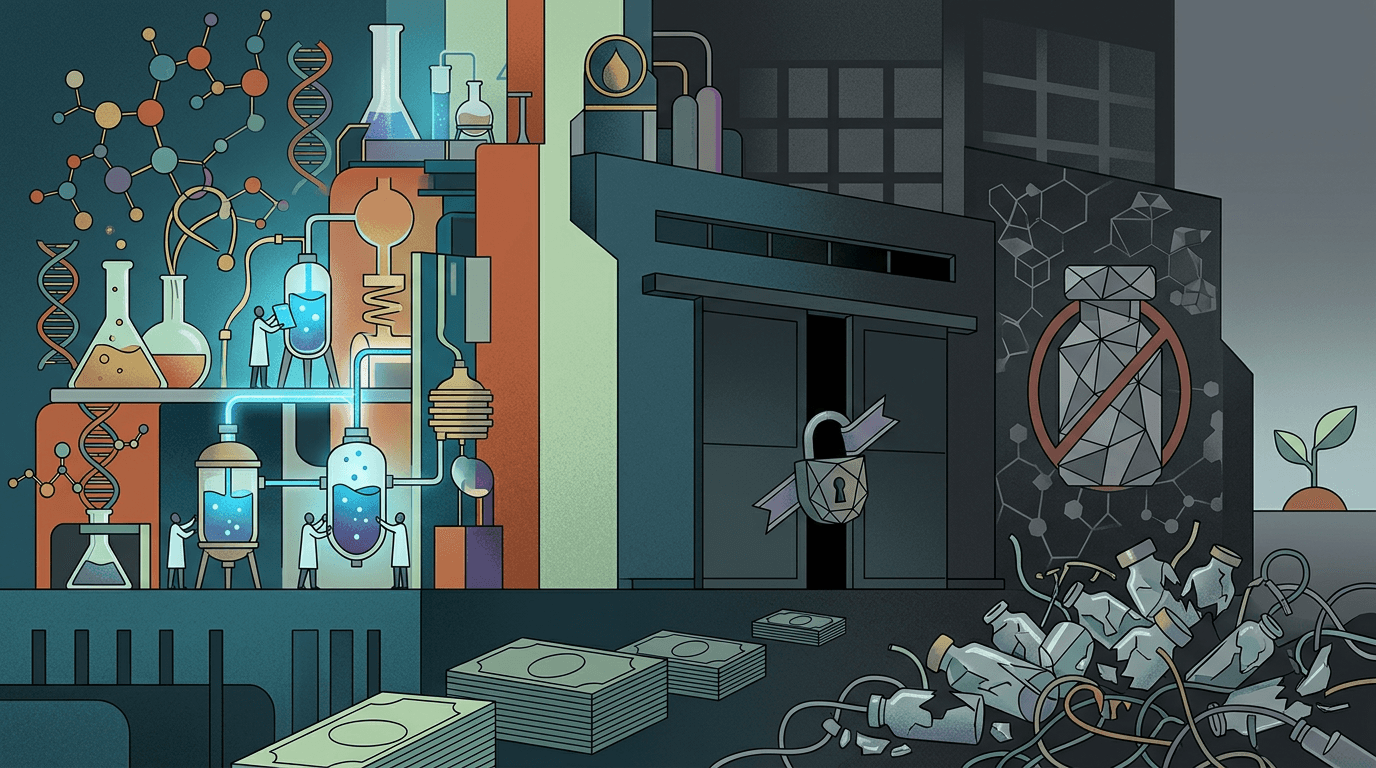

Merck poured $1 billion into a Durham vaccine factory to meet booming Gardasil demand. Now it's shutting the plant down and cutting 154 jobs as HPV vaccine sales crater 39%, with China shipments frozen indefinitely.
Two years ago, Merck was pouring concrete and hiring workers at a massive new vaccine plant in Durham, North Carolina. The company had committed roughly $1 billion to expand Gardasil production at its Old Oxford Road facility, betting big on surging global demand for the HPV vaccine. That bet just went sideways.
Merck filed a WARN notice (a legally required heads-up before mass layoffs) with North Carolina's Department of Commerce in late February. The paperwork tells a blunt story: 154 jobs eliminated across two Durham-area sites, with Gardasil production at the main facility ceasing entirely. The layoffs take effect on May 1, 2026.
Plant manager Amanda Taylor cited a "recent worldwide reduction in demand for this product" in the filing. That's corporate-speak for: the people we expected to buy this vaccine aren't buying it.
To understand what went wrong, you have to understand where Gardasil's growth was supposed to come from. And the answer, overwhelmingly, was China.
At its peak, roughly 40% of Gardasil's global sales were tied to China. The vaccine sold at premium prices through a cash-pay model, meaning Chinese consumers paid out of pocket rather than relying on government reimbursement. For a while, that was a goldmine. Urban women lined up for appointments. Merck's Chinese distribution partner, Zhifei, couldn't stock shelves fast enough.
Then three things happened at once.
First, the easy customers dried up. The wave of urban, price-insensitive women who wanted the vaccine after the pandemic had mostly gotten it. That initial surge of pent-up demand was exactly that: a surge, not a sustainable trend.
Second, Zhifei ended up sitting on a mountain of unsold inventory. Merck had been shipping aggressively to meet what looked like insatiable demand, but the pipeline was overstuffed. By late 2024, Gardasil sales in China were falling 17% year over year. Merck made the unusual decision to pause all shipments to China, initially expecting the freeze to last through mid-2025. It now extends through at least the end of 2025, with no shipments planned for 2026 either.

Join thousands of biotech professionals who start their day with our free, daily briefing.

Third, China approved a locally made nine-valent HPV vaccine in May 2025. That's the same type as Gardasil 9, but cheaper and domestically produced. In a market already squeezed by economic headwinds and government healthcare reforms pushing generic substitution, a lower-cost alternative was the last thing Merck needed.
The numbers tell the story in brutal shorthand. Gardasil sales dropped about 39% in 2025, falling to roughly $5.2 billion from their prior peak. That's not a dip; that's a cliff.
Morningstar responded by slashing its 2030 Gardasil sales forecast from $10 billion down to $7 billion. The message from analysts was clear: the old Gardasil growth story is over.
Merck's own 2026 guidance quietly confirmed this. The company projected total revenue of $65.5 to $67 billion, which missed Wall Street expectations. Buried in the fine print: zero Gardasil shipments to China assumed for all of 2026. Management isn't predicting a recovery. They're resetting the baseline.
The Durham factory shutdown is a case study in how quickly the ground can shift under a blockbuster drug. Merck broke ground on its $1 billion expansion when everything pointed upward: global vaccination campaigns were ramping, China was booming, and HPV awareness was climbing worldwide. Building a massive new bulk drug substance facility (the part of the process where the actual vaccine ingredient gets manufactured before it's bottled and shipped) seemed like a no-brainer.
But vaccine demand doesn't move in straight lines. It moves in waves. The post-pandemic catch-up wave crested, China's economy cooled, and local competitors showed up with cheaper products. By the time the factory was humming, the market had already turned.
For the 154 workers losing their jobs, the timing is especially painful. They're part of the Research Triangle's thriving biomanufacturing sector, but they were hired into a facility whose purpose evaporated before it fully matured.
These layoffs aren't happening in isolation. Merck announced a multiyear cost-cutting program targeting $3 billion in savings by the end of 2027. Reports suggest the company may cut roughly 6,000 jobs, about 8% of its global workforce. The company is trimming administrative, sales, and R&D roles while reorganizing its commercial structure into two new business units: one for oncology, one for everything else.
The strategic logic is straightforward. Merck's biggest product, the cancer drug Keytruda, accounted for 46% of the company's sales in 2024. But Keytruda faces biosimilar competition as key patents begin expiring around 2028. Morningstar projects Keytruda revenue could plummet from a $41 billion peak to under $10 billion annually by 2032.
That's a terrifying revenue gap. Gardasil was supposed to be one of the pillars holding up the other side of the bridge. Instead, it's sagging under its own weight, making the post-Keytruda math even harder.
Before you write Gardasil's obituary, some perspective. The Gardasil market is still projected to grow at roughly 12% annually through 2033, potentially reaching $12.6 billion. The WHO's cervical cancer elimination campaign is expanding immunization programs worldwide. More countries are vaccinating boys. Age ranges are broadening.
The demand is real. It's just shifting: away from premium cash-pay markets like urban China, toward government-funded programs in lower- and middle-income countries where pricing is tighter and margins are thinner. Merck remains the global leader in HPV vaccines, but key patents on Gardasil 9 have already expired in Japan (2024) and will expire in Europe (2026), opening the door for biosimilars.
So Merck faces a weird paradox. The world needs more HPV vaccines than ever. But the world Merck built its Gardasil empire around, one defined by premium pricing, China-driven growth, and patent-protected exclusivity, is fading fast.
A billion-dollar factory in Durham is the monument to that miscalculation. And 154 workers just paid the price.
The Trump administration just slapped a 100% tariff on every branded drug not made in America, forcing pharma companies into an impossible choice: slash prices, build U.S. factories, or watch their margins evaporate. The biggest shake-up in pharma trade policy is already reshaping the industry.