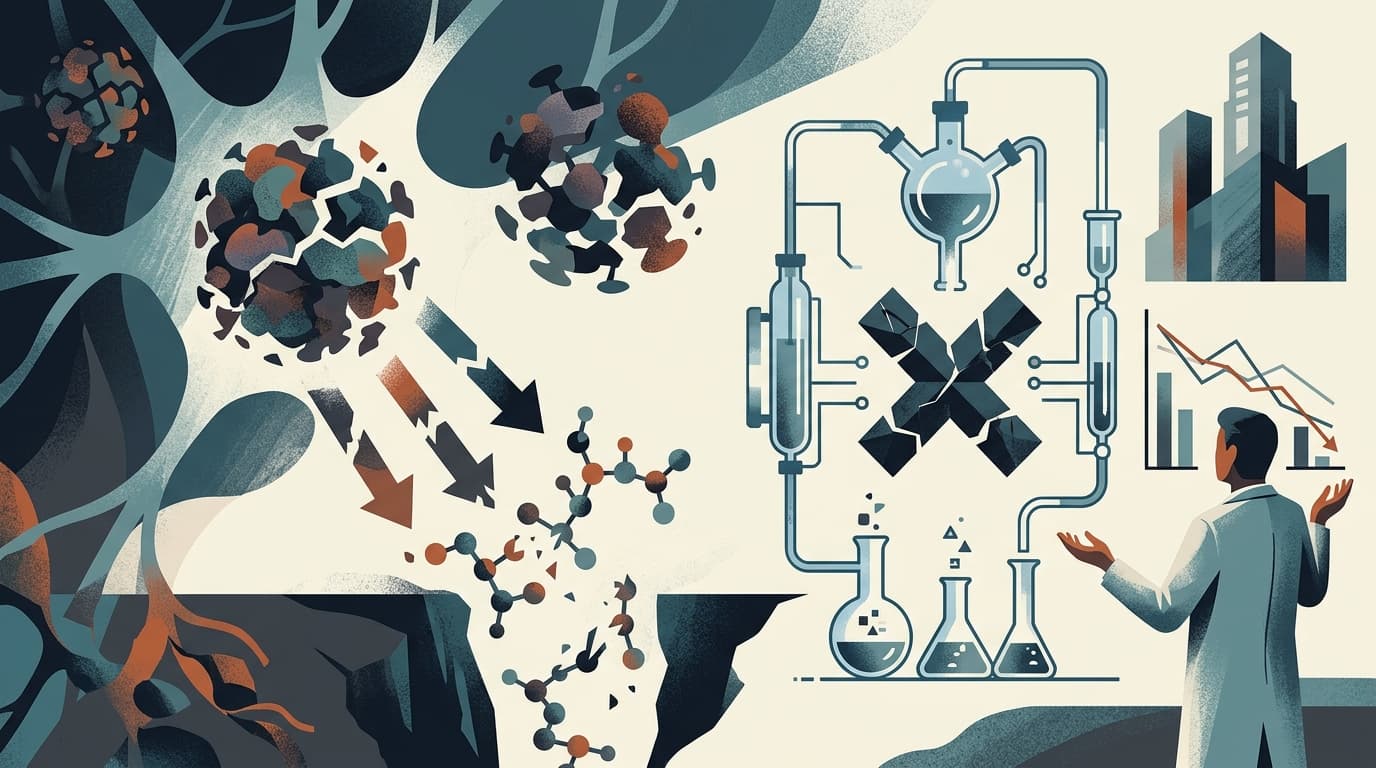

Merck killed its Phase 2 trial of MK-1167 after the Alzheimer's drug simply didn't work well enough. With a 99.6% failure rate in the field and only one remaining candidate in their pipeline, Merck's neuroscience ambitions are running out of runway.
Alzheimer's drug development is the place where good ideas go to die. And Merck just added another one to the pile.
The pharma giant quietly pulled the plug on its Phase 2 trial of MK-1167, an oral pill designed to boost brain signaling in Alzheimer's patients. The roughly 350-patient study didn't fail because the drug was dangerous. It failed because it simply didn't work well enough. A Merck spokesperson confirmed the trial "did not meet the necessary efficacy criteria to warrant further investigation."
That's corporate-speak for: we tried, the data said no, we're moving on.
The science behind MK-1167 was actually pretty elegant. Think of it like a volume knob on a radio.
Your brain has receptors called α7 nicotinic acetylcholine receptors (α7 nAChRs) that help with memory and cognition. In Alzheimer's patients, the signal running through those receptors gets weaker over time. MK-1167 was a positive allosteric modulator, which means it doesn't turn the radio on by itself. Instead, it cranks the volume up when natural signals (acetylcholine) are already playing.
The idea was to layer MK-1167 on top of existing drugs like donepezil, which already boost acetylcholine levels. More signal, louder amplification, better cognition. On paper, it made sense. In patients, the extra volume just wasn't loud enough to matter.
This isn't Merck's first swing and miss in Alzheimer's. It's not even their second.
The company previously ran two massive Phase 3 trials of verubecestat, a BACE1 inhibitor that blocked the production of amyloid plaques in the brain. Both were stopped for futility after independent monitors concluded there was "virtually no chance of finding a positive clinical effect." Before that, a growth-hormone pathway drug flopped too, showing no memory benefit whatsoever.
Then came MK-1942, a different small molecule targeting serotonin receptors. That one got axed in 2023, not for lack of efficacy, but because patients started showing abnormal liver function tests. Different drug, different problem, same outcome: dead program.

The FDA just cleared Vertex's CRISPR gene therapy for kids as young as two with sickle cell disease, making it the first gene therapy ever approved for toddlers with blood disorders. The science is stunning, but at $2.2 million a pop, almost nobody can get it yet.


Join thousands of biotech professionals who start their day with our free, daily briefing.
With MK-1167 now shelved, Merck is down to one remaining Alzheimer's candidate: MK-2214, a monoclonal antibody that targets a specific form of phosphorylated tau protein. It's in Phase 2 for early Alzheimer's disease. One shot left.
Alzheimer's drug development isn't just hard. It's historically, statistically, almost comically difficult.
The overall failure rate for Alzheimer's drugs? 99.6%, according to a major pipeline analysis of compounds tested since 2002. Only about 2% of drugs that reach Phase 2 or Phase 3 actually make it through. And when you break it down by stage, the picture gets even grimmer: 72% fail in Phase 1, 92% in Phase 2, and 98% in Phase 3.
Imagine a restaurant where 99 out of 100 dishes come back to the kitchen. You'd close the place. But in Alzheimer's research, people keep cooking because the stakes are too high to stop.
Analysts barely blinked at the news, and that tells you something.
When Merck's verubecestat program collapsed years ago, Leerink analyst Seamus Fernandez cut his Merck price target by just $1 per share (from $67 to $66). Sanford Bernstein's Tim Anderson said his team had "not given BACE compounds the benefit of the doubt" in their models at all. The message was clear: smart money had already written off Merck's Alzheimer's ambitions.
MK-1167 carried even less weight in financial models than verubecestat did. The consensus view is that Merck's growth story lives and dies with oncology, particularly Keytruda. Alzheimer's assets were always treated as lottery tickets, not pillars.
The stock barely moved. Nobody was surprised.
While Merck keeps stumbling, the Alzheimer's market is actually booming, just not for everyone.
Two anti-amyloid antibodies now dominate the space: lecanemab (Leqembi) from Eisai and Biogen, and donanemab (Kisunla) from Eli Lilly. Both received full FDA approval and are generating real revenue.
Donanemab has a clever twist that appeals to doctors and insurers alike. It targets mature amyloid plaques, clears them, and then patients can stop treatment. That "clear and stop" model is a fundamentally different value proposition from lecanemab's continuous dosing regimen. Multiple analysts expect donanemab to overtake lecanemab in sales within about a year of full global launch.
The broader pipeline isn't shrinking, either. In 2025, there were 182 clinical trials testing 138 drugs. By 2026, that number grew to 192 trials and 158 unique agents. Major pharma companies are pouring money into Alzheimer's through acquisitions: AbbVie bought Aliada Therapeutics for $1.4 billion in late 2024, Johnson & Johnson acquired Intra-Cellular Therapies for roughly $14.6 billion, and Sanofi picked up Vigil Neuroscience for $470 million to get an oral TREM2 agonist for neuroinflammation.
This isn't a field in retreat. It's a field where the winners are separating from the losers.
Merck now faces an uncomfortable strategic question. MK-2214, their tau-targeting antibody, is the last Alzheimer's asset standing in their pipeline. If it works, Merck stays relevant in neuroscience. If it doesn't, the company's CNS credibility takes another hit, and investors will wonder why Merck keeps trying.
The broader lesson here is sobering but important. Alzheimer's doesn't reward clever mechanisms or elegant science alone. It rewards brute-force persistence, massive patient populations, and a willingness to absorb failure after failure. Eisai spent decades on amyloid before lecanemab paid off. Lilly weathered its own string of setbacks before donanemab clicked.
Merck isn't giving up on the brain. But the brain, so far, hasn't given Merck much to work with.
AstraZeneca agreed to pay up to $1.77 billion for two kidney disease molecules that don't even exist yet, and it's actually the third massive deal they've signed with the same Chinese partner. When big pharma starts throwing billion-dollar checks at your organs, it's time to pay attention.