
Researchers delivered a protective gene to mouse livers and watched amyloid plaques shrink in their brains. No blood-brain barrier crossing required. This peripheral approach could rewrite the Alzheimer's treatment playbook.
If you wanted to fight a brain disease, you'd aim for the brain. Obviously. That's been the playbook for Alzheimer's research for decades: get drugs past the blood-brain barrier (the brain's bouncer), target the sticky amyloid plaques gunking up neurons, and hope for the best.
But what if the best angle of attack isn't through the brain at all? What if it's through your liver?
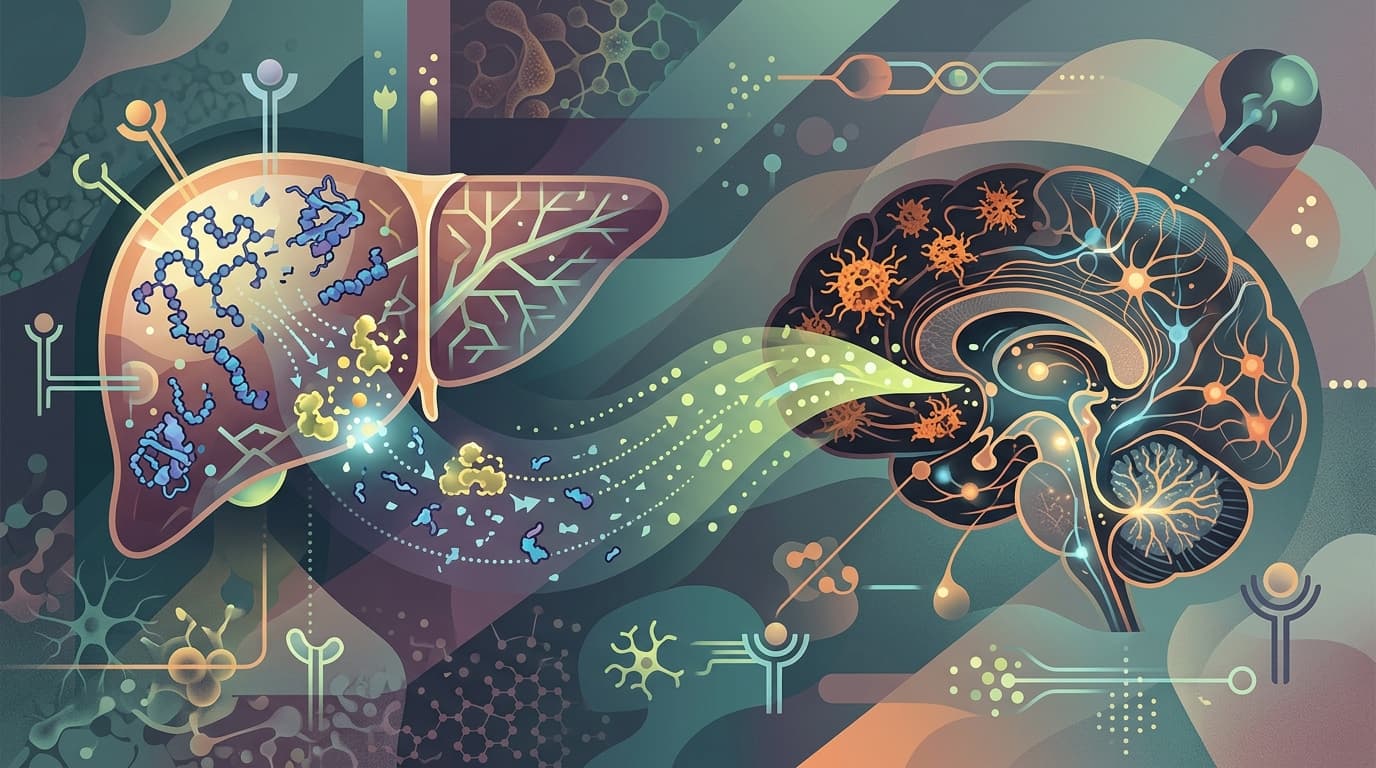
A team from Army Medical University in Chongqing, China, led by Dr. Zhong-Yuan Yu, just published a study in Neuron that flips the Alzheimer's script. They delivered a protective gene to the livers of mice and watched amyloid plaques shrink in their brains. No brain surgery. No crossing the blood-brain barrier. Just the liver doing what the liver does best: cleaning house.
The gene in question is called APOE3 Christchurch (APOE3Ch), a naturally occurring variant that's basically the genetic equivalent of a lucky charm. People who carry it seem unusually resistant to Alzheimer's, even when they have other high-risk genes stacked against them.
The researchers took mice carrying the high-risk APOE4 variant (the genetic bad hand that raises Alzheimer's risk significantly) and injected them with a standard liver-targeted viral vector carrying APOE3Ch. Think of it like mailing a package with a very specific delivery address: the liver cells open it, read the genetic instructions, and start producing the protective protein.
What happened next is where things get wild.
The concept relies on something called the peripheral sink hypothesis, and it's beautifully simple once you see it. Imagine your brain and your bloodstream as two pools connected by a drain. Amyloid-beta (the toxic protein that forms Alzheimer's plaques) exists in both pools. If you aggressively remove amyloid from the blood pool, more of it drains out of the brain pool to equalize the levels.
That's exactly what the APOE3Ch-expressing liver did. It supercharged the blood's ability to grab and clear amyloid. The liver and circulating immune cells called monocytes became amyloid vacuum cleaners, pulling the toxic protein out of the bloodstream faster than before. This shifted the balance, and amyloid started flowing out of the brain.

The White House just approved plans to oust FDA Commissioner Marty Makary after only 14 months on the job, marking the third leadership change at the agency in three years. For biotech investors and companies waiting on drug approvals, the turbulence is just getting started.


Join thousands of biotech professionals who start their day with our free, daily briefing.

The treated mice showed smaller amyloid plaques, reduced brain inflammation, and better performance on memory maze tests. All from a gene delivered to an organ that sits nowhere near the skull.
The blood-brain barrier is the single biggest headache in neurology drug development. It blocks roughly 98% of small molecules and nearly all large ones from reaching the brain. Current Alzheimer's antibody treatments like lecanemab (approved 2023) and donanemab (approved 2024) work by binding amyloid directly, but they need massive doses because so little actually penetrates into brain tissue.
Those drugs offer meaningful but modest benefits. And they come with a nasty side effect called ARIA: brain microbleeds and swelling that require constant MRI monitoring.
A liver-based approach sidesteps all of this. You don't need to cross the barrier if you're pulling amyloid out from the other side. It's like unclogging a drain from below instead of pushing through from above.
Let's pump the brakes before anyone starts calling their hepatologist. This is a mouse study. Mice are not tiny humans with tails. Their amyloid biology, immune systems, and lifespans are fundamentally different from ours.
The peripheral sink hypothesis has also had a bumpy track record. Previous attempts to clear amyloid from the blood (using enzymes like neprilysin) sometimes reduced plasma levels without meaningfully affecting brain pathology. The APOE3Ch approach may work differently because it enhances multiple clearance pathways simultaneously, but that theory needs more testing.
There's also the question of timing. Alzheimer's brains accumulate amyloid for 15 to 20 years before symptoms appear. Can a liver-based cleanup crew make a dent once plaques are deeply established? The mouse data is encouraging, but mice don't develop the decades-long buildup that humans do.
This study lands in a moment when the Alzheimer's field is actively searching for alternatives to the "brute force through the barrier" approach. Roche's trontinemab uses shuttle technology to ferry antibodies across the BBB more efficiently; its Phase III results aren't expected until 2028. Other groups are exploring oral compounds and energy-metabolism approaches.
But the liver angle is conceptually distinct from all of these. It treats Alzheimer's as a systemic disease, not purely a brain disease. And there's growing evidence to support that framing: peripheral organs, circulating proteins, and the gut-brain axis all influence amyloid dynamics.
If APOE3Ch liver therapy works in humans (a massive "if"), it could be delivered as a one-time gene therapy injection rather than biweekly infusions. That alone would transform the treatment economics and patient experience.
The Army Medical University team needs to replicate these findings in additional animal models, test different disease stages, and eventually move toward human safety studies. That timeline is measured in years, not months.
But the intellectual contribution is immediate. For decades, Alzheimer's researchers have been trying to pick a lock on the brain's front door. This study suggests there might be a back door through the liver that nobody thought to try. And sometimes, the best way to solve a problem isn't to attack it head-on; it's to change the battlefield entirely.
enGene's bladder cancer drug posted decent clinical data. But "decent" doesn't cut it when your competitors are posting 60% response rates. The stock lost 80% in a day, and Wall Street's reaction tells you everything about what happens when small biotechs bring a knife to big pharma's gunfight.