Lilly Just Spent $2.88 Billion to Teach Your Body to Eat Its Own Antibodies
Eli Lilly is spending $2.88 billion to acquire Merida Biosciences and its technology that selectively destroys disease-causing antibodies while leaving the rest of your immune system alone. It's the company's biggest bet yet that autoimmune disease will be its next blockbuster franchise.
Your Immune System Has a Friendly Fire Problem
Sometimes your immune system builds the wrong weapons. Instead of making antibodies that attack viruses and bacteria, it churns out rogue antibodies that attack you: your thyroid, your kidneys, your skin. Doctors call these pathogenic autoantibodies, and they're the root cause of dozens of autoimmune diseases affecting tens of millions of people worldwide.
The standard playbook? Carpet-bomb the entire immune system with broad immunosuppressants. It's like burning down your house to kill a spider. It works, sort of, but the side effects are brutal and patients often relapse.
Eli Lilly just bet $2.88 billion that there's a smarter way.
The Deal: What Lilly Bought and Why
On August 31, Lilly announced it would acquire Merida Biosciences, a private biotech developing engineered molecules that selectively destroy disease-causing autoantibodies while leaving the rest of the immune system intact. The deal is structured as a cash acquisition worth up to $2.875 billion, combining an upfront payment with milestone-based payouts. Lilly expects the transaction to close in Q4 2026, pending regulatory approvals.
This isn't Lilly buying a single drug. It's Lilly buying a platform, one that could potentially generate treatments across a whole spectrum of autoantibody-driven diseases. And that distinction matters a lot when you're writing a check this large for a company with only one program in the clinic.
How Merida's Tech Actually Works
Think of pathogenic autoantibodies as rogue employees who keep showing up to work and causing chaos. Traditional treatments try to shut down the whole office. Merida's approach is more like a bouncer with a photo ID: find the troublemakers, grab them, and escort them to the incinerator.
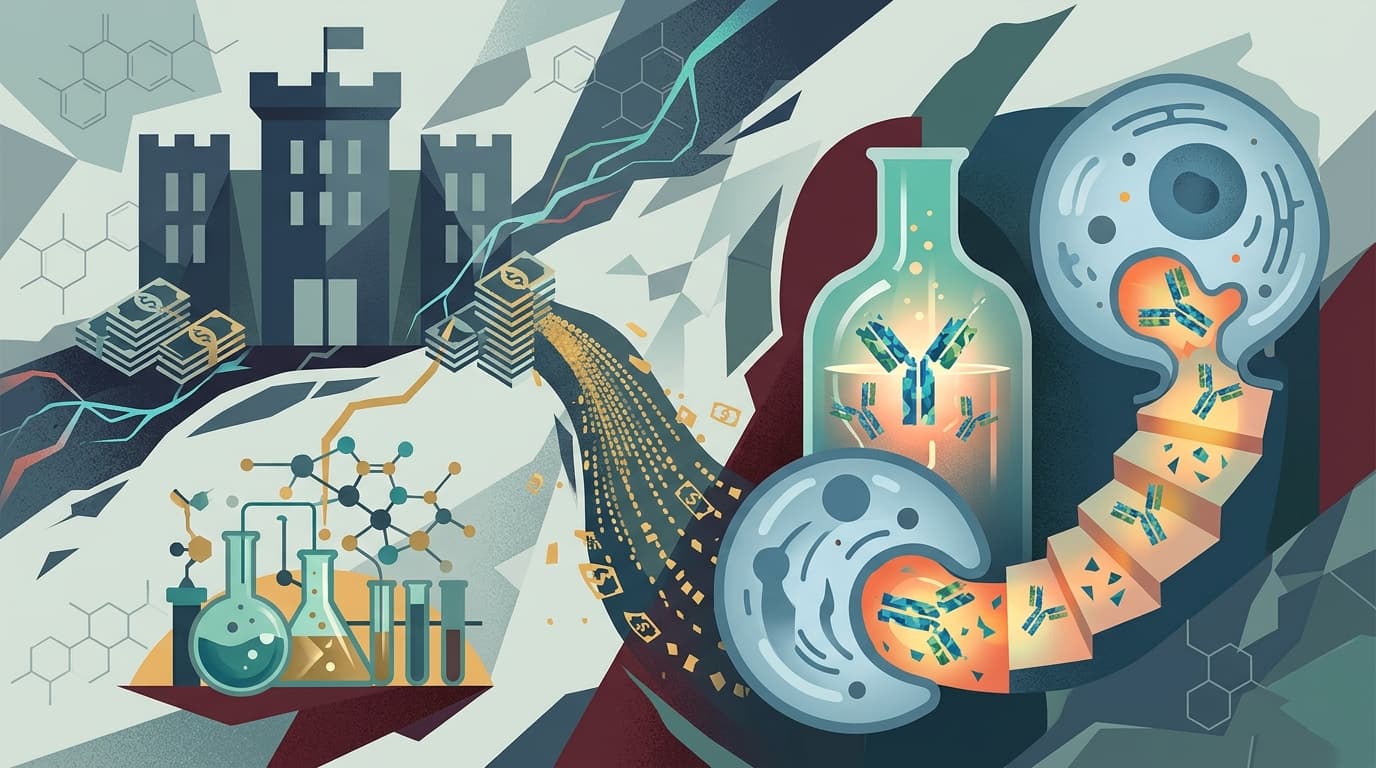
Here's the science in plain English. Merida builds Fc-based biotherapeutics (engineered proteins modeled on a piece of natural antibodies) that do two things simultaneously. First, they latch onto the specific rogue antibody causing disease. Second, they shuttle that antibody to liver cells, where it gets swallowed up and destroyed through the body's natural recycling system (called lysosomal degradation).
Get tomorrow's biotech intelligence before your competitors.
Join thousands of biotech professionals who start their day with our free, daily briefing.
But there's a clever bonus feature. The same molecule also puts the brakes on the B cells that manufacture the rogue antibodies in the first place. It's not just mopping up the mess; it's turning off the faucet. Merida's molecules do this by engaging a receptor called FcγRIIB on B cells, which tells them to stand down.
The result, at least in theory: you eliminate the bad antibodies and slow their production, all without touching the healthy parts of your immune defense.
What's in the Pipeline
Merida has three disclosed programs, and they range from "in humans" to "still in the lab."
MER511 is the lead candidate, currently in Phase 1 trials for Graves' disease and thyroid eye disease (TED). These are conditions where rogue antibodies attack the thyroid-stimulating hormone receptor, causing everything from dangerous thyroid overactivity to painful eye swelling. Early Phase 1 data reportedly showed robust reductions in pathogenic thyroid-stimulating antibodies with a favorable initial safety profile. That's encouraging, though Phase 1 is still very early innings.
Behind that sits MER769, an IND-enabling program targeting IgE-mediated allergic diseases like food allergy, asthma, and chronic hives. And then there's MER683, aimed at primary membranous nephropathy, a kidney disease driven by anti-PLA2R antibodies. Both are preclinical, meaning they haven't reached human testing yet.
So Lilly is paying nearly $3 billion for one Phase 1 asset, two preclinical programs, and a platform. That's a big check for a lot of "if." Which raises the obvious question.
Why Pay This Much for Something This Early?
Because Lilly is playing a different game now.
For the past few years, Lilly has been the obesity company. Tirzepatide (sold as Mounjaro and Zepbound) turned it into one of the most valuable pharmaceutical companies on Earth. But Lilly's leadership clearly doesn't want to be a one-trick pony. The company has been signaling hard that autoimmune disease is its next major growth engine, sitting alongside obesity, diabetes, oncology, and neuroscience.
The autoimmune therapeutics market is enormous, with estimates for 2026 clustering around $84 billion to $144 billion depending on how you draw the boundaries. Biologics already account for roughly 48% of revenue in the space, and the competitive roster includes heavyweights like AbbVie, Roche, Pfizer, and Novartis.
But most of those competitors are selling drugs that broadly suppress immune function. What Lilly is betting on is that selective autoantibody degradation could be a fundamentally better approach: more targeted, potentially fewer side effects, and applicable across multiple diseases. If Merida's platform works as hoped, one technology could yield drugs for thyroid disease, allergies, kidney disease, and potentially many more conditions.
Lilly has also been unusually active on the dealmaking front in 2026, and this acquisition fits a pattern of buying platform technologies rather than individual drugs. The Sitryx Therapeutics collaboration (targeting chronic autoimmune and inflammatory diseases) tells a similar story. Lilly is assembling an immunology arsenal, piece by piece.
Wall Street's Verdict: Cautious Optimism
Analyst commentary on the deal has been strategically positive but financially cautious. Most observers like the pipeline depth and the differentiated mechanism. A platform that selectively removes harmful antibodies without nuking the immune system is genuinely novel, and the breadth of potential indications gives Lilly multiple shots on goal.
The concerns are predictable. MER511 is only in Phase 1. The preclinical programs are years away from generating meaningful clinical data. And $2.875 billion is a lot of money for assets whose commercial payoff won't arrive until well into the next decade. Some commentary noted that LLY shares were under pressure around the announcement, with mixed sentiment in certain investor channels.
That said, Lilly can afford to think long-term. When your obesity franchise is printing money, you have the luxury of placing big, early bets on the next frontier.
The Bigger Picture
The Merida deal is a signal flare for the entire autoimmune space. The industry's biggest players have spent decades selling broad immunosuppressants, and patients still face incomplete disease control, frequent relapses, and serious side effects. The unmet need is massive.
Lilly is wagering that precision matters: that instead of dimming the entire immune system, you can surgically remove the specific antibodies causing harm. If it's right, this could reshape how we treat autoimmune disease. If it's wrong, it's an expensive lesson in platform risk.
Either way, the race to build smarter autoimmune therapies just got a lot more interesting. And Lilly just put $2.88 billion worth of chips on the table.
Clinical & Regulatory4 min read
The First New Blood Cancer Drug in 30 Years Just Got the Green Light
For nearly 30 years, patients with essential thrombocythemia had zero new FDA-approved treatments. PharmaEssentia's BESREMi just broke that streak with trial results that crushed the competition seven to one.