The Sleep Scientists Who Might Be on a Fast Track to Stockholm
Two scientists who independently discovered the same brain molecule in 1998 just won the Lasker Award, often called "America's Nobel." Their work on orexin rewrote sleep medicine and spawned an entire class of insomnia drugs; now the Nobel committee may come calling.
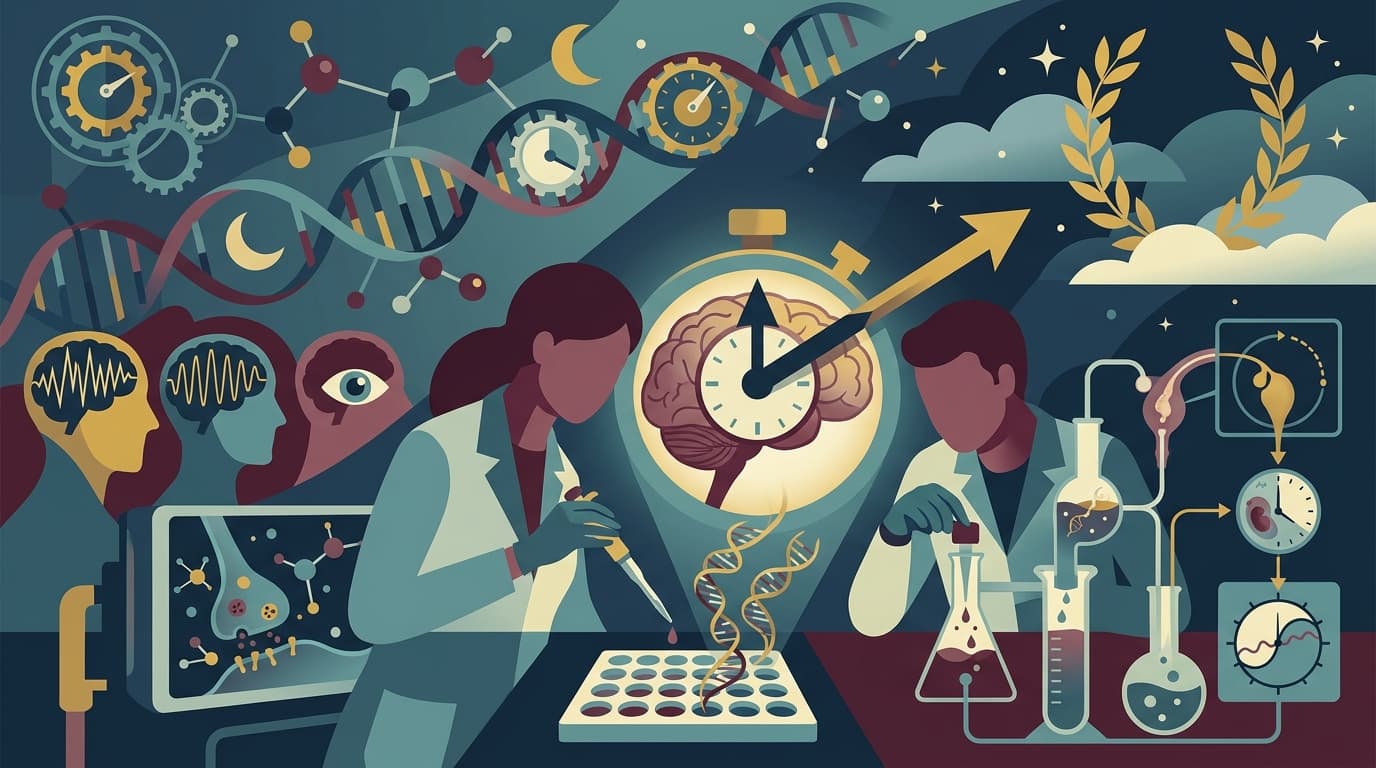
In 1998, two labs on opposite sides of the Pacific stumbled onto the same molecule at almost the exact same time. Neither group knew the other existed. One called it "hypocretin." The other called it "orexin." Both were describing a tiny brain peptide that would eventually rewrite our understanding of why humans stay awake, why some people can't, and how we treat insomnia today.
Now, nearly three decades later, the scientists behind that discovery just won the 2026 Albert Lasker Basic Medical Research Award. And if history is any guide, the Nobel committee is probably already taking notes.
America's Nobel (Literally)
The Lasker Award is often called "America's Nobel," and it's not just a polite nickname. Over 83 Lasker laureates have gone on to win the actual Nobel Prize, with roughly 31 of those in the last two decades alone. Almost half of the Basic Medical Research Award winners since 1962 have eventually made the trip to Stockholm.
This year's recipients are Emmanuel Mignot of Stanford University School of Medicine and Masashi Yanagisawa of the University of Tsukuba in Japan. The Lasker Foundation honored them for identifying orexin as the brain's key wakefulness signal and for proving that orexin deficiency is the root cause of narcolepsy.
That second part is the one that changed everything.
A Race Nobody Knew They Were Running
The story of orexin's discovery reads like a scientific rom-com where two people write the same book without ever meeting. In 1998, Luis de Lecea, Thomas Kilduff, and their colleagues published a paper in PNAS describing peptides they found by mining hypothalamus-enriched genetic data. They named them "hypocretins" because of where they lived in the brain (the hypothalamus) and their resemblance to another hormone (secretin).
Meanwhile, Takeshi Sakurai, working in Yanagisawa's lab, took a completely different approach. His team used a technique called reverse pharmacology: they started with orphan receptors (receptors with no known function) and worked backward to find what activates them. They published their findings in and called the peptides "orexins," from the Greek word for appetite, because the molecules initially seemed to regulate feeding.
Get tomorrow's biotech intelligence before your competitors.
Join thousands of biotech professionals who start their day with our free, daily briefing.
Cell
Same molecule. Two names. Two papers. One enormous discovery hiding in plain sight.
The Narcolepsy Breakthrough
For years, narcolepsy was one of medicine's weirder mysteries. People would fall asleep at random, sometimes dozens of times a day. Some experienced cataplexy, a sudden loss of muscle control triggered by strong emotions. (Imagine laughing so hard at a joke that your legs give out; for narcolepsy patients, that's not a metaphor.)
Doctors could describe the symptoms. They could manage them with stimulants. But nobody understood why it happened.
Then came the orexin connection. By 2000, researchers showed that people with narcolepsy type 1 had lost the specific neurons in their hypothalamus that produce orexin. The peptide was typically undetectable or extremely low in their cerebrospinal fluid. It was as if someone had flipped off the brain's "stay awake" switch at the circuit breaker.
This was a huge deal. Narcolepsy went from being a baffling collection of symptoms to a mechanistically defined brain disease with a clear biological cause. Think of it like the difference between saying "the car won't start" and knowing the fuel pump is broken. One is a complaint; the other is a diagnosis you can actually fix.
From Lab Bench to Bedside Table
The practical payoff arrived faster than most basic science breakthroughs. Once researchers understood that orexin keeps you awake, the obvious question followed: what if you could block it to help people sleep?
Merck developed suvorexant (Belsomra), the first dual orexin receptor antagonist (DORA), a drug that blocks both orexin receptors to quiet the brain's wakefulness signal. It won FDA approval in 2014 after entering clinical development in 2006. Eisai followed with lemborexant (Dayvigo), a second DORA with faster receptor dissociation kinetics, approved in 2019.
These weren't just me-too sleeping pills. They represented an entirely new class of insomnia treatment, one built on the specific biology that Mignot and Yanagisawa uncovered. Instead of sedating the whole brain (the old approach), DORAs target the precise system that controls the sleep/wake boundary.
And the therapeutic pipeline is now running in the other direction, too. Companies are developing orexin agonists, drugs that mimic orexin rather than block it, as potential treatments for narcolepsy itself. If blocking orexin helps insomniacs sleep, restoring it might help narcolepsy patients stay awake.
Why the Scientific Community Is Buzzing
The reaction from the research world has been enthusiastic, and it's clustering around three themes.
First: validation of basic science. Stanford Medicine called Mignot's work "transformative for sleep medicine" and said it has provided hope to millions living with narcolepsy. The award is being held up as proof that curiosity-driven research on an obscure neuropeptide can reshape an entire medical field.
Second: clinical impact. The Lasker Foundation specifically highlighted that orexin discoveries have already produced new medicines, both the receptor blockers for insomnia and the emerging agonists for narcolepsy. That bench-to-bedside arc is exactly the kind of story the Foundation loves to celebrate.
Third: momentum for sleep research. Yanagisawa noted that sleep science has historically received relatively little attention, and the prize raises expectations for further research in the field. It's a signal that the scientific establishment is finally treating sleep with the seriousness it deserves.
The Nobel Question
Let's address the elephant in the room. Will Mignot and Yanagisawa win the Nobel Prize?
Nobody can predict Stockholm's decisions, but the track record is hard to ignore. The Lasker-to-Nobel pipeline is one of the most reliable patterns in science. Carl Cori won the Lasker in 1946 and the Nobel just a year later. Earl Sutherland made the jump in 1970 and 1971. Robert Furchgott, Sydney Brenner, Oliver Smithies: the list goes on and on.
The orexin discovery checks every box the Nobel committee tends to favor. It identified a fundamental biological mechanism. It solved a long-standing clinical mystery. And it spawned an entire class of therapeutics that millions of people now use.
Sleep, it turns out, was never boring. We just needed someone to find the molecule that proved it.
For Mignot and Yanagisawa, the Lasker is a career-defining honor. But if history holds, it might also be an appetizer.
Clinical & Regulatory
4 min read
The Government Wants an AI Doctor for Your Heart
ARPA-H just bet $62.7 million that an AI can manage heart failure patients around the clock, prescribing drugs and ordering tests without waiting for a doctor. If it works, it could reshape how we treat the fastest-growing heart condition in America.