J&J Bet $16.6 Billion on a Tiny Heart Pump. Two Trials Just Backfired.
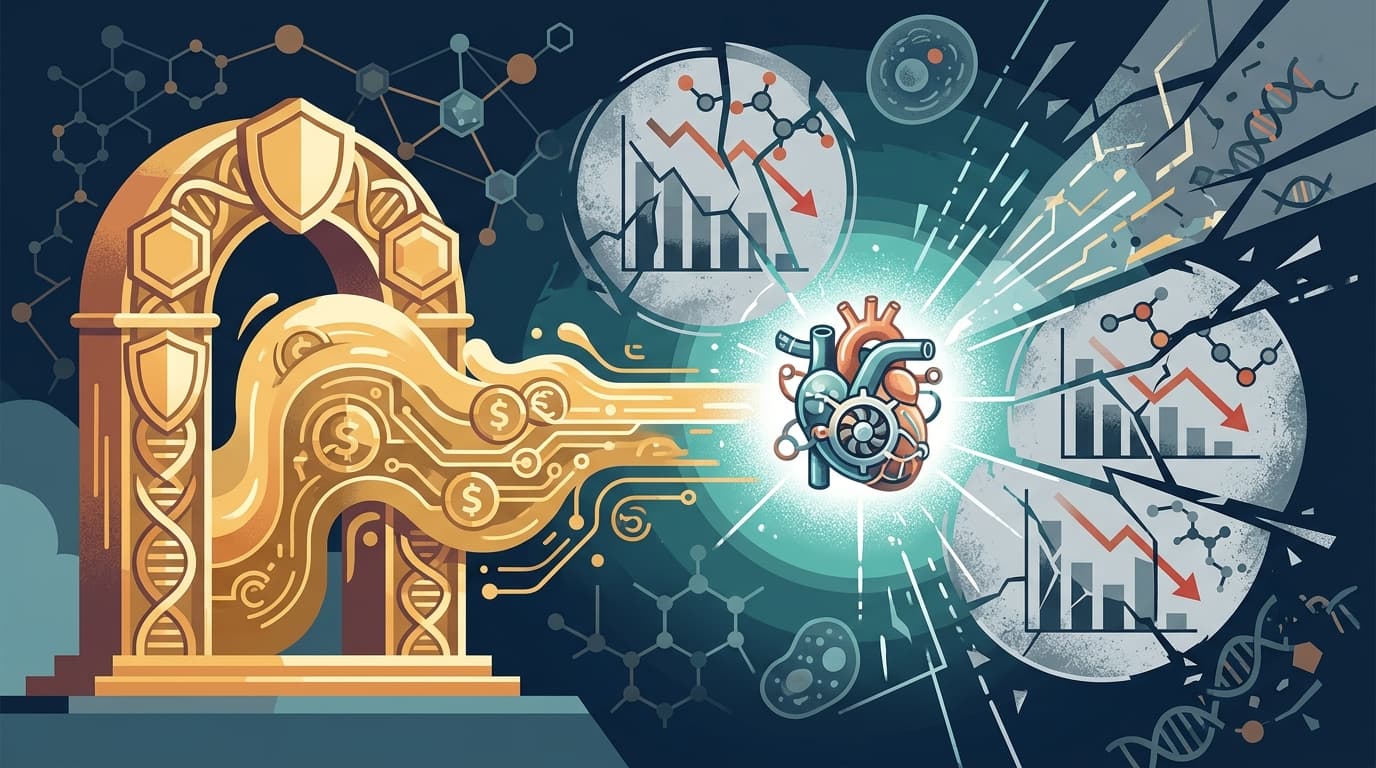
J&J's $16.6 billion bet on the Impella heart pump just hit a wall. Two major trials showed the world's most popular cardiac support device doesn't help (and might actually harm) patients in the procedures where it's used most often.
Imagine buying a house for $16.6 billion, then finding out the foundation has cracks.
That's roughly where Johnson & Johnson finds itself after two major clinical trials of its Impella heart pump flopped at the American College of Cardiology meeting. The Impella is the world's most widely used percutaneous heart pump: a miniature device threaded through an artery to help the heart pump blood during high-risk cardiac procedures. J&J bought Impella's maker, Abiomed, in late 2022 for that eye-popping sum, betting the tiny device would become the backbone of its cardiovascular strategy.
Both trials tested whether the Impella helps patients undergoing percutaneous coronary intervention (PCI), which is essentially a cardiac catheter procedure to open blocked arteries. Both came up empty.
The $16.6 Billion Gamble
To understand why these results sting so badly, you need to understand what J&J was buying into. The Abiomed deal, announced in November 2022, was the largest medtech acquisition of that year. J&J paid $380 per share upfront, with additional milestone payments of up to $35 per share tied to clinical wins.
Two of those milestones are particularly relevant right now. J&J promised Abiomed shareholders an extra $7.50 per share if the Impella won FDA approval for heart attack patients without cardiogenic shock by January 2028. Another $10 per share hinged on achieving top-tier clinical guideline recommendations for high-risk PCI or heart attack use. Both milestones just got a lot harder to hit.
By 2024, roughly 60,000 patients were being treated with Impella annually, a one-third jump from pre-acquisition levels. Sales grew more than 17% in 2025 alone. The device was flying off the shelves. The only problem? Most of that growth happened without randomized trial evidence proving the pump actually helps in the procedures where it's used most often.
Trial One: CHIP-BCIS3 (The One That Showed Potential Harm)
The first trial, called CHIP-BCIS3, was a UK-based study of 300 patients with severe heart disease: people with weak hearts, extensive blockages, and prior heart attacks. These are the exact patients cardiologists reach for the Impella to "protect" during complex procedures. The approach even has a catchy name in the field: "protected PCI."
Get tomorrow's biotech intelligence before your competitors.
Join thousands of biotech professionals who start their day with our free, daily briefing.
The trial measured a composite of bad outcomes including death, disabling stroke, heart attacks, and cardiovascular hospitalizations. Standard PCI without the Impella actually fared better, with favorable outcomes in 43% of pairwise comparisons versus 36% with the pump. The difference wasn't statistically significant on the primary endpoint, but the safety signals were alarming.
Cardiovascular death nearly doubled in patients who got the Impella: 26.7% versus 14.5% in the control group. All-cause death was higher too in the Impella group. The pump didn't help with secondary outcomes like stroke or heart failure hospitalizations either. Researchers even observed potential damage to the left ventricle, the heart's main pumping chamber.
Divaka Perera, the lead investigator from King's College London, didn't mince words: "We found no evidence that use of the temporary pump protected the heart... Our findings strongly suggest that we shouldn't be using this device routinely without more evidence of benefit."
The results were published simultaneously in the New England Journal of Medicine, which is the medical equivalent of dropping a bombshell on the front page of the New York Times.
Trial Two: STEMI-DTU (The One That Wasted Precious Time)
The second trial, called STEMI Door-to-Unload, tested a different but equally important question. When someone has a major heart attack (specifically an anterior STEMI, which is a blockage in the artery feeding the heart's largest muscle wall), could inserting the Impella before opening the blocked artery reduce the damage?
Think of it like a house fire. Standard practice says get the water on the flames as fast as possible. This trial asked: what if you set up a sprinkler system for 30 minutes first, then opened the hydrant?
The study enrolled 527 patients across multiple countries. The primary endpoint was infarct size, meaning how much heart muscle died, measured by MRI three to five days later. The result? No difference. Infarct size was 30.8% of the left ventricle in the Impella group versus 31.9% with standard immediate PCI.
But the Impella didn't just fail to help. It introduced real costs. Patients in the pump group waited an extra 47 minutes before their blocked artery was opened. In cardiology, there's an old saying: "time is muscle." Every minute a coronary artery stays blocked, more heart tissue dies. Adding 47 minutes of delay for zero benefit is a tough sell.
On top of the delay, the Impella group had higher rates of major bleeding and vascular complications (mostly at the insertion site). The pump stayed in for over 10 hours after the procedure. All that extra hardware, extra time, and extra risk produced nothing measurable in return.
Wall Street's Favorite Pump Has an Evidence Problem
The one setting where Impella does have strong randomized evidence is cardiogenic shock. The landmark DanGer Shock trial showed the pump improved 180-day survival by 12.7% in shock patients having emergency procedures. That's a real, meaningful benefit.
But the vast majority of pumps are placed in the exact scenarios these two trials just tested. And both came up empty.
Roxana Mehran, a prominent cardiologist at Mount Sinai, captured the tension perfectly: "CHIP-BCIS3 tells us that there is no benefit and possibly some harm... Routine use of this strategy cannot be recommended." She noted the contrast with the shock data, emphasizing that what works in crashing patients doesn't automatically translate to stable ones.
What Happens Next?
J&J's response has been measured. The company called the STEMI-DTU results "neutral" and pointed out that delaying reperfusion didn't increase infarct size, which they framed as evidence of some cardiac protection. They've signaled interest in future trials combining the Impella with blood pressure medications to reduce reperfusion injury.
There's also PROTECT IV, a 1,200-patient trial currently enrolling that could provide the randomized evidence the field has been lacking for high-risk PCI. Results aren't expected until at least 2027. Until then, J&J is in an awkward position: its best-selling cardiac device just lost two high-profile trials in its most common use case.
The competitive landscape adds pressure. Alternatives like the TandemHeart (a rival percutaneous support system), traditional intra-aortic balloon pumps (which are cheaper and less invasive), and newer entrants like Second Heart Assist's Whisper device are all circling. The old-fashioned balloon pump delivers similar mortality outcomes to the Impella in some studies, at a fraction of the cost and complexity.
The Bigger Picture
These trial failures expose a pattern that haunts medical devices more broadly. Unlike drugs, which require rigorous clinical trials before reaching patients, devices often gain FDA clearance through faster pathways and see widespread adoption before randomized evidence catches up. The Impella became a billion-dollar franchise largely on the strength of physician enthusiasm and registry data. Doctors liked how it stabilized patients during tough procedures. That felt like a benefit.
But feeling like something works and proving it works are two very different things. The CHIP-BCIS3 trial is the first randomized evidence against routine Impella use in elective high-risk PCI. Combined with the neutral STEMI-DTU results, the message from the data is clear: outside of cardiogenic shock, the case for the world's most popular heart pump just got a lot weaker.
J&J isn't giving up. With PROTECT IV still enrolling and the shock indication on solid footing, the Impella story isn't over. But for a company that paid $16.6 billion betting on this technology, the foundation is looking shakier than expected. And the patients who've been receiving these pumps without proven benefit? They're the ones who paid the real price.
5 min read
Astellas Just Killed a Drug No One's Been Able to Make Work
Astellas pulled the plug on its STING inhibitor trial for Sjögren's syndrome before it could even generate human data. The decision says as much about a notoriously undruggable target as it does about where Big Pharma is placing its bets.