
Janux Therapeutics just dosed the first patient with a "double-masked" cancer drug designed to stay completely invisible until it reaches the tumor. If it works, it could rewrite the safety playbook for one of oncology's most promising (and most dangerous) drug classes.
Imagine hiring a bounty hunter who can't tell the difference between the target and innocent bystanders. That's basically the problem with T cell engagers, one of oncology's most promising drug classes. They're powerful, they recruit your own immune cells to kill cancer, and they have an unfortunate habit of also destroying healthy tissue along the way.
Janux Therapeutics thinks it has a fix. On April 16, the San Diego-based biotech dosed its first patient with JANX014, a "double-masked" T cell engager targeting prostate cancer. The idea is deceptively simple: put a disguise on the drug so it stays invisible to the immune system until it reaches the tumor. Then, and only then, does it take off the mask and go to work.
If it sounds like something out of a spy movie, the science isn't far off.
T cell engagers (TCEs) are bispecific antibodies, meaning they grab onto two things at once. One arm latches onto a protein on the cancer cell. The other arm grabs CD3, a receptor on T cells (your immune system's hit squad). By physically bridging the two, TCEs force T cells to attack the cancer.
The concept is elegant. The execution has been brutal.
Because the proteins TCEs target often show up on healthy cells too, the drugs can trigger what's called on-target, off-tumor toxicity: your immune system attacking the right protein in the wrong neighborhood. One early TCE targeting a protein called EpCAM caused liver damage, heart problems, and fatal diarrhea in some patients, capping doses at levels too low to be truly effective.
Then there's cytokine release syndrome (CRS), where the sudden activation of so many T cells floods the body with inflammatory signals. Fever, dangerously low blood pressure, organ dysfunction. Another lovely side effect: neurotoxicity. The result is a drug class with enormous potential that doctors can only use at a fraction of its full power.
Janux's solution comes from its proprietary TRACTr platform (Tumor Activated T Cell Engager, because biotech loves a creative acronym). The core insight: if you can keep the drug dormant everywhere except the tumor, you eliminate most of the collateral damage.

OpenAI just dropped GPT-Rosalind, a purpose-built AI for drug discovery that already outperforms 95% of human experts on certain biology tasks. Amgen, Moderna, and Novo Nordisk are already on board, but can a language model actually make drugs get to patients faster?


Join thousands of biotech professionals who start their day with our free, daily briefing.
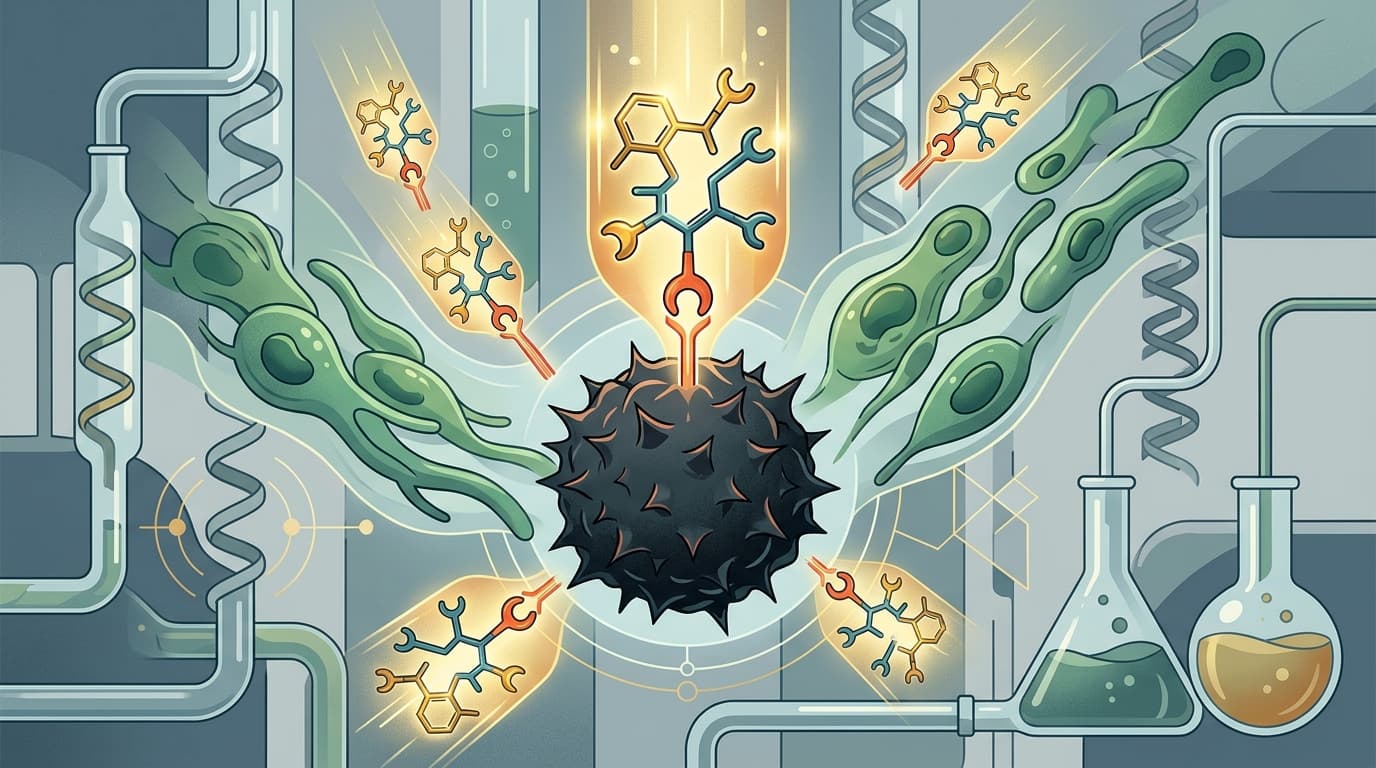
The mechanism works like a molecular padlock system. Peptide masks cover the drug's business ends, specifically the parts that bind to CD3 on T cells and to the tumor target. These masks are attached by special linkers that can only be cut by proteases (enzymes that chop up proteins) found in high concentrations inside tumors but not in normal tissue.
When the drug circulates through the bloodstream, it's essentially a ghost. Nothing can see it; nothing reacts to it. But once it reaches the tumor microenvironment, those tumor-specific proteases snip the masks off, and the fully active TCE emerges ready to recruit T cells.
The preclinical numbers are striking. In earlier Janux programs, masking reduced binding to the tumor target (EGFR, in that case) by more than 300-fold. Binding to CD3 dropped by over 1,000-fold. That's the difference between a drug that whispers through your bloodstream and one that screams.
JANX014 takes this a step further with "double masking," covering both binding arms simultaneously. Think of it as wearing a disguise and hiding behind a wall; you need both layers of protection removed before anything happens.
JANX014 is aimed at metastatic castration-resistant prostate cancer (mCRPC), one of the toughest forms of the disease. It targets PSMA, a protein heavily expressed on prostate cancer cells. Janux already has a lead PSMA program called JANX007 in Phase 1 trials, with interim data from December 2025 showing a 30% response rate in heavily pretreated patients.
So why build a second PSMA drug? Because Janux is essentially running an experiment in parallel design. JANX007 uses the company's earlier masking approach, while JANX014 layers on the double-mask technology. The company also has JANX013, a CD28 co-stimulatory molecule designed to be combined with JANX007, heading to the clinic in the second half of 2026.
The strategy is to hit the same target from multiple angles and let the data reveal which combination of masking and immune activation works best. It's less "throw spaghetti at the wall" and more "test three different pasta shapes to find the one that holds the most sauce."
Janux isn't the only company chasing masked T cell engagers. Vir Biotechnology, partnered with Astellas in a deal worth up to $1.7 billion, is developing VIR-5500, a dual-masked PSMA/CD3 engager already in Phase 1. CytomX Therapeutics pioneered the "Probody" approach to protease-activated antibodies. Harpoon Therapeutics is working on trispecific formats that add a third binding arm for extra precision.
The competition is fierce, particularly in prostate cancer, where PSMA has become one of the hottest targets in oncology. But Janux has a few cards to play. In April 2026, Bristol Myers Squibb nominated an undisclosed Janux TRACTr candidate as a development asset, triggering a $35 million milestone payment from a partnership that could be worth up to $885 million total. One analyst described the BMS deal as "further validation" of the platform.
Janux also has its EGFR-targeting program, JANX008, in Phase 1 for solid tumors like colorectal and head and neck cancers, plus a preclinical TROP2 program moving toward the clinic. The company raised roughly $181 million through its Series A and Series B, giving it runway to advance multiple programs.
Not everyone is sold. Some oncology analysts have raised concerns about cherry-picked data from JANX007's early trials. And updates on JANX008 have been slow, which tends to make investors nervous.
The broader question is whether masking technology truly solves the TCE safety problem or just reduces it enough to matter. A 1,000-fold reduction in CD3 binding sounds incredible on paper. But cancer biology has a way of humbling even the cleverest engineering. The tumor microenvironment varies wildly from patient to patient, and if protease levels aren't high enough, the masks might not come off efficiently.
JANX014 is in an open-label Phase 1 dose escalation trial, meaning the first goal is simply figuring out how much drug patients can tolerate. Early safety and efficacy data will likely trickle out at medical conferences over the next 12 to 18 months.
For Janux, the stakes are clear. If double masking proves significantly safer than single masking (or no masking at all), it could set a new standard for how TCEs are built. That would matter not just for prostate cancer, but for every solid tumor where T cell engagers have struggled with toxicity.
For patients with mCRPC who've run out of options, the promise is simpler: a drug that fights the cancer without fighting the rest of you.
Keytruda's patent cliff is approaching fast, and Merck just unveiled early data on a two-in-one cancer antibody that could help fill a $29.5 billion hole. The response rates are competitive, but the race is crowded and the clock is ticking.