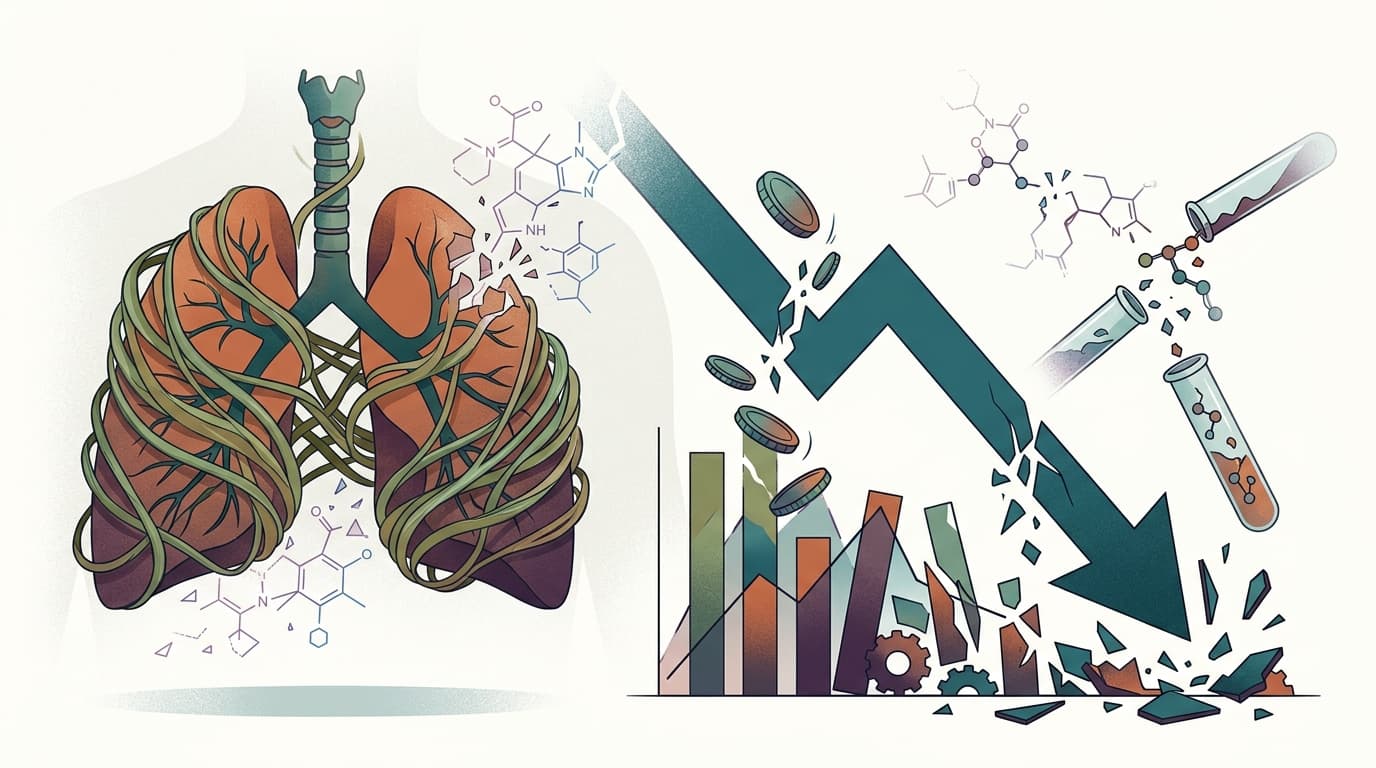

Syndax's axatilimab just flunked its Phase 2 trial in idiopathic pulmonary fibrosis, joining a long and growing list of drugs that couldn't crack the lung-scarring disease. Here's why IPF keeps eating pipelines alive, and what Syndax has left.
If biotech had a haunted house, idiopathic pulmonary fibrosis would be the room nobody comes back from.
Syndax Pharmaceuticals just learned that the hard way. The company announced that its drug axatilimab failed a Phase 2 trial in IPF, a progressive lung disease that turns healthy tissue into scar tissue until patients can't breathe. Syndax is walking away from the program entirely, and investors responded by sending shares down roughly 16%.
The kicker? This isn't even close to the first time IPF has humbled a promising drug. It's becoming a pattern that borders on tradition.
To understand why Syndax took this swing, you need to know a little about IPF biology. The disease involves a vicious cycle: immune cells called macrophages (think of them as the body's cleanup crew) go haywire and start promoting scar tissue instead of healing it. Over time, the lungs stiffen and lose their ability to exchange oxygen.
Axatilimab is an antibody that blocks a receptor called CSF-1R, which macrophages need to survive, multiply, and do their damage. The logic was elegant: cut off the signal that feeds the rogue cleanup crew, and maybe you can slow the scarring. It's a strategy that already works in another scarring disease, chronic graft-versus-host disease (cGVHD), where axatilimab is FDA-approved under the brand name Niktimvo.
So Syndax had a drug that was proven to tame macrophage-driven fibrosis in one disease. Why not try it in the lungs?
The MAXPIRe trial enrolled 145 patients across 62 sites in 14 countries. It was a proper study: randomized, double-blind, placebo-controlled, running for 26 weeks. The main question was simple. Could axatilimab slow the rate at which patients' lungs lost function, measured by a breathing test called forced vital capacity (FVC)?

Legend Biotech just got FDA clearance to test a therapy that could turn patients into their own CAR-T cell factories, no lab required. If it works, it could blow open access to a cancer treatment that today reaches only a fraction of eligible patients.


Join thousands of biotech professionals who start their day with our free, daily briefing.

The answer: no.
Axatilimab did not beat placebo on that primary endpoint. There's a small silver lining buried in the data: the drug's safety profile looked clean, with no new safety signals and no treatment-related deaths in either group. But in drug development, a safe drug that doesn't work is still a drug that doesn't work.
Syndax didn't hedge or promise a follow-up. The company said it does not plan further development in IPF, which is the clinical trial equivalent of unfollowing someone and blocking their number.
If you're keeping score at home, axatilimab joins a long and distinguished list of IPF failures from the past several years. The graveyard includes:
The approved drugs that actually work in IPF — pirfenidone, nintedanib, and most recently nerandomilast (Jascayd) — slow progression but don't reverse scarring or cure the disease. Every attempt to do better has crashed and burned, regardless of the target or mechanism.
Researchers point to a cocktail of reasons: the biology is ferociously complex, patient populations are heterogeneous, and Phase 2 results often look better than they really are because studies are too small. Some experts also note that running trials on top of existing background therapy (most IPF patients already take pirfenidone or nintedanib) makes it even harder to detect a new drug's benefit. It's like trying to hear a whisper in a noisy restaurant.
This failure has implications beyond Syndax. Axatilimab was the leading clinical program testing whether blocking CSF-1R could work in fibrotic lung disease.
The broader macrophage-targeting approach in fibrosis (including strategies like CCR2 antagonists) remains mostly preclinical or early-stage. So axatilimab's failure doesn't just close one door; it casts a shadow over an entire corridor of research. If the most advanced macrophage-directed therapy can't move the needle in IPF, the bar for the next attempt just got a lot higher.
The good news for Syndax is that IPF was never the whole story. The company's two main pillars remain intact.
First, axatilimab's cGVHD franchise is alive and well. The drug is already approved for patients who've failed at least two prior therapies, and Syndax has two more cGVHD trials running. A Phase 2 study combining axatilimab with ruxolitinib in newly diagnosed cGVHD should deliver topline data in Q4 2026. A bigger Phase 3 trial pairing it with corticosteroids has data expected in early 2028. Syndax was clear that the IPF miss does not affect any of these programs.
Second, the company has revumenib, a selective menin inhibitor and an approved drug in its own right. Between a growing cGVHD label and a second commercial asset, Syndax has options, even if the IPF dream is dead.
But the 16% stock drop tells you something important: investors had priced in at least some IPF upside, and that evaporated in a single press release.
IPF affects roughly 100,000 people in the U.S. alone, and available treatments are profoundly inadequate. The disease desperately needs new options. Yet the field keeps producing the same result: elegant science in the lab, disappointing data in the clinic.
Axatilimab's failure is a reminder that biology doesn't care about your mechanism-of-action slide deck. A drug can work beautifully in one fibrotic disease and completely whiff in another, because lungs are not skin, and IPF is not cGVHD. The immune system is a maze, and we keep running into the same walls.
Somewhere out there, another biotech is designing another IPF trial with another novel target. If history is any guide, the odds aren't in their favor. But somebody, eventually, has to crack it. The patients are running out of time, and the graveyard is running out of space.
The FDA just widened Anktiva's bladder cancer label to include high-grade papillary tumors, and it could reshape ImmunityBio's entire commercial story. Here's why a seemingly incremental regulatory update is actually a franchise-defining moment.