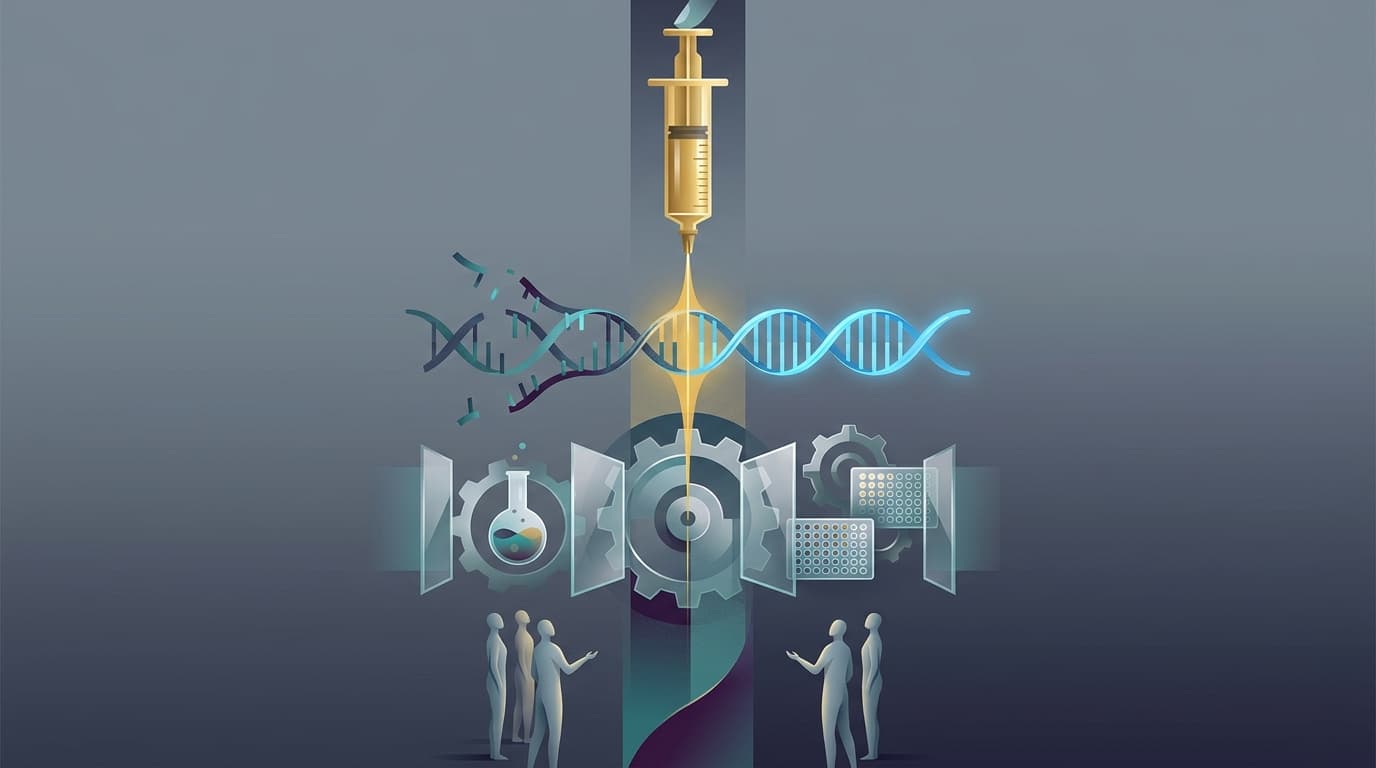

Intellia just became the first company to post positive Phase 3 results for a CRISPR therapy delivered directly inside the human body. One infusion cut hereditary angioedema attacks by 87%, and the implications stretch far beyond a single rare disease.
Imagine a disease where your body randomly swells up: your face, your throat, your gut. No warning. No pattern. It can last for days, and if it hits your airway, it can kill you. Now imagine someone tells you a single IV infusion could make it stop. Not manage it. Not reduce it. Stop it.
That's the promise Intellia Therapeutics just delivered data on. And for the first time ever, a CRISPR gene-editing therapy injected directly into the human body has aced a Phase 3 trial.
Intellia's therapy, called lonvo-z, was tested in 80 patients with hereditary angioedema (HAE), a rare genetic condition that causes unpredictable, painful swelling episodes. The treatment is elegantly simple in concept: a single 50 mg infusion that uses CRISPR/Cas9 (molecular scissors for DNA) to permanently disable the KLKB1 gene, which produces a protein called kallikrein that drives the swelling attacks.
The Phase 3 trial, called HAELO, was the gold standard of clinical design: global, randomized, double-blind, placebo-controlled. No wiggle room for bias. And the results were striking.
Patients on lonvo-z had an 87% reduction in monthly attacks compared to placebo. To put that in real numbers, treated patients averaged 0.26 attacks per month versus 2.10 for placebo. That's roughly one attack every four months instead of two attacks every month.
But the stat that really jumps off the page? 62% of patients on lonvo-z were completely attack-free and therapy-free for the entire six-month evaluation period. Only 11% of placebo patients could say the same. Both results hit statistical significance with p-values below 0.0001, which in statistics-speak means "this almost certainly wasn't a fluke."
When you're permanently editing someone's DNA inside their body, the safety bar isn't just high; it's on the roof. CRISPR skeptics have long warned about off-target edits, unintended consequences, and the irreversible nature of the technology. You can stop taking a pill. You can't un-edit a gene.

Daiichi Sankyo and Merck pulled their FDA application for a promising lung cancer ADC before the agency could reject it. The move reveals a tougher regulatory landscape for accelerated approvals and reshuffles the competitive race in small cell lung cancer.


Join thousands of biotech professionals who start their day with our free, daily briefing.
So the safety data matters enormously here. And it was clean. Adverse events were mostly mild to moderate: infusion-related reactions, headaches, and fatigue. No serious adverse events were reported in the lonvo-z arm. For a therapy this novel, that's about as reassuring as it gets.
HAE affects a relatively small patient population, and it already has treatments on the market from Takeda, BioCryst, and others. So why is Wall Street (and the entire biotech world) paying attention?
Because this isn't really about hereditary angioedema. It's about proof of concept for an entire technology platform.
Think of it like the first successful SpaceX landing. Yes, they landed one rocket. But what it proved was that reusable rockets work, which changed the math for everything that came after. Intellia just landed the rocket for in vivo CRISPR.
Previously, the only approved CRISPR therapy was Casgevy (from CRISPR Therapeutics and Vertex), which treats sickle cell disease. But Casgevy works ex vivo, meaning doctors remove a patient's cells, edit them in a lab, and put them back. It's effective but complex and expensive. Intellia's approach skips all of that. The editing happens inside the patient's body after a single infusion. That's a fundamentally different, and potentially far more scalable, model.
Intellia isn't wasting time. The company has already filed a Biologics License Application (BLA) with the FDA using a rolling submission. The agency accepted it and granted Priority Review, which means the FDA considers the therapy a potential significant improvement over existing treatments.
The PDUFA date (the FDA's deadline to make a decision) is March 10, 2027. If approved, Intellia is targeting a U.S. launch in the first half of 2027.
You might expect a stock to go ballistic after "first-ever Phase 3 win for in vivo CRISPR." Intellia shares rose about 23% to $14.92 after the data dropped. Solid, but the reaction also reflects real-world execution questions investors are weighing against the breakthrough science.
Can Intellia commercialize effectively against entrenched competitors like Takeda and BioCryst, who already have established relationships with HAE doctors? Will payers cover a potentially expensive one-time gene therapy when cheaper chronic treatments exist? And can the company, which is still pre-revenue, fund a launch while advancing its other pipeline programs?
These are fair questions. But they're also the kind of questions that get asked about every paradigm-shifting therapy before it proves the doubters wrong.
HAE patients today have options, but none of them are cures. Current treatments fall into two buckets: on-demand therapies to treat attacks when they happen (like icatibant injections or the newer oral drug sebetralstat) and long-term prophylaxis to prevent attacks (like lanadelumab or berotralstat). Both categories require ongoing, often lifelong treatment.
Lonvo-z doesn't fit neatly into either bucket. It's more like a third category: a one-time procedure that could replace chronic treatment entirely. That's a compelling pitch for patients who are tired of injections, pills, and the constant anxiety of wondering when the next attack will come.
The question is whether "one and done" beats "proven and familiar" in the eyes of doctors and patients. History suggests it usually does, but it takes time.
Rewind to 2020, when the first in vivo CRISPR trial in the U.S. began for a rare eye disease. Back then, editing genes inside a living human felt like science fiction with a permission slip. By 2023, Casgevy proved CRISPR therapies could win regulatory approval. Now, in 2026, Intellia has shown that you can inject CRISPR directly into a patient and get clean, durable, statistically bulletproof results in a late-stage trial.
The trajectory is unmistakable. Each milestone de-risks the next one, not just for Intellia but for every company building in vivo gene-editing therapies: cardiovascular programs, liver disease programs, and applications we haven't even imagined yet.
One infusion. One edit. Potentially one cure. The era of in vivo gene editing just got its first diploma.
Bristol Myers Squibb is dropping $1.5 billion in cash on Orbital Therapeutics, a preclinical-stage startup with zero approved drugs and zero revenue. The bet says everything about Big Pharma's platform fever and the desperate race to fill patent cliffs.