Incyte Just Bet $120M That AI Can Build Its Next Drug Pipeline
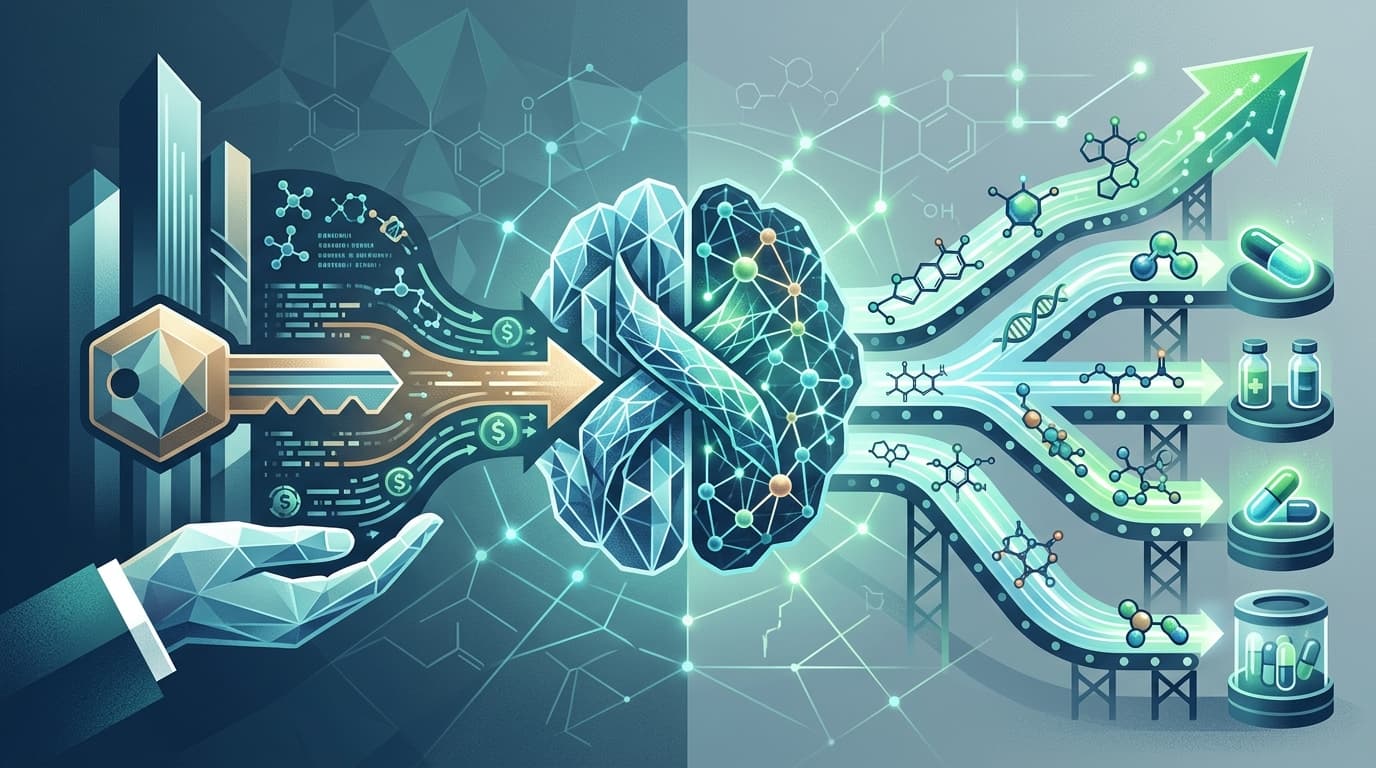
Incyte is pouring $120 million upfront into Genesis Molecular AI, complete with an equity stake and a commitment to share proprietary research data. If this "foundation model" approach to drug discovery works, it could reshape how mid-cap pharma competes.
The $120 Million Handshake
Most pharma companies dip a toe into AI. Incyte just cannonballed.
The mid-cap biopharma committed $120 million upfront to expand its collaboration with Genesis Molecular AI, a company whose platform designs drug molecules using artificial intelligence. That breaks down to $80 million in cash and a $40 million equity stake in Genesis. If everything works out across the first five programs, total payments could top $1 billion. Add more targets later, and the deal could stretch into "several billion."
This isn't a press release about exploring synergies. It's one of the largest upfront commitments a pharma company has made to an AI drug discovery partner, and it tells you something important about where the industry is headed.
From Pilot Project to Full-Blown Marriage
To understand why this deal matters, rewind to February 2025. That's when Incyte first partnered with Genesis, paying $30 million upfront for access to its GEMS platform (Genesis Exploration of Molecular Space) across just two drug targets. Think of it as a first date: let's see if this works on a couple of projects before we get serious.
Fifteen months later, Incyte is buying the ring.
The expanded deal adds at least five new discovery programs, all chosen by Incyte. The company also locked in options to nominate additional targets over time. Genesis can earn up to $232 million per program in milestone payments tied to preclinical, clinical, regulatory, and commercial success. Royalties on any approved drugs sit on top of that.
But the most interesting part isn't the money. It's the data.
The Real Currency: Proprietary Data
Incyte isn't just paying Genesis to run its AI models on a few isolated problems. Under the expanded agreement, Incyte will feed its own proprietary experimental data into GEMS to train and improve Genesis' foundation models. The deal also includes recurring research funding specifically earmarked for AI model training and computing infrastructure.
Get tomorrow's biotech intelligence before your competitors.
Join thousands of biotech professionals who start their day with our free, daily briefing.
Imagine you hired a personal chef, but instead of just telling them what to cook, you also gave them your grandmother's secret recipe book so they could learn your family's taste preferences over time. Every meal gets better because the chef understands you more deeply.
That's what's happening here. Incyte's internal research data (think: results from lab tests, compound performance data, medicinal chemistry insights) will make GEMS smarter, not just for one target but across the entire collaboration. The more data Genesis gets, the better its models perform, and the better the models perform, the more valuable the partnership becomes.
Industry observers are calling this one of the first major pharma collaborations explicitly designed to build large-scale foundation models using a partner's real-world experimental data. It's a fundamentally different approach from the typical "here's a target, run your software on it" arrangement.
What GEMS Actually Does
Genesis' platform isn't just a fancy search engine for molecules. GEMS combines several AI technologies into what the company calls an operating system for drug discovery.
At its core, the platform uses 3D models of how proteins and drug molecules interact, including the way proteins flex and move (a critical factor that simpler tools often miss). Its Pearl foundation model predicts protein-drug complex structures with sub-angstrom accuracy, which is like measuring the distance between atoms to within the width of a single hydrogen atom.
The system also runs generative chemistry models: think of them as AI that invents new molecules the way a language model generates sentences. These generators can spit out millions of potential drug candidates, each one scored for potency, selectivity, how well it gets absorbed by the body, and whether it's actually possible to manufacture.
The real selling point? GEMS is designed to work on "undruggable" targets, proteins that have historically been too slippery or too poorly understood for traditional small-molecule approaches. That's exactly the kind of challenge that would justify a nine-figure bet.
Why Incyte, and Why Now?
Incyte isn't making this move in isolation. The company has been quietly building an AI-native R&D strategy across multiple fronts.
In May 2026, Incyte announced a separate collaboration with Edison Scientific to deploy an autonomous "AI scientist" called Kosmos across its entire discovery and development pipeline. Management has reported over 20 AI agents operating across R&D, commercial, and corporate functions, including tools for drafting regulatory submissions.
The Genesis partnership handles the chemistry: designing and optimizing actual drug molecules. Kosmos handles the biology: interpreting experimental data, predicting clinical outcomes, and supporting decisions from target selection through early clinical trials. Together, they form a two-pronged AI strategy that covers nearly the full R&D lifecycle.
For a mid-cap company competing against much larger players, this is a calculated efficiency play. Incyte can't outspend Pfizer or Eli Lilly on brute-force R&D. But if AI genuinely accelerates drug discovery and reduces failure rates, a well-positioned mid-cap could punch well above its weight.
The Bigger Picture: AI Deals Are Getting Serious
Zoom out, and the Incyte-Genesis deal fits into a clear pattern. AI drug discovery partnerships have exploded in both size and ambition over the past 18 months.
Eli Lilly signed a deal with Insilico Medicine worth up to $2.75 billion in 2026. Sanofi inked two separate collaborations with Earendil Labs totaling over $4 billion in potential milestones. Lilly also committed $1 billion to a five-year partnership with NVIDIA to build an AI supercomputer for drug discovery. Merck matched that with a $1 billion multiyear pact with Google Cloud.
In 2025 alone, the AI drug discovery space saw 114 deals with a combined potential value of $43.4 billion. Upfronts for top-tier platform collaborations now regularly land in the $50 to $150 million range, a dramatic jump from the sub-$10 million pilots that were common just a few years ago.
The shift is clear: pharma isn't testing AI anymore. It's building on it.
The Skeptic's Checklist
None of this is guaranteed to work. Incyte's own SEC filings warn that AI use can introduce risks including "deficient or inaccurate analyses, legal liability, reputational harm, and release of confidential proprietary information."
The economics are also heavily back-loaded. That $1 billion-plus figure only materializes if multiple programs succeed across multiple indications and major global markets. History says most drug candidates fail; AI hasn't yet proven it can dramatically change those odds at scale.
Investors will be watching for concrete signs of progress: faster design-test-learn cycles, named targets entering preclinical development, and eventually IND filings (the applications that let you start testing a drug in humans) that trace directly back to GEMS-designed molecules. If those signals don't show up, the deal becomes an expensive experiment in feeding data into a black box.
But if they do show up? Incyte will have built something its competitors can't easily replicate: a proprietary AI discovery engine trained on its own data, getting smarter with every experiment. That's not just a tool; it's a moat.
Deals & M&A
5 min read
Biogen Spent $5.6B on Apellis. Then It Torched the Science.
Biogen closed its $5.6 billion Apellis acquisition and immediately killed most of the company's research programs, keeping only the two products already making money. It's a pattern that keeps repeating in big pharma M&A, and it says a lot about what acquirers actually value.