
Iranian strikes knocked out a third of the world's helium supply, and 50,000 MRI scanners are about to feel it. The crisis linking party balloons to cancer screenings is more urgent than you think.
Imagine a gas so light it escapes Earth's atmosphere, so scarce it can't be manufactured, and so critical that without it, tens of thousands of hospital scanners go dark. Now imagine a war just cut off a third of the world's supply.
That's what's happening right now with helium. And the fallout could reach your local hospital faster than you think.
On March 2, 2026, Iranian drone and missile strikes hit Qatar's Ras Laffan complex, the largest liquefied natural gas facility on the planet. Qatar declared force majeure immediately. Further attacks on March 18 caused extensive damage that experts say could take years to fully repair.
Ras Laffan doesn't just produce LNG. It also extracts helium as a byproduct, and that side hustle happens to account for roughly 30-33% of the entire world's helium supply. When the facility went offline, it left a massive hole in global helium production. There is no global spare capacity to fill that hole.
Think of it like a three-legged stool losing one leg. The stool doesn't wobble; it collapses.
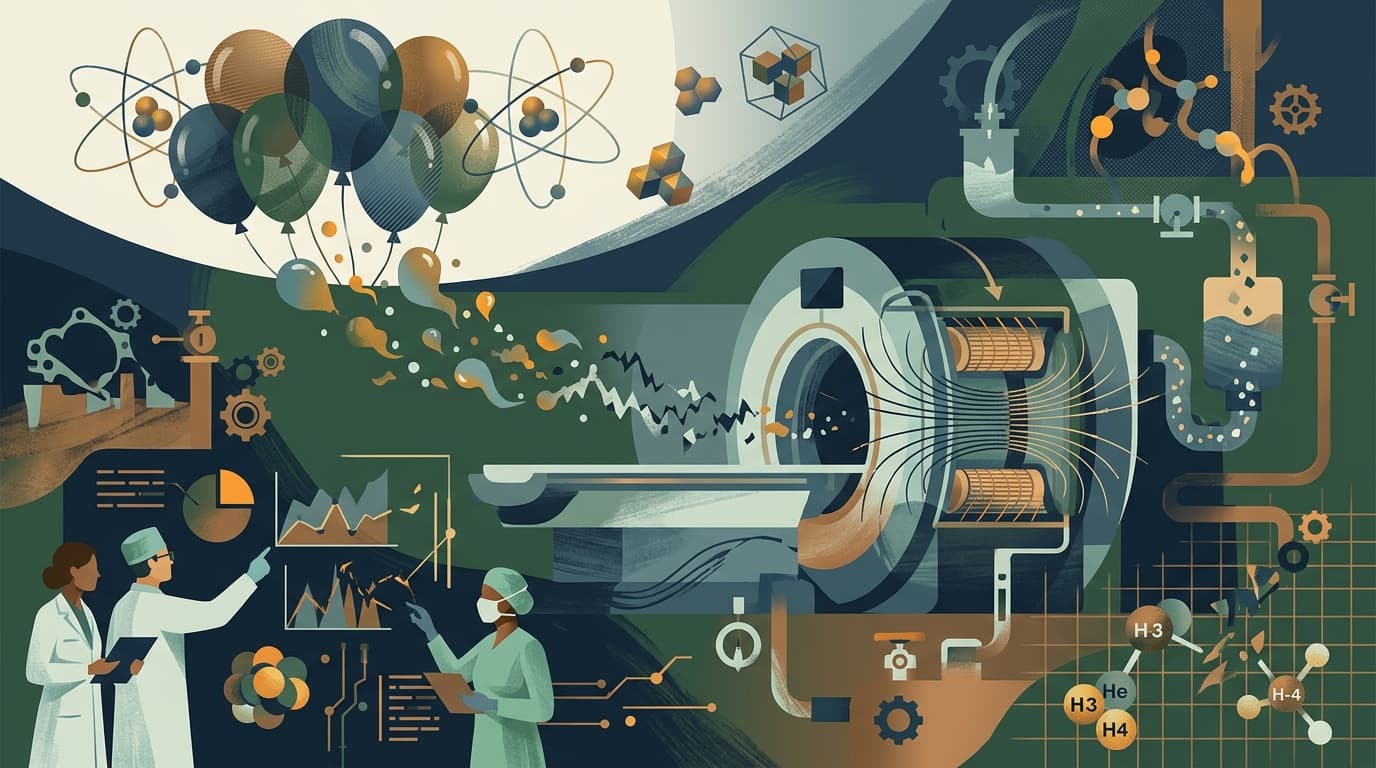
If you've ever had an MRI scan, you were lying inside a giant superconducting magnet cooled to roughly -269°C (colder than outer space). The only substance that keeps those magnets at that temperature is liquid helium. A typical MRI scanner holds between 1,200 and 1,800 liters of it.
Older machines lose small amounts every day through a process called boil-off, where the liquid helium slowly evaporates. Some legacy systems lose up to 10 liters daily, requiring refills every 9-14 months. Without those refills, the magnet warms up in an uncontrolled event called a "quench," which is basically the MRI equivalent of a car engine seizing. Recovery takes weeks.
Globally, about 50,000 conventional MRI scanners are humming away right now, performing an estimated 95 million scans per year. Together, they consume roughly 25-30% of the world's helium. That makes healthcare the single largest consumer category after scientific research and semiconductors.

Aardvark Therapeutics just froze its entire obesity pipeline after cardiac safety signals emerged, sending shares plummeting 54%. The company's clever approach to weight loss (tricking gut bitter taste receptors into suppressing hunger) may have a fatal flaw: those same receptors exist in the heart.


Join thousands of biotech professionals who start their day with our free, daily briefing.
The financial pain is already showing up. Spot helium prices (the cost for uncontracted, buy-it-now volumes) have doubled since early March. Most helium moves on long-term contracts. But here's the catch: when those contracts come up for renewal, they'll reflect the new reality.
Industrial gas giants like Linde, Air Products, and Air Liquide are already imposing surcharges and supply allocations. At least one unnamed supplier has begun tacking on specific helium fees. If the disruption stretches beyond a few months, analysts project contract prices could climb another 25-50%.
The United States produces roughly 40-50% of global helium (about 81 million cubic meters annually), while Algeria contributes a meaningful share. Russia's Gazprom has capacity at its Amur 2 plant, but US and EU sanctions block most of those exports from reaching Western markets. In short, there's nowhere to quickly make up the difference.
Helium doesn't travel like oil. It ships in specialized cryogenic containers that keep the gas in liquid form for up to around 45 days before it evaporates entirely. Right now, a number of these containers are stranded in the Middle East because the Strait of Hormuz (the narrow waterway connecting the Persian Gulf to open ocean) is effectively closed to Western shipping.
Rerouting around the Cape of Good Hope adds 10-14 days to transit times. That might sound manageable, but when your cargo has a built-in expiration timer, those extra days mean real losses. Some containers will arrive partially empty. Others won't arrive at all.
Shipments that left Qatar before the conflict are still trickling into Asian ports, which is why the full shortage hasn't hit yet. But the clock is ticking. Within weeks, the pipeline runs dry.
This is where allocation gets ugly. Semiconductor fabs, hospitals, aerospace companies, and research labs are all competing for the same shrinking pool. South Korea's chip giants Samsung and SK Hynix import 65% of their helium from Qatar, making them acutely vulnerable. AI chip production, already straining global helium demand, adds another layer of competition.
Hospitals don't stockpile helium the way semiconductor fabs do (some fabs reportedly have about six months of inventory). MRI scanners need continuous cooling, so healthcare providers operate on a just-in-time refill model. That makes them first in line to feel the squeeze.
The implications are sobering: delayed cancer screenings, postponed stroke assessments, backed-up emergency imaging. These aren't elective procedures. They're the scans doctors order when they suspect something is seriously wrong.
There is good news buried in this crisis. Philips has been selling its BlueSeal MRI systems since 2018. These scanners use a sealed magnet that requires only 7 liters of helium total, with no refills ever needed. The company has installed over 2,000 units worldwide.
GE HealthCare recently earned FDA clearance for its SIGNA Sprint 1.5T system with "Freelium" technology, another sealed-magnet design that eliminates ongoing helium consumption. Siemens Healthineers is reportedly developing its own helium-free models, though specifics remain scarce.
Growth in the helium-free MRI market is accelerating, but adoption still faces headwinds: some clinicians worry about image quality compared to traditional systems, and replacing 50,000 installed scanners takes time and capital that most hospitals don't have sitting around.
The best-case scenario for Ras Laffan is a partial helium restart in about six weeks. Experts call that outcome "highly unlikely." Full recovery could take years.
Meanwhile, hospitals with newer zero-boil-off MRI systems will weather the storm better than those running aging machines from the early 2000s. The crisis will probably accelerate the shift to helium-free technology, the same way an oil shock makes people suddenly interested in electric cars.
But for the next several months, the math is simple and unforgiving: there is less helium in the world than the world needs. Prices will rise. Scanners will go offline. Patients will wait longer for critical imaging.
All because of a noble gas most people associate with birthday balloons.
Innovent Biologics just matched Regeneron's $11B blockbuster Eylea in a 600-patient Phase 3 trial for wet AMD, but the real story is what happened next: better dosing durability, a cleaner safety signal, and a shot at China's fast-growing retinal disease market.