Gilead Just Paid $5 Billion for a Company That Raised €10.7M Six Years Ago
Gilead Sciences is paying up to $5 billion for Tubulis, a German ADC startup that raised just $12 million in its first funding round six years ago. The deal says as much about Big Pharma's desperation for next-gen cancer platforms as it does about one company's wild ride from university spin-out to mega-acquisition.
From Munich Lab to Mega-Deal
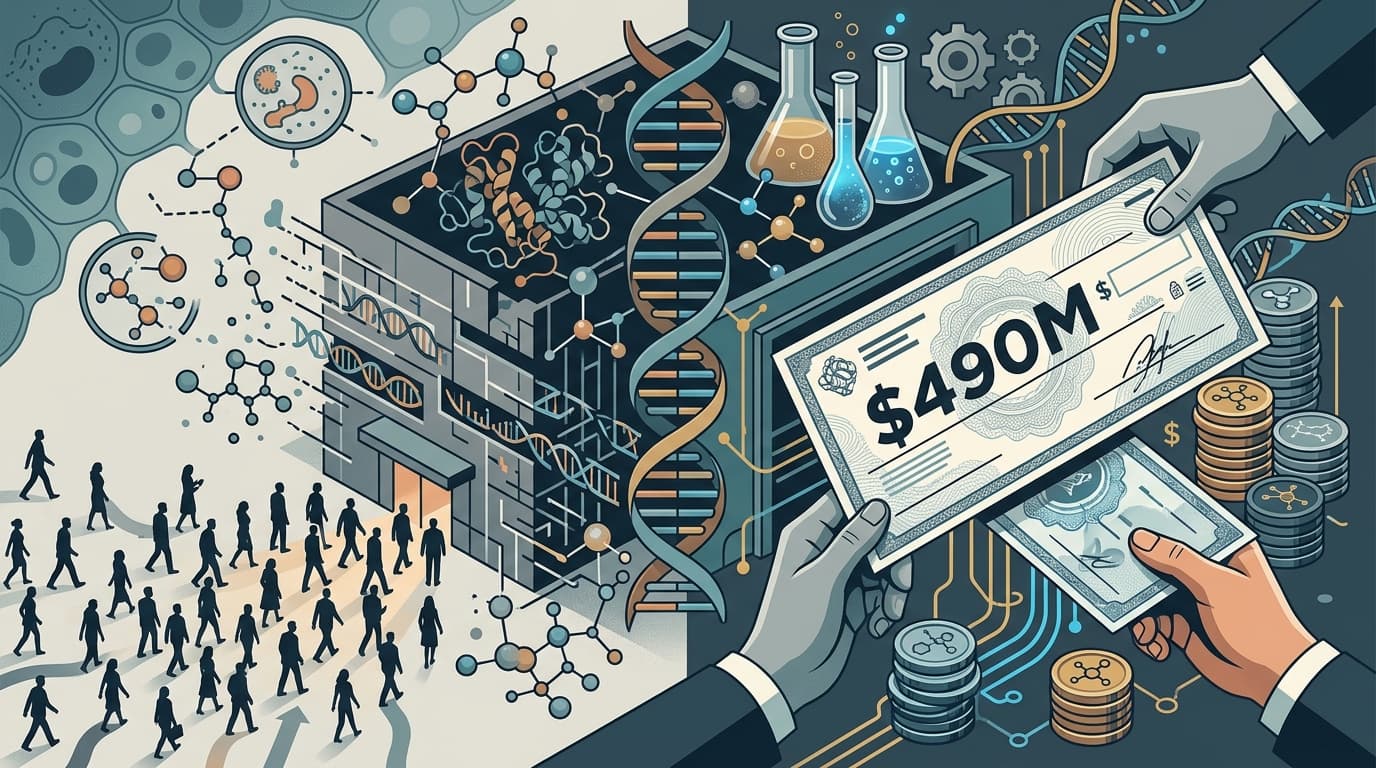
In 2020, a small German startup called Tubulis GmbH raised a €10.7 million Series A. It was a university spin-out from LMU Munich, co-founded by two scientists with a clever idea about how to build better cancer drugs. Six years later, Gilead Sciences just agreed to buy the entire company for up to $5 billion.
That's roughly a 400x markup from first fundraise to acquisition price. Even by biotech standards, that's an absurd trajectory. And it tells you everything you need to know about how badly Big Pharma wants what Tubulis is selling.
The Hottest Three Letters in Oncology
To understand this deal, you need to understand ADCs. An antibody-drug conjugate is basically a guided missile for cancer treatment: you take an antibody (the GPS system that finds tumor cells), attach a toxic payload (the warhead), and connect them with a chemical linker (the glue holding it all together). The antibody delivers the poison directly to the cancer, sparing healthy cells from the worst side effects of traditional chemotherapy.
The concept is elegant. The execution is brutally hard. If the linker isn't stable enough, the payload detaches too early and poisons the wrong cells. If the conjugation chemistry isn't precise, you get a messy batch of drugs that behave unpredictably. First-generation ADCs had real problems with both issues.
Tubulis built its reputation on solving the glue problem. Its proprietary P5 conjugation technology is a cysteine-selective linker chemistry that produces ultra-stable, uniform ADCs. Think of it like the difference between duct-taping a grenade to an arrow versus precision-engineering a smart bomb. Both deliver explosives; only one does it reliably.
What Gilead Is Actually Buying
The deal breaks down into two pieces: $3.15 billion in cash at closing plus up to $1.85 billion in milestone payments tied to future performance triggers. Gilead plans to finance the upfront with cash on hand and new debt. The transaction is expected to close in Q2 2026.
Get tomorrow's biotech intelligence before your competitors.
Join thousands of biotech professionals who start their day with our free, daily briefing.
But Gilead isn't just buying two clinical-stage drugs. It's buying a platform.
Tubulis has two lead candidates in Phase 1/2a trials right now. TUB-030 targets a protein called 5T4 in advanced solid tumors. TUB-040 goes after NaPi2b in platinum-resistant ovarian cancer and non-small cell lung cancer. Behind those sit five more preclinical programs, all built on the same P5 technology.
After the deal closes, Tubulis will operate as a dedicated ADC research and development organization within Gilead, with its Munich headquarters becoming the company's global ADC innovation hub. Gilead isn't absorbing Tubulis into a corporate machine; it's preserving the engine and feeding it rocket fuel.
Gilead's Oncology Shopping Spree
This isn't Gilead's first rodeo with cancer drugs, and it's not even close to its biggest ADC bet. Back in 2020, Gilead paid $21 billion for Immunomedics, which gave it Trodelvy, a first-in-class ADC that became the foundation of its oncology business. The Tubulis deal actually grew out of a collaboration the two companies started in December 2024.
What's striking is the pace of spending. In a matter of weeks during 2026, Gilead also picked up Arcellx for $7.8 billion (cell therapy) and Ouro Medicines for about $2.2 billion. Add Tubulis and you're looking at roughly $15 billion committed to oncology acquisitions in a compressed window. This is a company that built its empire on HIV drugs now betting the farm on cancer.
The strategic logic is straightforward: HIV revenue, while still massive (Gilead is guiding $29.6 to $30.0 billion in total product revenue for 2026), faces long-term headwinds. Every blockbuster eventually meets generic competition. Gilead needs new growth engines, and oncology is where it's planting flags.
Wall Street Shrugged (For Now)
You might expect a $5 billion acquisition to move the stock. It didn't, really. Gilead shares dipped about 2.2% on the announcement day, which is the market equivalent of a polite yawn.
The analyst reaction has been "makes sense, but show me the data." RBC Capital Markets nudged its price target from $118 to $123 while keeping a neutral rating. Other banks like Cantor Fitzgerald, UBS, and Deutsche Bank maintain buy ratings with targets up to $155, but they're pricing the broader HIV and oncology story, not Tubulis specifically.
The concern is simple math. Tubulis has zero approved products and zero revenue. Its most advanced programs are still in early-stage trials. Paying $3.15 billion upfront for clinical-stage assets is, as one industry publication put it, at "the upper end of what investors usually tolerate" for platform-stage oncology deals. The $5 billion total only looks cheap if multiple programs reach the market; it looks expensive if the science doesn't pan out.
The Bigger Picture: ADCs Are Eating Oncology
Tubulis isn't getting this valuation in a vacuum. The entire ADC sector is in a full-blown gold rush.
The global ADC market sits around $15 to $16 billion in 2025 and is projected to hit $28 to $39 billion by 2035, depending on who's counting. Pfizer's $43 billion acquisition of Seagen in 2023 was the starting gun. AbbVie followed with its $10.1 billion purchase of ImmunoGen in 2024. Bristol-Myers Squibb struck a deal with BioNTech worth up to $11.1 billion in 2025, though that deal centers on a bispecific antibody rather than an ADC.
The pattern is clear: every major pharma company wants its own ADC franchise, and the supply of quality platforms is shrinking fast. When demand outstrips supply, prices go up. A company that raised €10.7 million in 2020 and accumulated approximately €495 million in total venture funding can suddenly command a $5 billion exit.
The Bet Behind the Bet
What makes the Tubulis deal fascinating isn't just the price tag. It's what it says about where oncology is heading.
Gilead isn't buying a single drug. It's buying the ability to make drugs: a repeatable chemistry platform that can generate candidate after candidate. In a world where individual clinical programs fail all the time (roughly 95–97% of cancer drugs in trials never reach patients), owning the factory matters more than owning any single product.
The risk is real. Clinical-stage biotech is inherently uncertain, and $3.15 billion is a lot of money to park in "maybe." But Gilead is clearly betting that the ADC wave has a long way to run, and that the companies building the best tools will be worth far more than anyone paying today.
A Munich startup born from a university lab just became the centerpiece of one of pharma's most aggressive oncology strategies. Not bad for six years of work.
Funding & Financings
5 min read
The Gene Editing Company That Wants to Replace Your Cholesterol Meds
A gene editing startup co-founded by a Nobel laureate just filed to go public, and it's not chasing rare diseases. Scribe Therapeutics wants to use CRISPR to replace your daily cholesterol pills with a single dose that silences the genes behind heart disease.