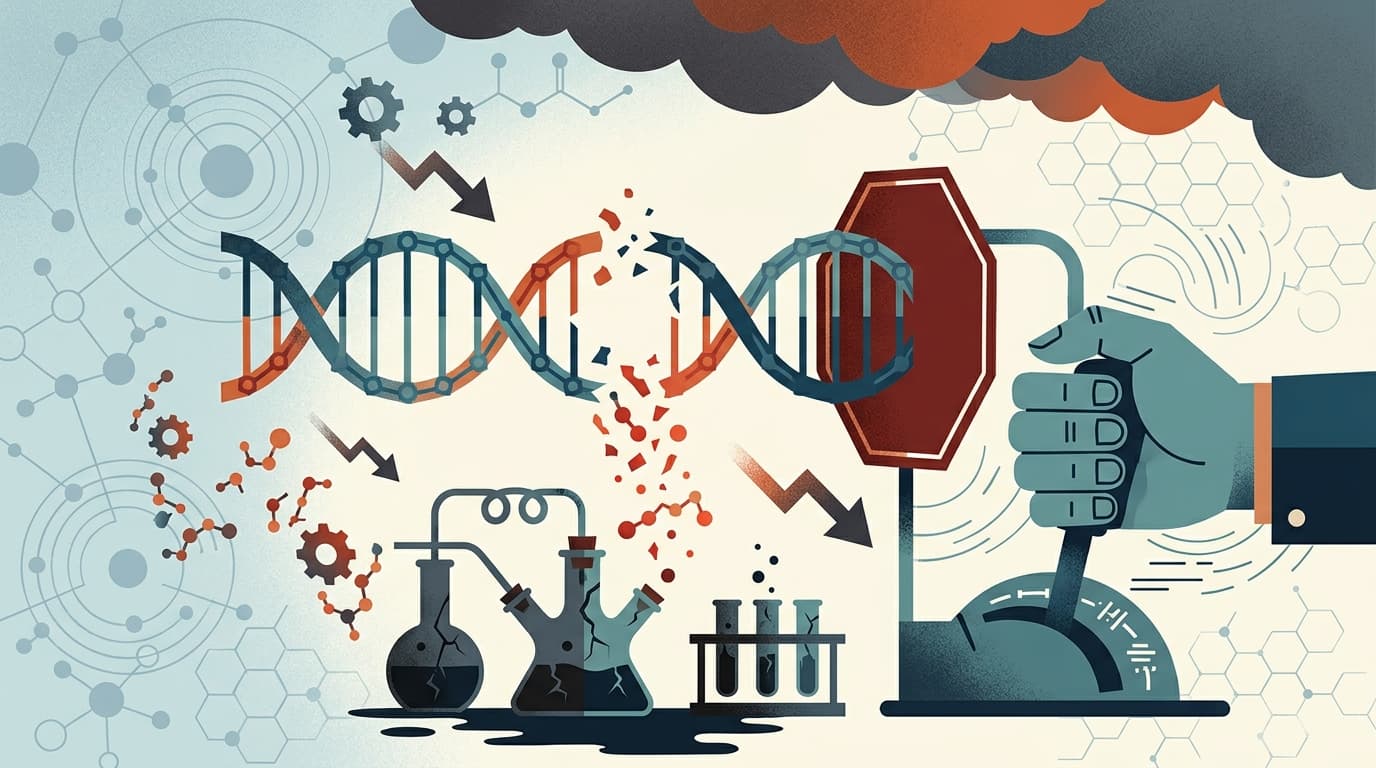
Sarepta slapped a black box warning on its flagship Duchenne gene therapy after two children died of liver failure, then cut 36% of its workforce. The crisis isn't just about one company; it's exposing a safety problem that haunts the entire AAV gene therapy field.
Two children received a gene therapy that was supposed to save their lives. They died of liver failure instead.
That's the reality Sarepta Therapeutics is now confronting, and it's reshaping everything: the company's future, its workforce, and possibly the entire trajectory of gene therapy for neuromuscular disease. On the heels of an FDA investigation, Sarepta slapped a black box warning (the most serious safety label the FDA can require) onto its flagship Duchenne muscular dystrophy treatment, Elevidys. Then it announced 500 layoffs. The stock is in free fall. And the questions facing the company don't have easy answers.
This isn't just a Sarepta story. It's a stress test for one of medicine's most ambitious ideas.
The Promise That Turned Into a Crisis
Elevidys (delandistrogene moxeparvovec, if you want the tongue-twister) was supposed to be a landmark. It's a gene therapy designed to deliver a shortened version of the dystrophin protein to boys with Duchenne muscular dystrophy, a devastating genetic disease that progressively destroys muscle tissue. Think of dystrophin as the shock absorber in your muscles; without it, every movement causes a little more damage. Most boys with Duchenne lose the ability to walk by their early teens and face life-threatening complications by their twenties.
The therapy uses an AAV vector (essentially a hollowed-out virus repurposed as a delivery truck) to ferry a working gene into muscle cells. It sounded like science fiction when Sarepta first started developing it. And in June 2023, the FDA granted Elevidys accelerated approval, a fast-track pathway based on promising early biomarker data showing that the therapy could produce micro-dystrophin protein in patients' muscles.
There was a catch, though. The confirmatory trial, called EMBARK, was supposed to prove the therapy actually helped kids move better. It didn't. The primary endpoint measured patients on a 34-point movement scale, and the treated group improved by just 0.65 points more than placebo. That gap wasn't statistically significant. Europe's drug regulator, the EMA, concluded the study "failed to show a meaningful effect on movement abilities."
Get tomorrow's biotech intelligence before your competitors.
Join thousands of biotech professionals who start their day with our free, daily briefing.
So even before the safety crisis erupted, Elevidys was standing on thin clinical ice.
When Liver Failure Changed Everything
The safety signals started surfacing in mid-2025, and they were alarming. The FDA reported two fatal cases of acute liver failure in non-ambulatory pediatric males (boys who had already lost the ability to walk) treated with Elevidys. Both patients developed sharply elevated liver enzymes and were hospitalized within two months of their infusion. Neither survived.
By June 2025, the FDA had launched a formal investigation. Sarepta voluntarily suspended U.S. distribution of Elevidys for non-ambulatory patients while the review played out. And by November 2025, the FDA had made its decision: a new boxed warning for acute serious liver injury and acute liver failure, including fatal outcomes, plus a narrowed indication that restricted the therapy to ambulatory patients aged four and older.
The non-ambulatory indication was simply removed from the label.
For families who had pinned their hopes on Elevidys, especially for boys who could no longer walk, the news was devastating. For Sarepta, it was an existential blow. The company also got hit with a new requirement: a postmarketing observational study of roughly 200 patients followed for at least 12 months, with weekly liver function tests for three months after every infusion.
And then, in a grim escalation, the FDA broadened its review to other Sarepta AAVrh74 gene therapies after a total of three deaths potentially related to these products were reported, including one adult death in a limb-girdle muscular dystrophy trial. The investigation isn't just about one drug anymore; it's about the platform.
500 People Just Lost Their Jobs
When a biotech's flagship product goes into crisis, the financial math changes fast. Sarepta made that painfully clear by announcing roughly 500 job cuts, which represents about 36% of its entire workforce.
The restructuring isn't just about headcount, either. Sarepta is pausing several pipeline programs and redirecting resources toward its highest-priority assets. The company framed the moves as necessary to protect cash flow and manage convertible debt due in 2027, a looming financial obligation that doesn't care about your clinical setbacks.
The numbers tell a survival story. Sarepta expects to save about $120 million annually from the workforce reduction alone. Pipeline reprioritization should add another $300 million per year in non-personnel savings. All told, the restructuring targets roughly $400 million in total annual cost savings, with one-time severance charges estimated between $32 million and $37 million.
That's a company in triage mode, cutting deep to stay alive long enough to figure out what comes next.
Wall Street Is Playing Hot Potato
Sarepta's stock chart in September 2026 looks like a heart monitor during a panic attack. The shares closed at about $22.02 on September 9, dropped to $20.52 the very next day, and closed near $20.45 on September 11. The market cap has shrunk to roughly $2.16 billion, a far cry from the company's peak valuation when gene therapy optimism was running high.
Analyst sentiment is all over the map. The consensus target sits around $25 to $26, which implies some upside from current prices, but the wide spread in price targets tells you nobody really knows where this goes.
One telling detail: when Novartis recently reported a failed trial for a muscle-wasting disorder, both Sarepta and Dyne Therapeutics got dragged down in the selloff. That kind of guilt-by-association trading reveals just how fragile investor confidence has become across the entire rare-disease gene therapy sector.
A Problem Bigger Than Sarepta
This is where the story gets uncomfortable for the whole field. The liver toxicity seen with Elevidys isn't a one-off fluke. It's part of a pattern that keeps repeating across AAV-based gene therapies, especially those that use high-dose systemic delivery (flooding the entire body with viral vectors rather than targeting a specific tissue).
Consider the track record. Onasemnogene abeparvovec (Zolgensma), the gene therapy for spinal muscular atrophy, has seen its own serious safety signals, including cases of thrombotic microangiopathy (a dangerous blood-clotting condition) and fatal outcomes. Other AAV programs for conditions like X-linked myotubular myopathy have faced similar tragedies.
The common thread is that when you inject massive quantities of a viral vector into the bloodstream, the immune system sometimes responds with catastrophic force. The liver, which filters blood and processes foreign particles, takes the brunt of the hit. Think of it like sending a fleet of delivery trucks through a city's downtown all at once: even if each truck is carrying something helpful, the sheer volume can cause a traffic jam that shuts everything down.
FDA materials highlight that the most dangerous events cluster around systemic high-dose delivery, where immune activation against the viral shell or the gene it carries can damage the liver, kidneys, heart, or blood vessels. The risk varies by vector type, dose, disease population, and whether patients have pre-existing liver or immune vulnerabilities. But it's clearly a platform-wide concern, not a single company's manufacturing error.
What Happens Now
Sarepta faces a narrow path forward. Elevidys still has an approved indication for ambulatory Duchenne patients, but the boxed warning, the restricted label, and the shadow of two pediatric deaths make every new prescription an act of careful risk-benefit calculation for clinicians and families.
The company's later EMBARK data (year-two and year-three follow-up results) reportedly showed some functional and safety signals that were more encouraging than the failed primary endpoint. Whether those longer-term trends are enough to rebuild confidence, both medical and commercial, remains an open question.
For the broader gene therapy field, the Sarepta crisis is accelerating a reckoning that's been building for years. Investors are demanding clearer evidence that AAV therapies work and that they're safe. Regulators are tightening oversight. And families facing terrible diseases are caught in the middle, weighing hope against risk in the most personal calculation imaginable.
The dream of gene therapy, fixing broken genes with a single infusion, hasn't died. But the idea that it would be simple? That's gone. The field now has to prove it can deliver on its promise without the kind of tragedy that brought Sarepta to its knees. Because when the patients are children, the margin for error isn't just small. It's zero.
4 min read
J&J Just Locked Down a $5 Billion Drug Until 2035. Generics Can't Touch It.
A federal court just blocked generic Spravato until 2035, handing J&J a decade of exclusivity on a drug headed toward $5 billion in peak sales. For generics companies, the ruling is a costly warning shot.