Moderna and Merck's personalized mRNA cancer vaccine just became the first of its kind to win a Phase 3 trial, and the entire biotech industry is rethinking what's possible. The catch? Every single dose has to be built from scratch for each patient.
A Seven-Year Bet Just Paid Off
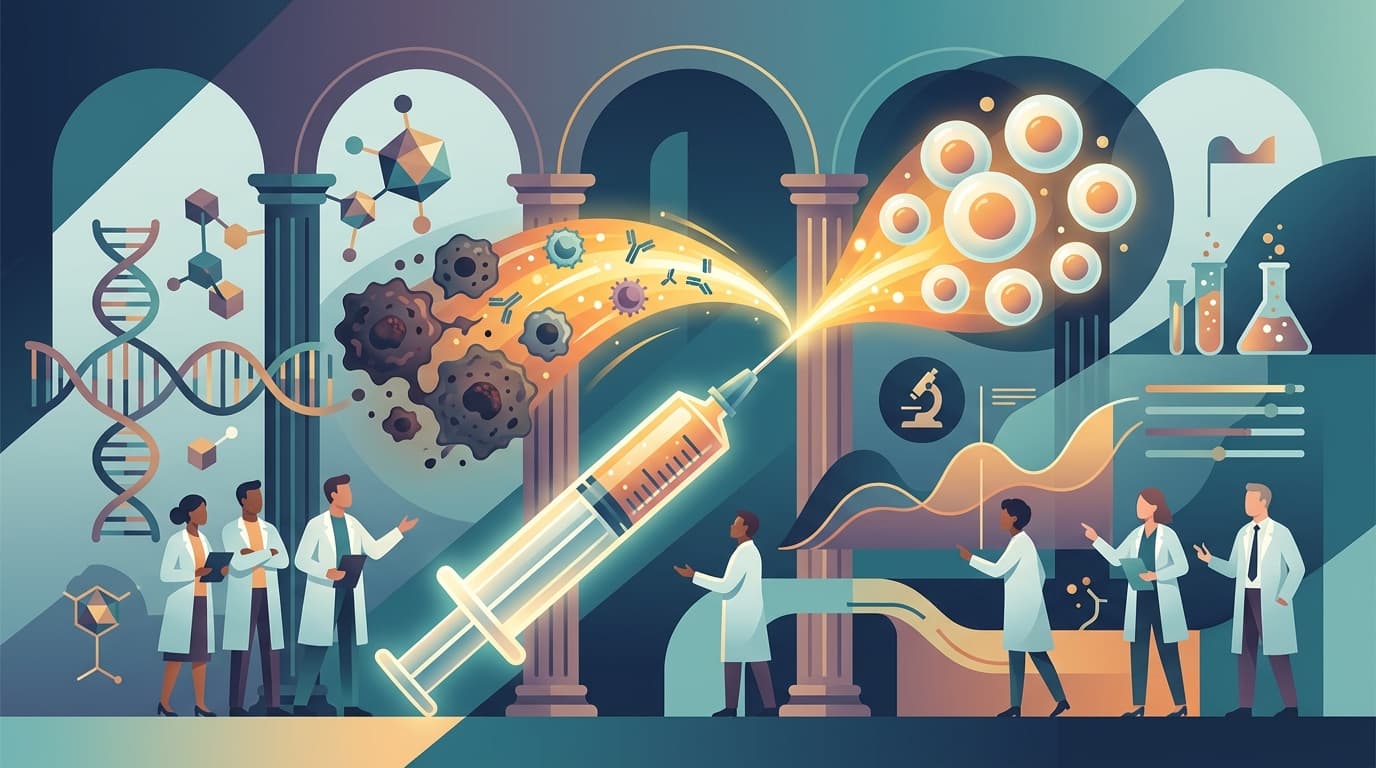
Imagine getting a vaccine made just for you. Not a one-size-fits-all shot, but a custom-built molecular weapon designed to hunt down your specific cancer. That's exactly what Moderna and Merck just proved works in the biggest test of its kind.
Their personalized mRNA cancer vaccine, intismeran autogene, hit both major goals in a Phase 3 trial involving 1,137 patients with high-risk melanoma. It's the first individualized neoantigen therapy to report positive results at this stage. And the biotech world is losing its mind over what comes next.
What Actually Happened
The trial, called INTerpath-001, tested a simple but radical idea. After surgeons remove a patient's melanoma, what if you could train the immune system to recognize and destroy any cancer cells left behind?
Patients were randomly split into two groups (at a 2:1 ratio). One group got intismeran plus Merck's blockbuster immunotherapy Keytruda. The other got Keytruda alone. The vaccine was given at 1 mg every three weeks for up to nine doses, alongside Keytruda every six weeks.
The primary endpoint was recurrence-free survival: how long patients lived without their cancer coming back. The vaccine combo beat Keytruda alone on that measure and on a key secondary goal, distant metastasis-free survival, which tracks whether cancer spreads to other organs. No new safety concerns popped up either.
Full data haven't dropped yet (those are coming at an upcoming medical conference), but the topline results were enough to trigger some serious excitement.
How You Build a Vaccine for One Person
This is where things get wild. Traditional vaccines use the same ingredients for everyone. Intismeran takes a completely different approach, one that's more like a tailor making a bespoke suit than a factory stamping out T-shirts.
First, doctors sequence the DNA from a patient's tumor. Then algorithms identify up to 34 unique mutations, called (proteins found only on that patient's cancer cells). Moderna's mRNA platform encodes those neoantigens into a single vaccine. When injected, the patient's own cells start producing those proteins, training the immune system to seek and destroy anything displaying them.
Get tomorrow's biotech intelligence before your competitors.
Join thousands of biotech professionals who start their day with our free, daily briefing.
neoantigens
Every single dose is different. Your vaccine is literally yours and nobody else's.
The Long Road to Overnight Success
This wasn't some lucky moonshot. The program has been building evidence since 2019, when the Phase 2b trial (KEYNOTE-942) first enrolled patients with resected high-risk melanoma.
By 2022, early results showed a 44% reduction in the risk of recurrence or death compared to Keytruda alone. The data kept maturing. By 2026, five-year follow-up from that Phase 2 study showed an even stronger 49% reduction in recurrence risk. The FDA noticed, granting Breakthrough Therapy Designation. Europe's EMA gave it PRIME status, their version of a fast-track endorsement.
The Phase 3 trial was essentially the final exam. And the vaccine passed.
Analysts didn't hold back. RBC Capital Markets called it a "major win," noting the data were strong enough to hit statistical significance at the interim analysis (meaning the trial succeeded before it was even finished collecting data). TD Cowen went further, calling it a "landmark moment" for the entire technology platform.
William Blair viewed the results as clearly positive for Moderna's stock and broader business. For Merck, the timing is strategic: Keytruda's patents will eventually expire, and a next-generation cancer franchise built around personalized vaccines could soften that blow.
Not everyone was popping champagne, though. Leerink Partners cautioned that the market's enthusiasm might be running ahead of the vaccine's realistic sales potential. That skepticism isn't unreasonable; commercializing a product this complex is a whole different challenge from proving it works.
The Manufacturing Problem Nobody Wants to Talk About
And here's the catch. Making a bespoke vaccine for every single cancer patient is, to put it mildly, a logistical nightmare.
Think about it: tumor biopsy, DNA sequencing, computational neoantigen selection, mRNA synthesis, formulation into lipid nanoparticles, quality control, cold-chain shipping. All of it has to happen fast enough that the patient can actually start treatment in time. Each dose is essentially a batch size of one.
That's the opposite of how pharmaceutical manufacturing works. Drugmakers love scale. They love producing millions of identical doses. Personalized vaccines flip that model upside down. The market for personalized cancer vaccines sits at roughly $404 million today, but analysts project it could balloon to $12.3 billion by 2035, if the manufacturing puzzle gets solved.
Cold-chain logistics, regulatory compliance across different countries, and ongoing patent disputes around lipid nanoparticle technology all add layers of complexity. This is the part where having Merck's global infrastructure matters enormously.
The Bigger Picture: Who Else Is in the Race?
Moderna and Merck just planted the flag, but they're not alone on the mountain. BioNTech and Genentech (Roche) are the closest direct rival, running their own personalized neoantigen vaccine, autogene cevumeran, through multiple mid-stage trials. If you remember BioNTech from a certain pandemic, you know they have mRNA manufacturing chops.
Gritstone Bio is taking a different angle with self-amplifying mRNA and shared-antigen approaches (targeting common mutations like KRAS rather than building a unique vaccine per patient). CureVac, Arcturus, and a handful of others are earlier in development.
But none of them have Phase 3 data. That distinction belongs solely to intismeran, and in drug development, being first with proof matters.
Why This Is a Big Deal Beyond Melanoma
The INTerpath-001 win is about melanoma today, but the implications stretch far wider. Moderna already has a Phase 3 trial running in non-small cell lung cancer using the same platform.
If the concept works across tumor types (and the Phase 2 biology suggests it should, since every solid tumor has unique mutations), this could become an entirely new pillar of cancer treatment. Not chemo. Not radiation. Not even traditional immunotherapy alone. A vaccine built from your own tumor's weaknesses, deployed to prevent your cancer from ever coming back.
We're still waiting for the detailed data, the subgroup analyses, and ultimately the overall survival numbers. Those will determine whether intismeran becomes a standard of care or a niche option. But after seven years of development and one very convincing Phase 3 readout, the idea of a personalized cancer vaccine has officially graduated from "cool science" to "this might actually work at scale."
The mRNA revolution didn't end with COVID. It might have just found its real calling.
4 min read
Exelixis Was Three Months From an Answer. Then the FDA Hit Pause.
The FDA just pushed back its decision on Exelixis' colorectal cancer combo by three months, and analysts are surprised. With tightening regulatory standards for combination oncology drugs and a crowded competitive landscape, the stakes of this delay go well beyond one company's pipeline.