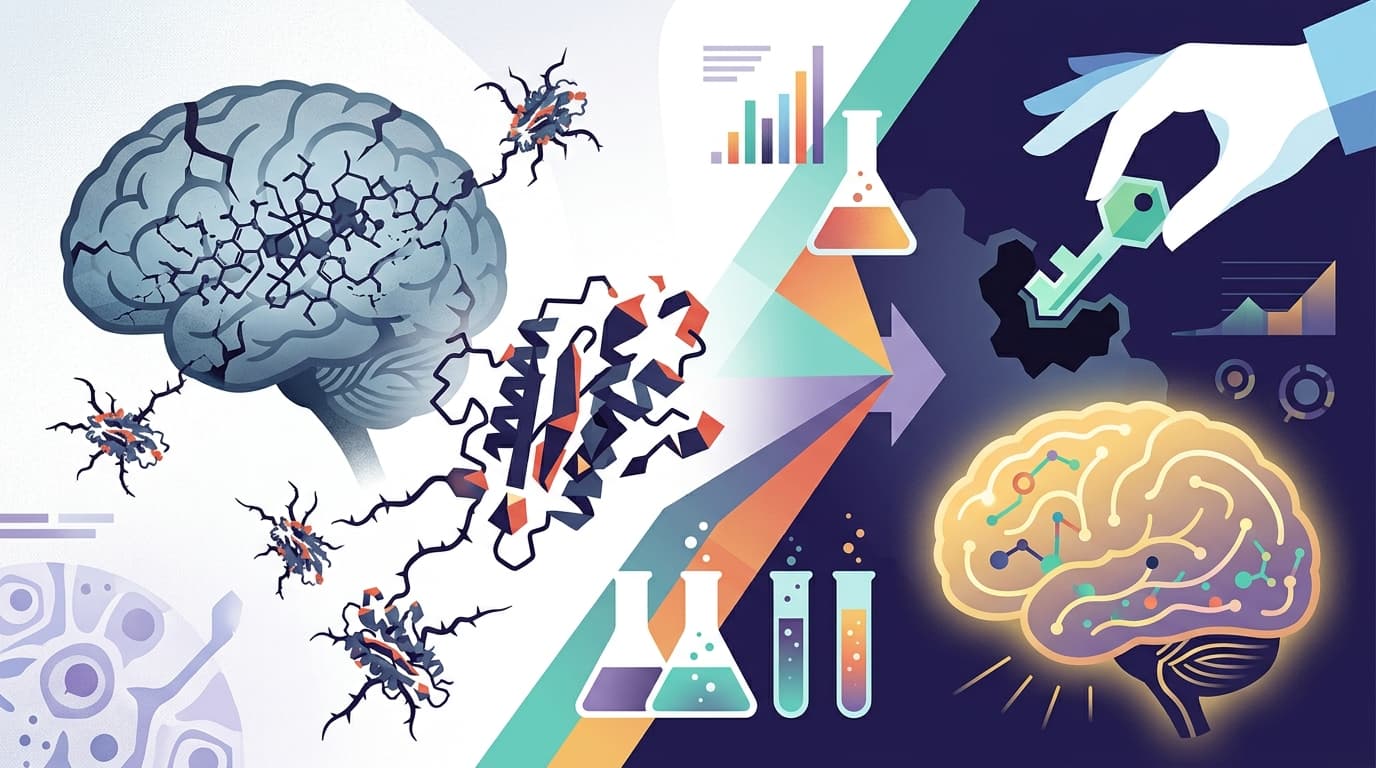

UCSF scientists identified a single protein, FTL1, that drives brain aging in mice, and reducing it actually reversed cognitive decline. In a field obsessed with slowing aging, this is the first target that put the car in reverse.
Your brain is getting slower, and it's not just because you stayed up too late. Scientists at UC San Francisco just identified a single protein that acts like a dimmer switch on your brain, gradually turning down the lights as you age. The kicker? They figured out how to flip it back on.
The protein is called FTL1, and it accumulates in the hippocampus (the brain's memory center) as you get older. Think of it like limescale building up in your pipes. A little bit is harmless. But over time, it gunks up the works until nothing flows the way it should.
Published in August 2025 in Nature Aging, the study from Saul Villeda's lab at UCSF tracked what happens when FTL1 levels creep up in aging mice. The results paint a grim picture: weakened connections between neurons, simplified brain cell structures, sluggish cellular metabolism, and declining memory. Basically, FTL1 turns a young, bustling brain into one that's running on power-save mode.
But what makes this discovery remarkable isn't the bad news. It's what happened when they tried to undo it.
The UCSF team ran a clever series of experiments to prove FTL1 was the culprit, not just a bystander.
First, they boosted FTL1 in young mice. These mice, which should have been in their cognitive prime, started showing signs of aging. Their neurons developed simplified, stubby extensions instead of the complex branching networks you'd see in a healthy young brain. Memory performance tanked. It was like giving a 25-year-old the brain of a retiree.
Then came the reversal. Researchers reduced FTL1 levels in older mice, and something extraordinary happened. Synaptic connections (the bridges neurons use to talk to each other) started rebuilding. Memory performance improved. Metabolic function recovered. Villeda described it as a "true reversal of impairments," not just hitting the brakes on decline, but actually backing up the car.

Boehringer Ingelheim just named ADCs and T-cell engagers as its top M&A targets, adding another deep-pocketed buyer to oncology's most competitive shopping aisle. With nearly EUR 6.4 billion in annual R&D spending, the privately held pharma giant is about to make the bidding wars even more intense.


Join thousands of biotech professionals who start their day with our free, daily briefing.
That distinction matters enormously. Most aging research focuses on slowing things down. This study suggests you might actually be able to rewind.
FTL1 doesn't just weaken brain connections directly. It also drags down the energy metabolism of hippocampal cells, starving them of the fuel they need to function properly.
Think of your brain cells like a city's power grid. FTL1 is essentially shutting down power plants one by one. The lights stay on for a while, but eventually, whole neighborhoods go dark. The UCSF team found that treating cells with metabolism-boosting compounds countered FTL1's negative effects on metabolism and normalized neurite growth. This opens up a second avenue for potential therapies: instead of (or in addition to) targeting FTL1 itself, you could simply give the brain's power grid a backup generator.
It's a two-pronged approach, and both prongs look promising in preclinical work.
Brain aging research has been having a moment. In January 2026, scientists identified another protein called DMTF1 that can rejuvenate neural stem cells when boosted. A Stanford study from mid-2025 pinpointed ribosome collisions (essentially traffic jams in the protein-building machinery) as a major driver of age-related brain decline. And Johns Hopkins researchers discovered that more than 200 types of misfolded proteins, far beyond the usual suspects like amyloid plaques, contribute to cognitive decline.
The FTL1 finding is different for one critical reason: reducing a single protein has been shown to reverse, not just slow, age-related cognitive impairment. That's the holy grail distinction. Plenty of targets can pump the brakes. FTL1 is one where the car actually goes in reverse.
If you're wondering whether anyone is going to try to turn this into a drug, the answer is almost certainly yes. The anti-aging biotech market hit roughly $85 billion in 2025 and is projected to exceed $120 billion by 2030. Longevity startups pulled in approximately $3.74 billion in funding in 2023, and that funding has continued flowing through partnerships and venture capital.
Companies are already circling adjacent targets. Halia Therapeutics is going after inflammaging (chronic, low-grade inflammation linked to brain aging) by blocking specific protein interactions. BioAge Labs has partnered with Novartis to develop therapies targeting metabolic and inflammatory pathways tied to aging. Altos Labs, armed with around $3 billion in initial funding, is pursuing epigenetic reprogramming to reverse cellular aging and preparing for clinical trials.
A clean, single-protein target like FTL1 with a demonstrated reversal mechanism? That's catnip for pharma business development teams.
Let's be honest about the limitations. This is a mouse study. Mice are not humans, and the history of neuroscience is littered with findings that looked incredible in rodents and then went nowhere in clinical trials. The UCSF team didn't draw direct connections to specific neurodegenerative diseases like Alzheimer's, though the hippocampal changes they observed are certainly relevant to those conditions.
Translating "reduce FTL1 in the brain" into an actual human therapy is a monumental challenge. You'd need a way to deliver the treatment across the blood-brain barrier, target the right cells, and avoid unintended consequences. FTL1 presumably exists for a reason; you can't just delete proteins willy-nilly without checking what else they're doing.
The path forward likely runs in two parallel tracks. One involves developing drugs or genetic tools that directly lower FTL1 levels in the brain. The other focuses on the metabolic angle, finding compounds that can counteract FTL1's energy-sapping effects without touching the protein itself.
Neither track will produce a pill you can buy at CVS anytime soon. But the scientific foundation here is unusually solid: a clearly identified target, a demonstrated mechanism, and a proven reversal in animal models. That's more than most aging research can claim.
For an industry that has spent decades chasing amyloid plaques with limited success, a fresh target that actually reverses cognitive decline feels like finding a new door in a room everyone assumed had been fully searched. The door is open. Now someone has to walk through it.
A stealthy oncology startup just burst onto the scene with $100 million and a platform that claims to solve one of cancer drug development's oldest problems. The investors backing Stipple Bio read like a who's who of biotech venture capital, but the company hasn't even named its target yet.