
Insilico Medicine just dosed the first patient in the world's first Phase III trial of a drug designed entirely by AI. Rentosertib, a generative-AI-created molecule for a devastating lung disease, is now the closest any AI-designed drug has come to regulatory approval.
For years, the AI drug discovery industry has been making big promises and collecting even bigger checks. Dozens of startups have pitched investors on the dream: let algorithms design medicines faster, cheaper, and smarter than humans ever could. But none of them have actually proven the drugs work in a large, late-stage clinical trial.
That just changed.
On September 9, 2026, Insilico Medicine dosed the first patient in GENESIS-IPF-3, the world's first Phase III trial of a drug designed entirely by generative AI. The drug is called rentosertib, and it's being tested against idiopathic pulmonary fibrosis (IPF), a brutal lung disease that gradually turns healthy tissue into scar tissue until patients can barely breathe.
Phase III is the final and most important stage of clinical testing before a company can seek regulatory approval. Think of it as the championship game. Plenty of drugs look good in early rounds, but Phase III is where most contenders get knocked out. The fact that an AI-designed molecule made it this far? That's a first for the entire industry.
IPF is a cruel disease. Your lungs slowly stiffen with scar tissue, and your breathing gets worse over time. The current standard-of-care drugs, nintedanib and pirfenidone, can slow the decline, but they don't stop it. They definitely don't reverse it. And the side effects (liver problems, nausea, diarrhea) make many patients miserable. A newer option called nerandomilast was approved in October 2025, but the core problem remains: nothing on the market can actually halt the fibrosis.
Rentosertib takes a different approach. It blocks a protein called TNIK, which acts like a master switch for several fibrosis-related pathways in the body. When TNIK is active, it flips on processes that promote scarring, inflammation, and the transformation of healthy cells into the fibrous cells that destroy lung tissue. By shutting down that switch, rentosertib aims to hit fibrosis from multiple angles at once.

Novartis's $12 billion RNA therapy bet just failed its biggest clinical test in a rare muscle disease, dragging down an entire sector's stocks with it. The result exposes a stubborn problem: getting RNA drugs to actually reach muscle tissue remains one of biotech's hardest unsolved challenges.


Join thousands of biotech professionals who start their day with our free, daily briefing.

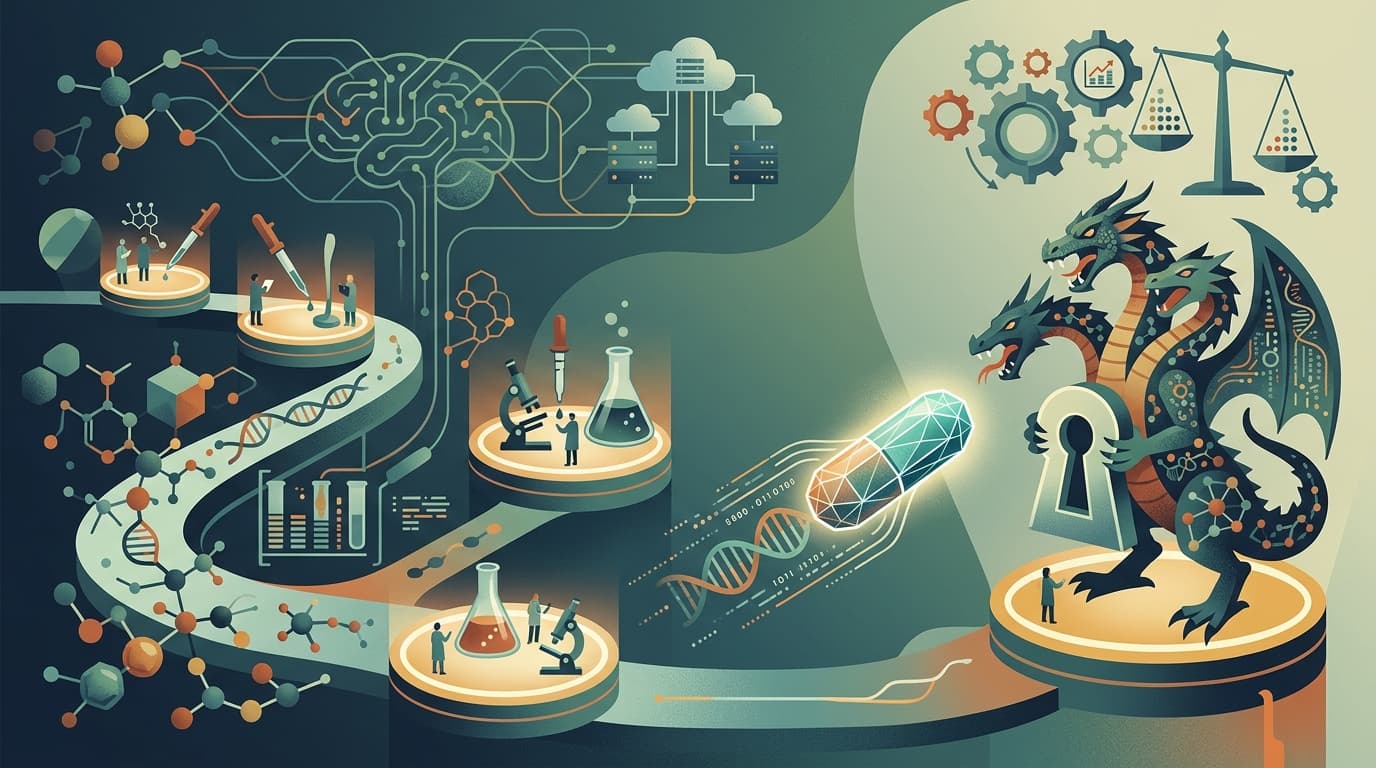
What makes the story unusual is how the drug was created. Insilico didn't just use AI to speed up one step of the process. Its platform, PandaOmics, first identified TNIK as a promising target. Then a second AI system, Chemistry42, generated and optimized the actual molecule to block it. The whole journey from target discovery to preclinical candidate took roughly 18 months, a timeline that would normally stretch to four or five years using traditional methods.
Rentosertib didn't just skip to Phase III on hype alone. It earned its spot.
The earlier Phase I trial in healthy volunteers showed solid safety and clean pharmacokinetics (how the drug moves through the body). Then came the Phase IIa trial, a double-blind, placebo-controlled study in 71 IPF patients across 22 sites in China. The results, published in Nature Medicine in 2025, were genuinely encouraging.
Patients on the 60 mg once-daily dose saw their forced vital capacity (FVC, a key measure of lung function) improve by an average of 98.4 mL over 12 weeks. The placebo group, meanwhile, declined by 20.3 mL. That's a meaningful swing. Safety looked manageable too: adverse events were similar across all groups, including placebo. The most notable side effects were liver-related issues and diarrhea, and the liver problems showed up mainly in patients who were also taking nintedanib.
GENESIS-IPF-3 is designed to answer the question that Phase II couldn't: does this actually work over a long period of time, in a larger group of patients?
The trial will enroll 320 patients across 47 centers in China. It's randomized, double-blind, and placebo-controlled; the gold standard of clinical trial design. Patients will take rentosertib or placebo once daily for 52 weeks, a full year.
The primary endpoint is the annual rate of decline in FVC. In plain English: how much lung function do patients lose over a year? The key secondary endpoint tracks the time until a patient experiences any disease progression event. Professor Zuojun Xu is leading the study, with Academician Nanshan Zhong and President Chang Chen serving as co-leading principal investigators.
The first two patients were dosed at Peking Union Medical College Hospital and Shanghai Pulmonary Hospital on the same day. If the trial succeeds, rentosertib would become the first AI-designed drug to potentially reach regulatory approval.
This isn't just an Insilico story. It's a litmus test for the entire AI drug discovery sector.
Consider the landscape: there are now over 173 AI-discovered drug programs in clinical development globally, with roughly 24 in Phase II and at least 3 at the pivotal stage. But no AI-designed drug has been approved by the FDA or any other major regulator as of mid-2026. The industry has raised billions of dollars on the promise that AI can revolutionize how medicines are made. Rentosertib is the closest any company has come to proving that promise in the real world.
Insilico's competitors aren't exactly close behind. Recursion's REC-4881 is in Phase 1b/2 for familial adenomatous polyposis. Exscientia has clinical-stage programs, but nothing beyond early development. Absci remains largely in preclinical territory. Insilico has a clear lead.
The company has raised over $400 million to get here, with backers including Warburg Pincus, Sequoia Capital, Fidelity, and Temasek. Its $2.75 billion deal with Eli Lilly in March 2026, which included a $115 million upfront payment, was one of the biggest validation moments in AI drug discovery history. Founded in 2014 by Alex Zhavoronkov, Insilico has quietly transformed from a Baltimore startup into a unicorn-scale clinical-stage company.
For a decade, AI drug discovery has been the "next big thing" in biotech. Conferences have been packed with flashy presentations about how algorithms would transform medicine. Investors have poured billions into the space. But the hardest question has always lingered: can these AI-designed molecules actually survive the brutal gauntlet of clinical trials?
Rentosertib is about to answer that question. If it succeeds in Phase III, it won't just help IPF patients who desperately need better options. It will validate an entirely new way of making drugs, one where algorithms do the creative heavy lifting that used to take armies of chemists years to accomplish.
If it fails? The AI drug discovery hype cycle might need a serious reality check. Either way, we'll know a lot more in about a year.
ARPA-H just bet $62.7 million that an AI can manage heart failure patients around the clock, prescribing drugs and ordering tests without waiting for a doctor. If it works, it could reshape how we treat the fastest-growing heart condition in America.