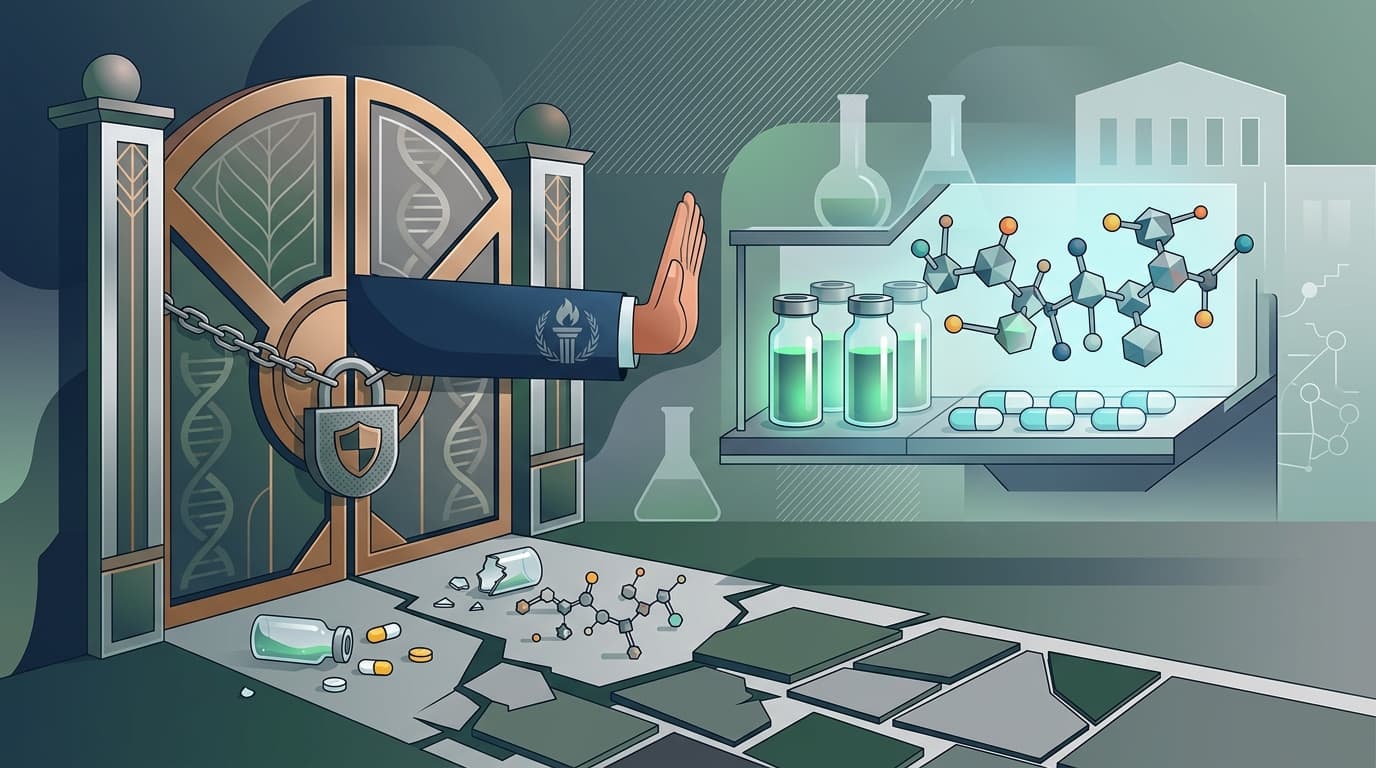
The FDA Just Slammed the Door on Cheap Liraglutide
The FDA just proposed keeping liraglutide off the 503B Bulks List, potentially blocking compounding pharmacies from making cheaper versions of Saxenda and Victoza at scale. With semaglutide and tirzepatide getting the same treatment, the entire compounded GLP-1 market is under threat.
Imagine you've been buying perfectly good coffee from a local roaster for half the price of Starbucks. Now imagine the government steps in and says, "Actually, only Starbucks can sell this blend." That's roughly what just happened to millions of patients relying on compounded versions of a popular weight-loss and diabetes drug.
On May 1, 2026, the FDA published a Federal Register notice delivering a tentative verdict: liraglutide will not be added to the 503B Bulks List. If that sentence means nothing to you, don't worry. It means everything to the compounding pharmacies that have been producing cheaper versions of liraglutide (the active ingredient in Novo Nordisk's Saxenda and Victoza) for patients who can't afford or access the brand-name versions.
The decision didn't come alone, either. The agency proposed the same exclusion for semaglutide and tirzepatide, the blockbuster ingredients behind Ozempic, Wegovy, Mounjaro, and Zepbound. In other words, the FDA is trying to shut down the entire compounded GLP-1 buffet in one move.
What the 503B List Actually Is (And Why It Matters)
Think of the 503B Bulks List as a VIP guest list for drug ingredients. If a bulk substance makes the list, large-scale compounding facilities (called outsourcing facilities, or 503B facilities) can legally use it to produce medications without individual patient prescriptions. It's how compounders scale up production and serve thousands of patients at once.
Getting on the list requires one thing above all else: demonstrated clinical need. The FDA has to be convinced that approved commercial products aren't cutting it for certain patient populations, whether because of allergies, dosing limitations, or some other medical gap.
The FDA's evaluation follows a structured process. First, someone nominates a substance. Then the agency publishes a Federal Register notice with its reasoning, opens a public comment period of at least 60 days, and eventually issues a final decision. The agency applies what it calls a "balancing test," weighing safety risks, effectiveness evidence, historical use, and available alternatives.
Get tomorrow's biotech intelligence before your competitors.
Join thousands of biotech professionals who start their day with our free, daily briefing.
For liraglutide, the FDA reviewed nominations, public comments, and an April 2026 memo. Its conclusion was blunt: no clinical need exists for outsourcing facilities to compound liraglutide from bulk drug substances.
The FDA's Argument: "You Don't Need This"
The agency's rationale boils down to a single idea. FDA-approved liraglutide products (Saxenda for weight management, Victoza for type 2 diabetes) aren't medically unsuitable for patient populations. Compounded versions from raw ingredients don't fill a genuine clinical gap.
Nominators tried several angles. They argued for alternative strengths, custom titration schedules, microdosing, oral or buccal delivery forms, different excipients, and novel container systems. The FDA rejected every single one as insufficient evidence of need.
Perhaps the most telling part: the FDA explicitly said that supply shortages, cost, and convenience don't count as clinical need under its 503B analysis. Those concerns get handled through a separate process (the drug shortage list). It's a bit like telling someone who can't afford a Tesla that the solution isn't building a cheaper electric car; it's applying for a rebate.
FDA Commissioner Marty Makary framed the decision as protecting patients and upholding the integrity of the drug approval process when approved products are available.
The Irony of Timing
Here's where things get awkward. Novo Nordisk has been dealing with manufacturing delays, and resupply estimates have slipped repeatedly.
Saxenda is generally available, though demand surges since 2022 have caused sporadic pharmacy-level shortages in at least 12 countries. Meanwhile, generic liraglutide from Teva (launched in mid-2024) and Meitheal (April 2025) have helped, with more generics expected after February 2026.
So the FDA is saying there's no clinical need for compounded liraglutide while the branded version has faced supply challenges. The agency's position is that shortages are a temporary, separate issue handled by different rules. Compounders see it differently: they filled the gap when Novo Nordisk couldn't keep up, and now they're being told to stop.
A Billion-Dollar Industry Under Siege
This decision doesn't exist in a vacuum. It's the latest salvo in the FDA's broader crackdown on compounded GLP-1 medications, which became enormously popular in recent years.
Telehealth platform Hims & Hers derived 33% of its Q4 2024 revenue (about $162 million) from GLP-1 products.
The FDA started tightening the screws in late 2024. It declared tirzepatide shortages resolved in December 2024 and semaglutide shortages resolved in February 2025. That triggered deadlines for compounders: 503A pharmacies (state-licensed, patient-specific) had to stop compounding semaglutide by April 22, 2025, and tirzepatide by February 18, 2025. 503B outsourcing facilities had to stop compounding semaglutide by May 22, 2025, and tirzepatide by March 19, 2025.
But compounders didn't exactly roll over. Many pivoted to adding ingredients like vitamin B12, levocarnitine, or niacinamide to their formulations, arguing the additions created a "significantly different" product that wasn't a mere copy of the branded drug. Over 80% of compounded GLP-1 prescriptions now include such additives. The FDA has pushed back, saying these additions must be medically necessary and documented, not just tacked on as a legal fig leaf.
What Happens Next
The comment period runs until June 29, 2026. After that, the FDA will issue a final decision and respond to any petitions. If the exclusion stands, 503B facilities won't be able to use bulk liraglutide to compound drugs (outside of active shortage periods), effectively closing one of the last clean legal pathways for large-scale compounded liraglutide production.
This doesn't kill all compounding. 503A pharmacies can still compound patient-specific prescriptions in limited cases: documented allergies to excipients, unique concentration needs, genuine intolerances. But those are one-off prescriptions, not the kind of mass production that made compounded GLP-1s accessible to millions.
The compounding industry hasn't issued formal reactions yet (the notice is barely two days old), and patient advocacy groups have been quiet so far. But expect the comment period to get heated. When the FDA proposed similar restrictions for semaglutide and tirzepatide, lawsuits followed. There's no reason to think liraglutide will be any different.
The Bigger Picture: Who Wins?
The global GLP-1 market is projected to reach $58.48 billion in 2026. Some analysts see it hitting $150 billion by the early 2030s. That's an enormous pie, and compounders have been grabbing slices that Novo Nordisk and Eli Lilly would very much like back.
From the FDA's perspective, this is about safety. Compounded drugs don't go through the same rigorous approval process as branded ones. Formulations are untested for efficacy or purity at the FDA level. When approved products are available and supply is adequate, the agency's logic holds: why take the risk?
From the patient's perspective, it's about money and access. A month of branded Saxenda can run over $1,000 without insurance. Compounded alternatives cost a fraction of that. Telling patients that cheaper options are off the table because they don't meet a "clinical need" threshold feels tone-deaf when the real barrier to treatment is financial.
And from the compounding industry's perspective, this is existential. GLP-1s became the biggest revenue driver for many outsourcing facilities and telehealth platforms. Losing the ability to compound them, first semaglutide and tirzepatide, now liraglutide, threatens the business model that fueled years of explosive growth.
The Bottom Line
The FDA is drawing a clear line: compounding pharmacies exist to fill genuine medical gaps, not to serve as discount competitors to branded drugs. Whether you see that as principled regulation or corporate protectionism probably depends on whether you're paying $1,200 a month for Saxenda or sitting in Novo Nordisk's boardroom.
Comments are open until June 29. If you have something to say about it, the FDA is literally asking. The docket number is 2026-08491. The final decision will shape who gets to make GLP-1 medications, who gets to buy them, and at what price, for years to come.
Clinical & Regulatory4 min read
The First Drug That Eats a Cancer Protein Just Got FDA Approval
The FDA just approved the first-ever PROTAC, a drug that doesn't just block cancer proteins but destroys them entirely. Vepdegestrant's approval for ESR1-mutated breast cancer validates an entirely new class of medicine, and the implications stretch far beyond one tumor type.