
The FDA told uniQure its promising Huntington's gene therapy needs a sham brain surgery trial before approval, torching the stock by 40%. The resulting ethical and regulatory showdown could reshape the future of every gene therapy that targets the brain.
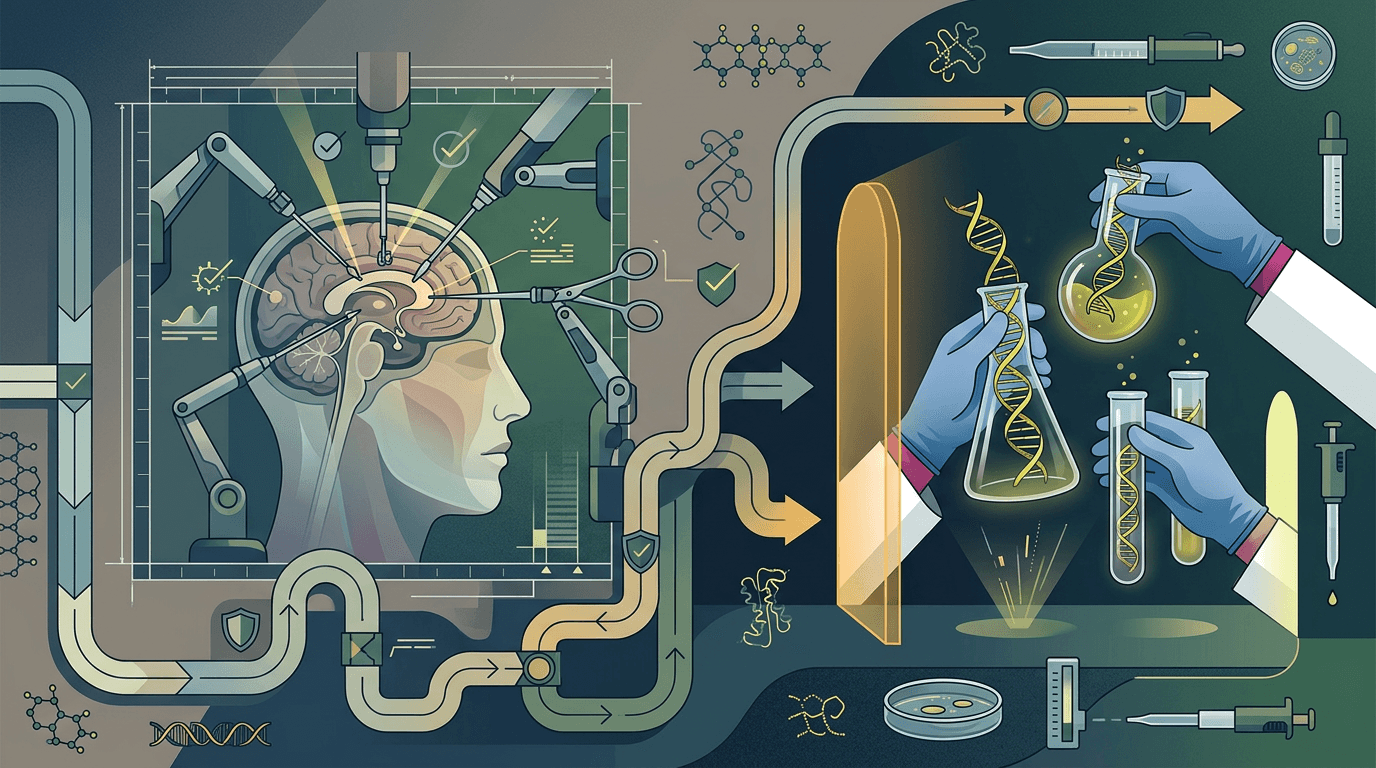
Imagine volunteering for brain surgery. Doctors drill into your skull, prep the operating room, put you under anesthesia. But there's a catch: you might not actually receive the treatment. The holes get drilled. The drug never goes in. And you won't know which group you're in for years.
That's what the FDA is asking for, and uniQure just said it's going to try anyway.
On March 2, uniQure revealed that the FDA rejected its plan to file for approval of AMT-130, a gene therapy for Huntington's disease. The company wanted to submit based on its Phase 1/2 data. The FDA said no: that evidence isn't enough.
Instead, the agency wants something far more demanding. It's requiring a brand-new Phase 3 trial, one that's prospective, randomized, double-blind, and controlled with sham surgery. Translation: some patients would undergo a full surgical procedure (skull drilling included) without actually receiving the therapy, just to create a proper comparison group.
Wall Street's reaction was swift and brutal. uniQure's stock cratered more than 40%, falling from the $60s to roughly $10.50 in a single session. Wells Fargo slashed its price target from $60 to $15. Cantor Fitzgerald went even further, cutting from $55 to $9. It was the biotech equivalent of falling off a cliff.
Huntington's disease is caused by a faulty gene that produces a toxic version of the huntingtin protein. Over time, this protein destroys brain cells, leading to uncontrollable movements, cognitive decline, and eventually death. About 30,000 to 40,000 Americans live with it, and there is no approved treatment that slows the disease. The three FDA-approved drugs only manage symptoms like involuntary movements (called chorea). Think of them as painkillers for a broken bone: they help you cope, but the bone is still broken.
AMT-130 takes a completely different approach. It's a gene therapy delivered directly into the brain's striatum (a region heavily affected by Huntington's) via a viral vector. Once there, it deploys a tiny piece of genetic code called a microRNA that essentially tells cells to stop making the toxic protein. It earned Breakthrough Therapy designation from the FDA in April 2025, a label reserved for drugs that show substantial improvement over existing treatments.

Bristol Myers Squibb's Sotyktu faces a March 6 FDA decision that could push the oral TYK2 inhibitor beyond psoriasis and into the crowded psoriatic arthritis market. The drug's unusual mechanism offers a cleaner safety profile than rival oral options, and BMS is betting that difference matters.


Join thousands of biotech professionals who start their day with our free, daily briefing.

The Phase 1/2 results looked genuinely promising. In the high-dose group of 12 patients tracked for 36 months, AMT-130 slowed disease progression by 75% compared to a matched group of untreated patients from the Enroll-HD natural history database (p=0.003, which means the result was statistically significant). Patients also showed a 60% improvement in total functional capacity, a measure of how well someone handles daily life. And since December 2022, there have been zero serious adverse events.
So why isn't the FDA satisfied?
The crux of the disagreement comes down to one word: controls.
uniQure compared its treated patients to an external control group, essentially historical data from untreated Huntington's patients in a large observational database. The FDA initially seemed open to this approach. The agency even agreed in December 2024 that certain biomarker data could support accelerated approval.
Then came the reversal. In a Type A meeting on January 30, 2026, the FDA made its position clear: external controls aren't rigorous enough. The gold standard, in the agency's view, requires patients randomized to either the real surgery or a sham version, with neither the patients nor the doctors evaluating them knowing who got what.
The logic is straightforward from a scientific perspective. Placebo effects are real, especially in neurology. Brain surgery itself can trigger responses that mimic improvement. Without a sham control, you can't be sure the drug is doing the work.
But the ethical objections are equally straightforward.
Picture being a Huntington's patient. Your disease is progressive and fatal. No approved therapy can slow it. Someone offers you a spot in a clinical trial for what looks like the most promising treatment in decades, but there's a coin flip involved. Heads, you get the real thing. Tails, surgeons open your skull, pretend to deliver the therapy, close you back up, and send you home. You'll be monitored for years. You can't join other trials during that time. And you might never know the difference until the study is over.
Patient advocates argue that exposing people with a fatal neurodegenerative disease to the real risks of surgery (infection, bleeding, anesthesia complications) without any therapeutic benefit crosses a moral line.
uniQure's Phase 1/2 trial in the U.S. actually did include a small sham-controlled arm. But that cohort was too small and the follow-up too short to show a statistically meaningful difference at 12 months, which gave the FDA ammunition to demand a larger, longer study.
uniQure isn't backing down. The company plans to request a Type B meeting with the FDA in Q2 2026 to discuss Phase 3 trial designs and push for regulatory flexibility. It's also preparing to release four-year follow-up data from its Phase 1/2 study in Q3 2026, which could strengthen the case that external controls are sufficient.
The stakes extend far beyond Huntington's. This regulatory showdown will set a precedent for every gene therapy that requires surgical delivery to the brain. Parkinson's disease, ALS, and other neurodegenerative conditions are all in the pipeline across the industry. If the FDA holds firm on sham surgery controls for all of them, it could dramatically increase the cost, timeline, and ethical complexity of bringing these therapies to market.
The FDA did recently introduce a "Plausible Mechanism" framework (published February 23, 2026) that offers more flexible approval pathways for bespoke gene therapies targeting ultra-rare genetic diseases. Whether Huntington's, which affects tens of thousands of people rather than handfuls, qualifies for that kind of flexibility remains an open question.
Both sides have a point, and that's what makes this so hard. The FDA isn't wrong that rigorous evidence protects patients from ineffective or harmful treatments; history is littered with therapies that looked great in small, uncontrolled studies and failed when tested properly. But the Huntington's community isn't wrong either: asking dying patients to undergo fake brain surgery feels like a cruelty that statistics alone can't justify.
uniQure's market cap has shrunk significantly since the FDA rejection. Most analysts are recalibrating.
The company now faces a question that no amount of data can fully answer: How do you prove a brain surgery works without putting a control group through the same ordeal? The answer will shape the future of neurological gene therapy for years to come. And for the 30,000 Americans living with Huntington's disease, the clock is ticking louder than ever.
The first human safety trial of a CRISPR-armed bacteriophage just landed in The Lancet Microbe, and the results are surprisingly clean. A Danish biotech armed bacteria-killing viruses with gene-editing scissors, and now they're headed for cancer patients next.