
The first human safety trial of a CRISPR-armed bacteriophage just landed in The Lancet Microbe, and the results are surprisingly clean. A Danish biotech armed bacteria-killing viruses with gene-editing scissors, and now they're headed for cancer patients next.
Somewhere in your gut right now, trillions of bacteria are going about their business. Most of them are helpful. Some are not. And a growing number of the bad ones have learned to shrug off every antibiotic we throw at them.
Antibiotic-resistant infections killed 1.14 million people in 2021 alone. By 2050, that number is projected to climb 67.5%, hitting 1.91 million deaths per year. If you zoom out further, researchers estimate 39 million people will die directly from resistant infections between 2025 and 2050. That's roughly three deaths every minute.
We need new weapons. And the one that just passed its first human safety test sounds like something out of science fiction.
On March 3, 2026, SNIPR Biome, a Danish biotech company, published the results of the first-ever human safety trial of a CRISPR-armed bacteriophage in The Lancet Microbe. Let's unpack that phrase, because it's a mouthful.
Bacteriophages (phages for short) are viruses that infect and kill bacteria. They're nature's original antibiotics, discovered over a century ago. Think of them as tiny assassins that only target specific bacterial species while leaving everything else alone.
CRISPR is the gene-editing tool that lets scientists cut DNA at precise locations. You've probably heard of it being used to edit human genes. But SNIPR Biome had a different idea: what if you armed the assassin virus with molecular scissors?
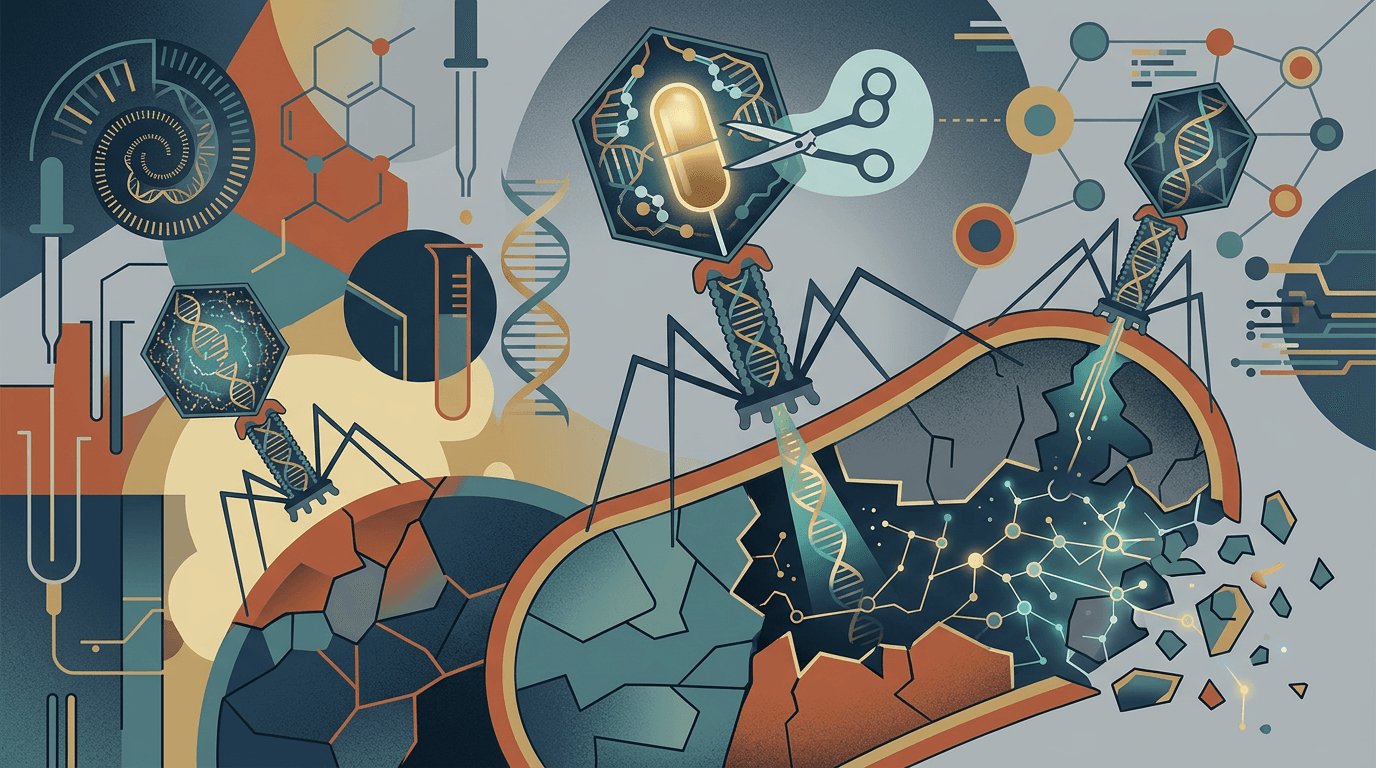
That's SNIPR001. It's a cocktail of four engineered phages, each carrying a CRISPR-Cas system programmed to target E. coli in the gut, including antibiotic-resistant strains. The phages find the bacteria, inject themselves inside, and then the CRISPR system shreds the bacterial DNA from within. It's like sending in a spy who picks the lock and plants the explosives.
The Phase 1 study was a randomized, placebo-controlled, double-blind trial in 36 healthy volunteers. Participants took SNIPR001 orally, twice daily, for seven days. The goal wasn't to cure anyone (these were healthy people, after all). It was to answer the most fundamental question in drug development: is this thing safe?

Bristol Myers Squibb's Sotyktu faces a March 6 FDA decision that could push the oral TYK2 inhibitor beyond psoriasis and into the crowded psoriatic arthritis market. The drug's unusual mechanism offers a cleaner safety profile than rival oral options, and BMS is betting that difference matters.


Join thousands of biotech professionals who start their day with our free, daily briefing.
The answer, based on the data: yes, it appears to be.
No serious adverse events were reported in any of the SNIPR001 dose groups. The rate of side effects wasn't significantly different from placebo. And the broader gut microbiome stayed intact, which matters enormously. One of the biggest problems with traditional antibiotics is that they're like carpet-bombing a city to take out one building. SNIPR001, by contrast, acted more like a guided missile.
One of the most reassuring findings involves where the therapy ended up in the body. Functional SNIPR001 was recovered from stool samples in dose-proportional concentrations (higher dose, more phage detected). But it was not meaningfully found in blood or urine.
That's a big deal. It means these engineered phages stayed confined to the gastrointestinal tract, doing their job exactly where they were designed to work, without wandering off into the rest of the body. For a therapy built on gene-editing technology, that kind of containment is the difference between reassuring regulators and terrifying them.
At the highest dose, researchers observed a 78% reduction in gut E. coli levels compared to placebo. That reduction didn't hit statistical significance in this small trial, but the directional signal was clear.
So who actually needs a CRISPR-armed phage aimed at gut E. coli? Cancer patients, for starters.
People undergoing hematopoietic stem-cell transplants (basically, bone marrow transplants) for blood cancers have severely weakened immune systems. E. coli living in their gut can escape into the bloodstream, causing life-threatening infections. If you could selectively wipe out that E. coli before the transplant without nuking the rest of the microbiome, you'd potentially save lives.
That's exactly what SNIPR Biome is testing next. The company has launched a Phase 1b trial across eight U.S. centers, targeting 24 hematological cancer patients undergoing transplants. Recruitment is already more than halfway complete.
Christian Grøndahl, CEO and co-founder of SNIPR Biome, highlighted the Phase 1b progress, emphasizing the potential to reduce E. coli bloodstream infection risk in these vulnerable patients. Eric van der Helm, the company's VP of Business Development, Bioinformatics & Lab Automation, called the Phase 1 results a "major milestone" that validated the therapy's safety profile, gut restriction, and CRISPR-enabled precision.
SNIPR Biome isn't working in isolation. The phage therapy field has been quietly building momentum. Companies like Armata Pharmaceuticals, Adaptive Phage Therapeutics, and Locus Biosciences are all pushing engineered phages toward the clinic.
But SNIPR001 represents something genuinely new: the first published human safety data combining phage therapy with CRISPR gene editing. It's proof that the concept works in living, breathing people without causing harm.
Regulatory agencies are paying attention, too. The FDA has been "supportive" of phage development, enabling access through expanded access programs for life-threatening cases. The EMA has also been developing guidelines for bacteriophage products. The regulatory ice is thawing.
Let's be honest about what we don't know yet. This was a tiny trial in healthy people. The therapy's actual clinical benefit (does it prevent infections in sick patients?) remains unproven. The 78% E. coli reduction at the highest dose is encouraging but not statistically significant. And the leap from 36 healthy volunteers to cancer patients with compromised immune systems is a big one.
SNIPR Biome also received just $3.9 million from CARB-X back in 2021 to develop SNIPR001, which is modest funding for a platform this ambitious. Scaling up production of engineered phage cocktails, navigating complex regulatory pathways, and proving efficacy in larger trials will require significantly more capital.
But the foundation has been laid. For the first time, scientists have shown that you can take a century-old concept (using viruses to kill bacteria), upgrade it with 21st-century gene-editing technology, put it in a pill, give it to humans, and have it work safely where it's supposed to.
In a world where bacteria are evolving faster than our antibiotics can keep up, that's not just a scientific milestone. It's a glimpse of how we might actually fight back.
The FDA told uniQure its promising Huntington's gene therapy needs a sham brain surgery trial before approval, torching the stock by 40%. The resulting ethical and regulatory showdown could reshape the future of every gene therapy that targets the brain.