
The FDA just cleared a smartphone app as a prescription treatment for preventing migraines, and the clinical trial data is surprisingly strong. Click Therapeutics' CT-132 could reshape how we think about treating neurological conditions, if it can survive the graveyard that swallowed its competitors.
A doctor might soon tell you to download an app, and your insurance could cover it.
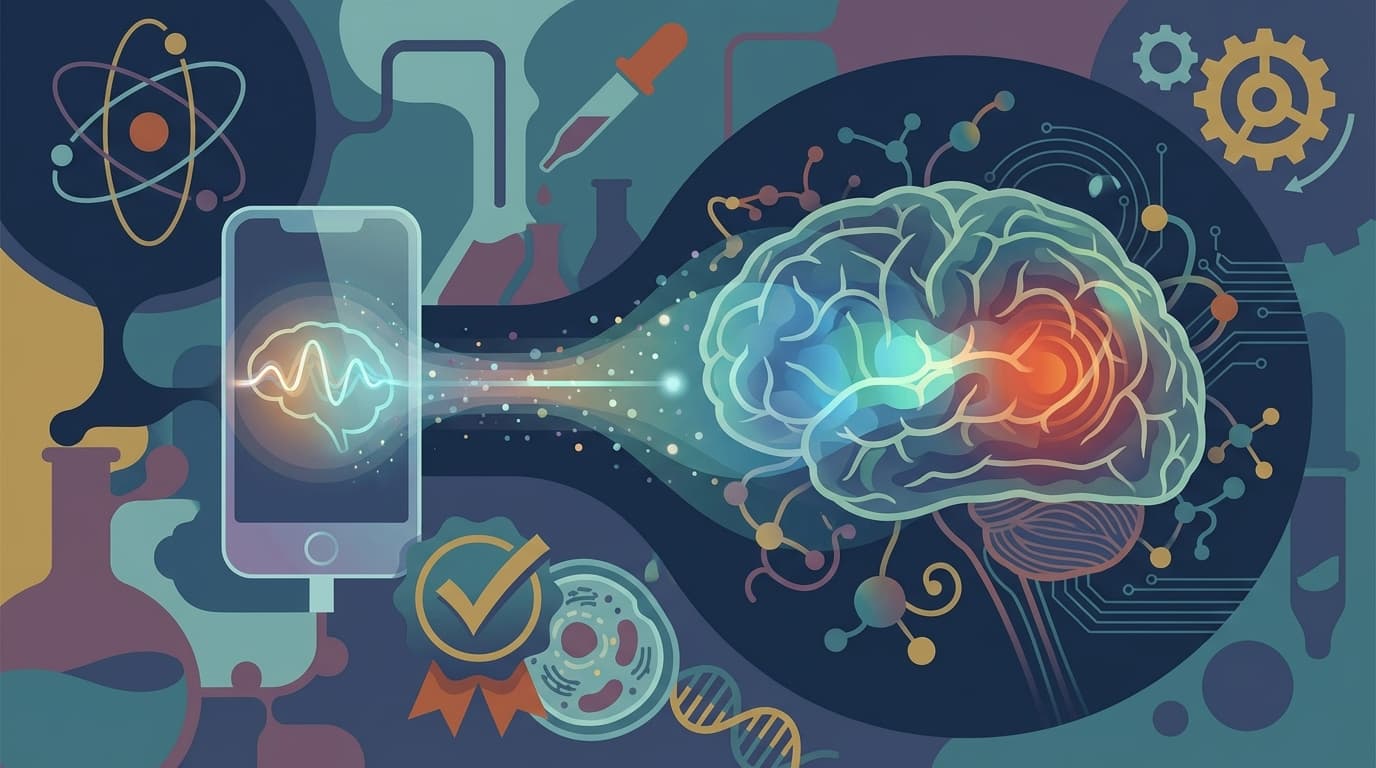
Click Therapeutics just made history with CT-132, the first FDA-authorized prescription digital therapeutic designed to prevent migraines. Not manage them. Not track them. Actually prevent them from happening. And the whole thing runs on your phone.
If that sounds like something out of a Black Mirror episode, fair. But the clinical data backing this thing is surprisingly legit.
Migraine isn't just a bad headache. It's a neurological condition that affects roughly 37 million Americans, often striking multiple times per month and wrecking productivity, relationships, and quality of life. Current treatments range from triptans to the newer CGRP inhibitors, drugs that block a protein involved in migraine signaling. They help a lot of people, but not enough of them.
CT-132 takes a completely different approach. Instead of targeting a molecule, it targets the brain's wiring. The app delivers a 12-week program of cognitive and behavioral exercises (think of it like physical therapy, but for the neural circuits that make your brain hypersensitive to migraine triggers). Each daily session runs about 5 to 10 minutes. No pills. No injections. No side effects.
The idea is that your brain can be retrained to stop overreacting to stimuli that would normally spark an attack. It's built on principles from cognitive behavioral therapy (CBT), a well-established psychological approach, but packaged into bite-sized app sessions powered by Click's AI platform.
Click didn't just wave some wellness data at regulators and hope for the best. They ran two randomized, double-blind, sham-controlled trials, the gold standard in clinical research. That means participants were split into groups where some got the real app and others got a convincing fake version. Neither the patients nor the researchers knew who was getting what.
The main study, called ReMMi-D, enrolled 558 adults who already suffered 4 to 14 migraine days per month. These weren't people trying the app instead of medication; they were already on standard treatments. CT-132 was the cherry on top.

Half of migraine patients don't respond to CGRP drugs, the only biologic game in town. A brand-new startup just launched with $130 million to target a completely different brain pathway, and it could change the treatment map entirely.


Join thousands of biotech professionals who start their day with our free, daily briefing.

After 12 weeks, the app group saw their monthly migraine days drop by 3.04 days on average. That's meaningful when you're someone who gets hit with migraines 8 or 10 times a month. The treatment difference versus the sham group was an additional 0.9 fewer migraine days, statistically significant at P=.005.
Now, 0.9 extra days might not sound like a mic drop. But context matters. This was on top of whatever medications patients were already taking. It's like squeezing extra miles per gallon out of a car that's already been tuned up. And participants also reported significant improvements in quality of life and disability scores, with gains showing up as early as week four.
One of the biggest questions was whether CT-132 would add anything for patients already on CGRP inhibitors, the blockbuster class of migraine drugs that includes names like Aimovig and Ajovy. These are the heavy hitters of modern migraine prevention. If the app couldn't move the needle for those patients, its real-world utility would shrink considerably.
So Click ran a second trial. The ReMMiD-C bridging study enrolled 110 patients specifically taking CGRP inhibitors and tested CT-132 against a sham control. The result: comparable effectiveness to the larger trial. The app delivered additional benefit even when stacked on top of the best drugs currently available.
That's a big deal. It means CT-132 isn't competing with existing treatments; it's complementing them. Your neurologist doesn't have to choose between the app and your medication. You get both.
This might be the most remarkable part of the whole story. Across both trials, there were no treatment-related adverse events and no discontinuations due to the app. Zero.
Compare that to the side effect profiles of most migraine drugs (constipation, injection site reactions, fatigue, nausea) and the appeal becomes obvious. CT-132 is essentially risk-free. The FDA noted it has no contraindications, meaning there's no medical reason anyone in the target population couldn't use it.
Engagement was also sky-high. Participants completed nearly 100% of their daily tasks throughout the 12-week program. That's unheard of for any health app, let alone one that asks you to do cognitive exercises every single day.
Click Therapeutics deserves some credit for simply still being alive. The prescription digital therapeutics space has been brutal. Pear Therapeutics, which had FDA-authorized apps for substance use disorders, filed for bankruptcy in 2023. Akili Interactive, which made an FDA-authorized video game for ADHD, paused several programs to focus on survival. The whole sector was starting to look like a graveyard.
Click, founded in 2012 in New York City, has managed to stay in the game partly through smart partnerships. Their deal with Otsuka Pharmaceutical, worth up to $305 million in milestones, already produced Rejoyn, an FDA-authorized digital therapeutic for major depressive disorder that cleared in April 2024. CT-132 is their second FDA win, and it came through the De Novo regulatory pathway, a route designed for truly novel, first-of-their-kind devices.
The company had also secured a Breakthrough Device designation from the FDA back in 2022, which helped accelerate the review process. Their pipeline stretches across schizophrenia, insomnia, chronic pain, and more, with collaborations including Boehringer Ingelheim.
The big question isn't whether CT-132 works; the trials answered that. The real test is whether anyone will prescribe it, and whether insurers will pay for it.
Digital therapeutics have historically struggled with both. Doctors aren't trained to "prescribe" apps. Payers don't have clean reimbursement codes for software. Patients aren't used to thinking of their phone as a medical device. These are the headwinds that sank Pear Therapeutics, and Click will have to navigate them carefully.
But the migraine market is massive, the safety profile is immaculate, and the data shows clear additive benefit even for patients on the best available drugs. Eric Baron, DO, a neurologist and headache specialist, called the authorization a "groundbreaking milestone" in migraine management, pointing to the rigorous trial design and the zero adverse events as key differentiators.
If Click can crack the distribution code, CT-132 could become the first digital therapeutic to achieve real commercial traction in neurology. And if your doctor ever tells you the cure is on the App Store, don't laugh. The science says they might be right.
Astellas just dropped $335 million upfront on a cancer drug that stays completely dormant until it reaches the tumor; then it wakes up and attacks. The early data on VIR-5500 is turning heads, and the deal's timing tells you everything about Astellas' post-XTANDI anxiety.