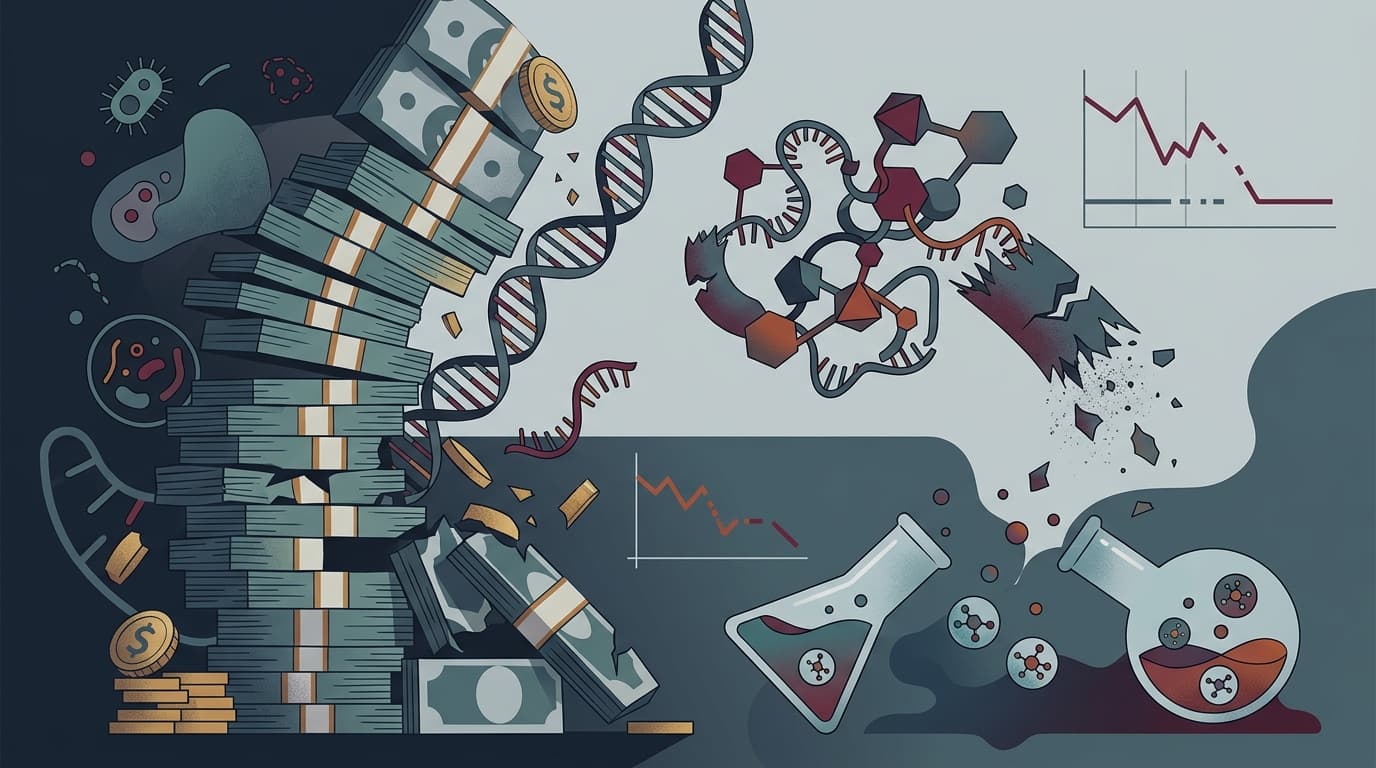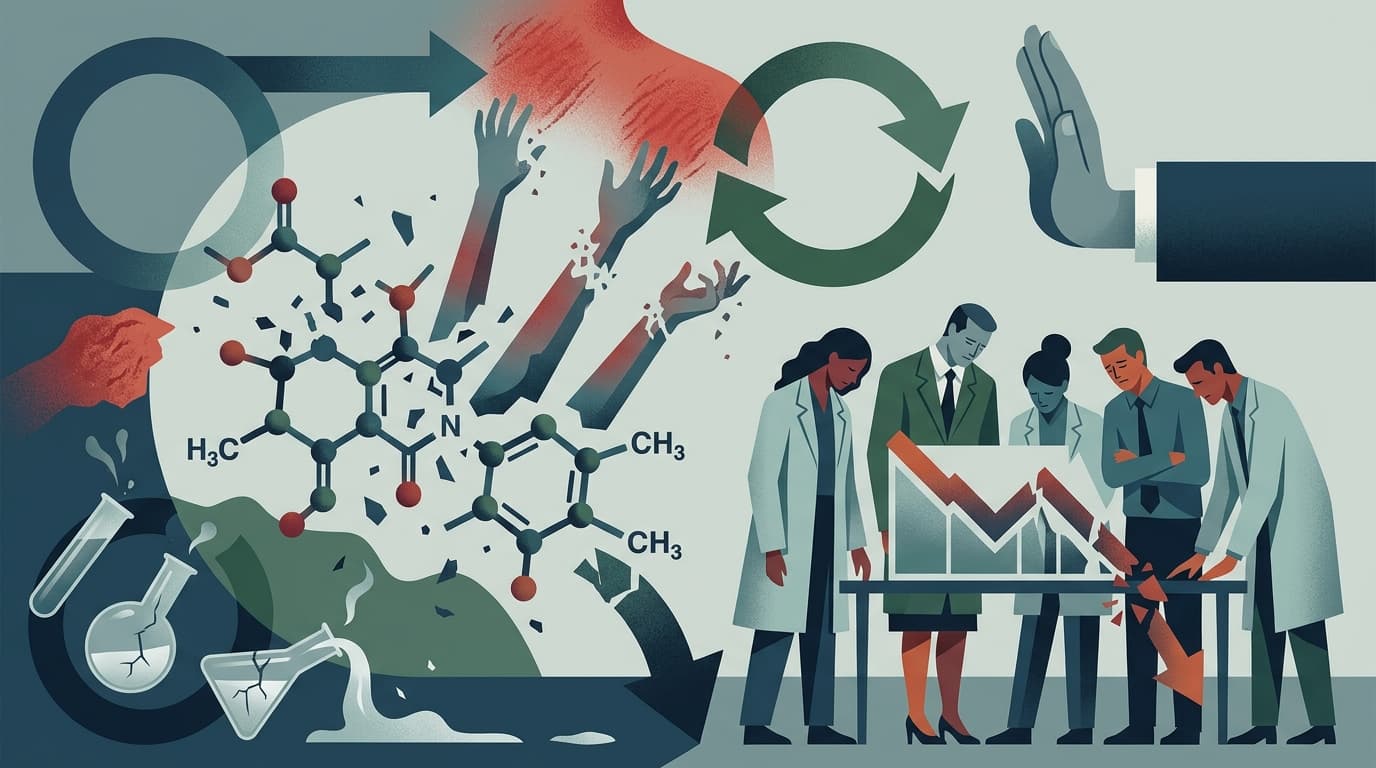

Evommune's eczema drug EVO756 just failed its second mid-stage trial this year, effectively killing an entire drug target that attracted hundreds of millions in investment. Two swings, two misses, and now every other company chasing MRGPRX2 has a credibility problem.
Imagine betting big on a lock that's supposed to open the door to a massive new market. You try the key once. It doesn't turn. You file it down, adjust your grip, and try again. Still nothing.
That's roughly where Evommune found itself this week. The company's oral eczema drug EVO756 failed its Phase 2b trial in moderate-to-severe atopic dermatitis, missing both its primary and secondary endpoints. Every dose tested came up short.
What makes this sting even more: it's the second time this drug has flopped in a mid-stage trial this year. The first miss came in chronic spontaneous urticaria (CSU), a condition marked by unpredictable hives and itching. That study enrolled 160 patients and also whiffed at all doses. Now, with 121 adults in the eczema trial producing the same result, Evommune is discontinuing EVO756 development in CSU and atopic dermatitis.
Two swings. Two misses. One dead drug target.
To understand why this matters beyond one company, you need to know what EVO756 was designed to block: a receptor called MRGPRX2.
Think of mast cells as the body's overeager bouncers. When they sense a threat (real or imagined), they release a flood of chemicals like histamine that cause itching, redness, and swelling. Normally, the signal to "go" comes through a well-known pathway involving IgE antibodies, the classic allergy route.
But MRGPRX2 is a side door. It lets all kinds of molecules (peptides, certain drugs, even opioids) activate mast cells without going through the IgE pathway. Researchers believed that blocking this side door could shut down a major driver of chronic itch and inflammation in skin diseases, while leaving normal immune function intact.
It was an elegant hypothesis. The kind of clean, mechanistic story that gets investors and drug developers excited. Multiple companies jumped in.
Evommune wasn't the only one chasing MRGPRX2. The competitive landscape tells you just how popular this target had become.

Novartis's $12 billion RNA therapy bet just failed its biggest clinical test in a rare muscle disease, dragging down an entire sector's stocks with it. The result exposes a stubborn problem: getting RNA drugs to actually reach muscle tissue remains one of biotech's hardest unsolved challenges.


Join thousands of biotech professionals who start their day with our free, daily briefing.

Incyte paid $750 million to acquire Escient Pharmaceuticals and its oral MRGPRX2 antagonist, EP262, which entered Phase Ib/II trials across multiple conditions. Septerna brought SEP-631, a slightly different flavor of MRGPRX2 blocker (a "negative allosteric modulator"), into Phase 1 testing. Novartis listed an MRGPRX2 inhibitor in its immunology pipeline. Blueprint Medicines published research on potent oral antagonists. Even GSK showed up in early screening work.
In other words, this wasn't some fringe idea. It was a legitimate therapeutic thesis backed by serious money and serious science. EVO756's back-to-back failures don't just kill one drug; they raise uncomfortable questions about whether MRGPRX2 is the right lock to pick at all.
If two well-designed mid-stage trials can't move the needle on eczema severity scores or hive symptoms, competitors now have a credibility problem. Every MRGPRX2 program in the pipeline just got harder to fund, harder to recruit for, and harder to pitch to regulators.
You'd expect analysts to run for the exits after a double failure. Surprisingly, many didn't.
Raymond James cut its price target on Evommune to $32 from $52 after the CSU failure, and then lowered it again to $18 from $32 after the atopic dermatitis failure. Leerink cut from $28 to $22. RBC went from $29 to $21 but kept an Outperform rating.
Why the lingering optimism? The answer likely involves Evommune's broader pipeline beyond MRGPRX2. Some analysts argued that lessons from these failures could inform future trial designs in other programs.
Call it faith. Call it sunk-cost bias. Either way, analysts are telling you they think there's something left in this company even after its lead program went to zero.
The good news for patients: the eczema pipeline is absolutely massive. Over 120 therapies from more than 100 companies are in development, and the disease has become one of the most active battlegrounds in all of dermatology.
JAK inhibitors like abrocitinib and upadacitinib already offer strong oral options. Biologics like dupilumab (targeting the IL-4/IL-13 pathway) remain the gold standard for moderate-to-severe cases. And newer mechanisms are flooding the clinic: IL-31 receptor blockers like nemolizumab specifically target itch, and TYK2 inhibitors represent yet another twist on the JAK-STAT pathway.
The unmet need is still real, though. Many patients don't respond well enough to existing drugs, can't tolerate them long-term, or live with persistent itch that current therapies only partially relieve. That's why the field keeps growing.
But MRGPRX2 was supposed to carve out a unique niche: upstream mast-cell control without touching IgE pathways. With that thesis now deeply wounded, companies will have to prove the biology works before anyone writes another big check.
Evommune says it won't advance EVO756 in atopic dermatitis. Combined with the earlier CSU failure, that effectively ends the program in those indications. The question now shifts to the rest of the MRGPRX2 field.
Incyte's EP262 and Septerna's SEP-631 are still in the clinic. Their trials will carry extra scrutiny now. If those programs also stumble, MRGPRX2 could join the graveyard of targets that looked brilliant in preclinical models but couldn't deliver in humans. It wouldn't be the first time biology fooled everyone in the jump from lab bench to bedside.
For Evommune, the path forward depends on whatever else it has cooking. Analysts seem to think there's reason to stay interested; the stock is priced like a company in trouble, but the targets suggest a company with options.
For the broader eczema field, the lesson is familiar: elegant science doesn't guarantee clinical success. Sometimes you find the right key. Sometimes the lock was never going to open.
ARPA-H just bet $62.7 million that an AI can manage heart failure patients around the clock, prescribing drugs and ordering tests without waiting for a doctor. If it works, it could reshape how we treat the fastest-growing heart condition in America.