
Erasca's pan-RAS inhibitor posted jaw-dropping early cancer data that analysts called a "home run." Then the stock fell 42% in a single day. A patient death, a patent fight, and transparency questions collided with the best data in Erasca's history.
Imagine hitting a grand slam in the bottom of the ninth, only to get ejected from the game on your way around the bases. That's roughly what happened to Erasca last week.
On April 27, the small biotech company dropped preliminary Phase 1 data for ERAS-0015, a drug designed to attack one of the most notorious targets in cancer: the RAS oncogene. The results were, by most accounts, spectacular. Evercore ISI analyst Jon Miller called the profile a "home run." Patients with notoriously stubborn cancers were responding. Tumors were shrinking at low doses.
Then the stock fell 47% in a single day. What on earth happened?
To appreciate why this data matters, you need to understand the villain in this story.
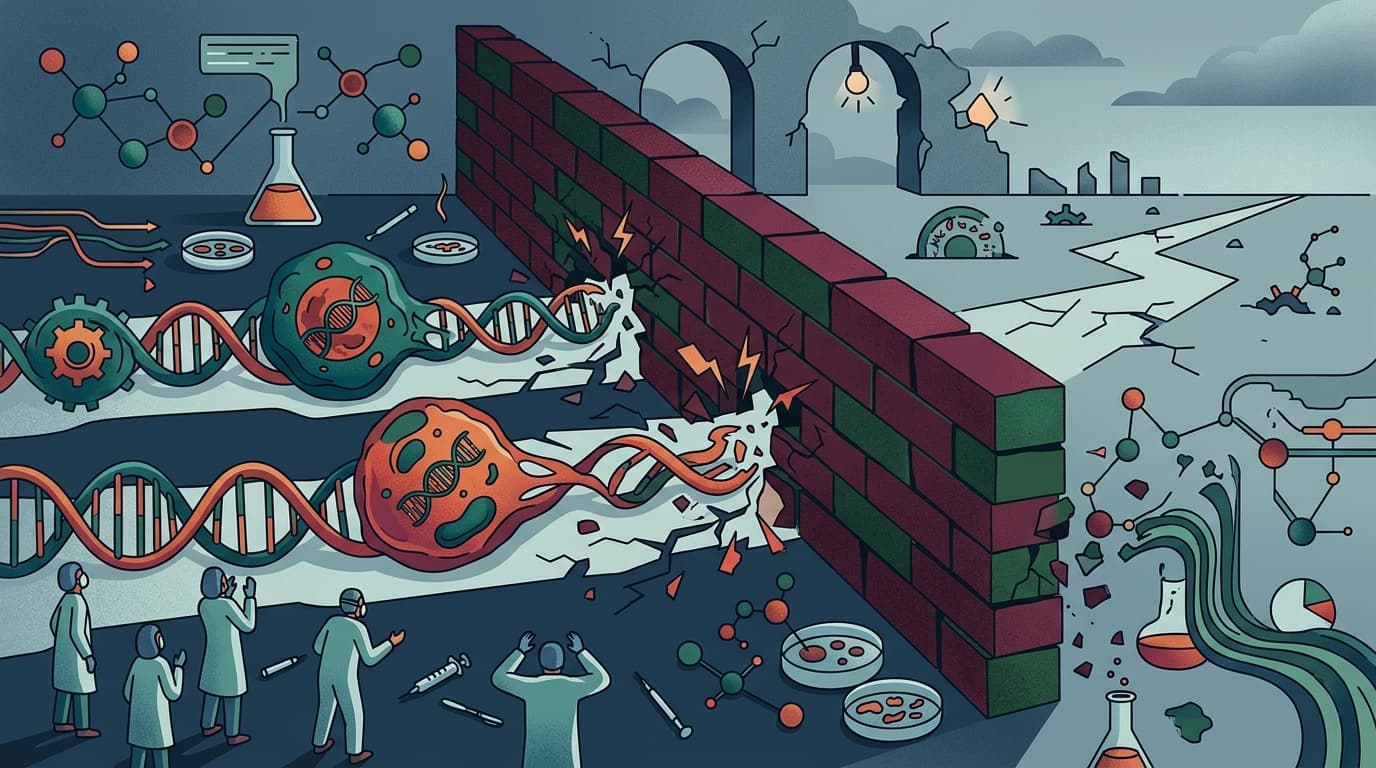
RAS is a family of genes (KRAS, NRAS, HRAS) that, when mutated, act like a stuck gas pedal for cell growth. They tell cells to divide and never stop. These mutations show up in about 25-30% of all human cancers, including roughly 92% of pancreatic cancers and 30% of lung cancers. For decades, scientists tried and failed to build drugs that could grab onto the RAS protein. Its surface is smooth and featureless, like trying to stick a Post-it note to a marble.
The field called it "undruggable." That word became gospel from the early 1990s through the 2010s. Researchers tried going around the problem, targeting proteins upstream and downstream of RAS. Nothing worked well enough.
The first real crack came in 2013, when a UCSF lab found a tiny groove in one specific mutant form (KRAS G12C) that a small molecule could latch onto. That discovery eventually led to two approved drugs: sotorasib (Amgen, 2021) and adagrasib (Mirati/BMS, 2022). They were historic firsts, but they only work against one specific mutation.
Erasca's ERAS-0015 is different. It's what's called a pan-RAS molecular glue, meaning it's designed to work across multiple RAS mutation types, not just one. If the first-generation drugs were skeleton keys for a single door, this one is trying to open the whole hallway.

The FDA flagged serious concerns about two of AstraZeneca's biggest cancer drugs in the same advisory committee briefing. With prediction markets pricing Truqap approval at just 17.6% and camizestrant's trial design under fire, billions in future revenue hang on a single April 30 meeting.


Join thousands of biotech professionals who start their day with our free, daily briefing.

The data from two trials (AURORAS-1 in the U.S. and JYP0015M101 in China) covered patients with RAS-mutant solid tumors who had already failed other treatments. These are people running out of options.
In second-line-or-later non-small cell lung cancer patients with KRAS G12X mutations, ERAS-0015 showed a 62% unconfirmed response rate at pharmacologically active doses. That number climbed to 75% in patients who'd already been through both immunotherapy and platinum chemotherapy. For context, Erasca claims these rates exceed comparators by 24 percentage points.
But the pancreatic cancer data might be even more jaw-dropping, because pancreatic cancer is where drugs go to die. The five-year survival rate is dismal; effective treatments are vanishingly rare. ERAS-0015 posted a 40% unconfirmed response rate in second-line KRAS G12X pancreatic cancer patients. In a disease this brutal, that number turns heads.
The safety profile looked clean on paper: no dose-limiting toxicities as of the March 31 data cutoff, mostly low-grade side effects, and zero patients discontinuing treatment because of drug-related adverse events. Preclinical data even suggested the drug might be best-in-class, requiring one-fifth to one-tenth the dose of Revolution Medicines' competing drug (RMC-6236) in animal models, with higher bioavailability and a longer half-life.
So why did investors head for the exits?
The stock collapse wasn't about one thing. It was about three things landing at once.
First, a patient died. Buried in the safety data was a treatment-related death, with pneumonitis (lung inflammation) flagged as a potential concern. In early-stage cancer trials with very sick patients, deaths aren't unheard of. But the disclosure rattled a market that was already pricing in perfection, so there was a long way to fall.
Second, a legal grenade. Three days before the data dropped, Revolution Medicines sent Erasca a letter alleging that ERAS-0015 infringes a U.S. patent and claiming trade secret misappropriation. Revolution's stock rose over 10% the same morning Erasca's cratered. Whether the claim has merit is anyone's guess at this stage, but the timing was brutal. It turned what should have been a pure science story into a courtroom drama.
Third, questions about transparency. Analysts noted that Erasca's cross-study comparisons with Revolution's rival drug, daraxonrasib, lacked head-to-head trial data. Comparing results across different trials with different patient populations is like comparing batting averages from different eras of baseball; it's suggestive, not definitive. Mizuho analysts called the data "competitive" but emphasized the need for confirmed responses and durability data. Those unconfirmed response rates? Confirmed rates were notably lower: 32% in lung cancer and 20% in pancreatic cancer.
Retail investor sentiment on Stocktwits flipped to bearish. The mood went from celebration to suspicion in hours.
Zoom out, and the story here isn't really about one bad trading day. It's about the gap between scientific promise and market patience.
RAS-driven cancers affect hundreds of thousands of patients every year. KRAS mutations alone account for roughly 86% of all RAS-mutant cancers. Pancreatic cancer (92% RAS-mutant) and colorectal cancer (44% RAS-mutant) represent enormous unmet needs. A true pan-RAS drug that works across mutations would be transformative.
Erasca's early data suggests ERAS-0015 could be a real contender. Responses were observed at doses as low as 8 mg daily, across multiple RAS mutation types and tumor types. All 14 evaluable patients showed significant drops in circulating tumor DNA (bits of cancer DNA floating in the blood, a marker that the drug is actually hitting its target). The company plans to share monotherapy expansion and combination data in the first half of 2027.
But early data is early data. Phase 1 trials are small by design; they're meant to test safety and find the right dose, not prove a drug works at scale. The unconfirmed responses need confirmation. The pneumonitis signal needs watching. And the patent fight with Revolution Medicines could get ugly and expensive.
Erasca also has a second pan-RAS asset in its pipeline, ERAS-4001, a selective pan-KRAS inhibitor that received FDA clearance to begin its Phase 1 trial (BOREALIS-1) in early June 2025. Initial data from that program is expected sometime this year.
For now, the question isn't whether ERAS-0015's data is good. Most analysts agree it is. The question is whether "good" survives contact with confirmed response rates, longer follow-up, a patent lawsuit, and one very unfortunate death. The science says breakthrough. The market says prove it.
Sometimes a home run and a 47% stock drop can happen on the same day. Welcome to biotech.
Incyte's Opzelura just posted another round of strong vitiligo data, and the cream is printing $678 million a year. But AbbVie's Rinvoq pill is headed for FDA approval in the same disease, and the safety tradeoffs between a cream and a pill could reshape the entire market.