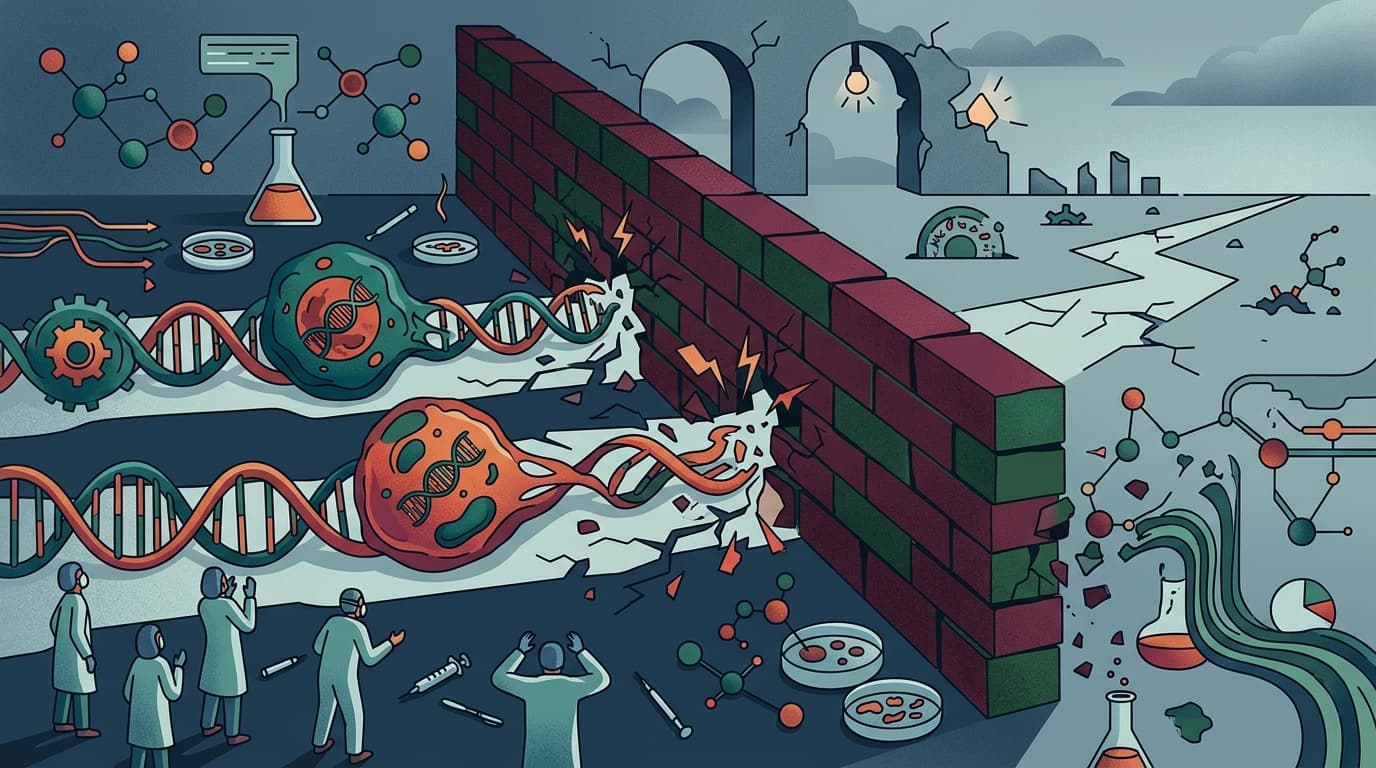
AstraZeneca's Two Biggest Cancer Bets Just Hit a Wall
The FDA flagged serious concerns about two of AstraZeneca's biggest cancer drugs in the same advisory committee briefing. With prediction markets pricing Truqap approval at just 17.6% and camizestrant's trial design under fire, billions in future revenue hang on a single April 30 meeting.
Imagine training for two marathons at the same time, only to roll both ankles the week before race day.
That's roughly where AstraZeneca finds itself right now. The FDA just released briefing documents flagging serious concerns about two of the company's key oncology drugs ahead of an advisory committee meeting on April 30, 2026. Not one. Two. In the same meeting. Both facing skepticism that could derail their paths to approval.
The drugs in question: camizestrant, a next-generation breast cancer treatment, and Truqap (capivasertib), which AstraZeneca wants to expand into prostate cancer. Together, they represent billions in projected revenue and a cornerstone of AstraZeneca's push toward $80 billion in annual sales by 2030.
Prediction markets are already brutal. And the advisory committee hasn't even voted yet.
The Breast Cancer Drug With a Timing Problem
Camizestrant is what's called an oral SERD: a pill that blocks estrogen receptors in cancer cells. It's designed for women with HR-positive, HER2-negative advanced breast cancer who develop a specific genetic mutation (ESR1) while on first-line treatment. Think of it as a plan B that kicks in when the cancer starts outsmarting plan A.
The clinical trial behind it, SERENA-6, showed impressive numbers on the surface. Patients who switched to camizestrant saw a 56% reduction in the risk of their cancer progressing or dying. Median progression-free survival (the time before cancer gets worse) was 16 months versus 9.2 months in the control group.
Sounds like a slam dunk, right? The FDA doesn't think so.
The problem is subtle but significant. SERENA-6 detected the ESR1 mutation through blood tests and switched patients to camizestrant before their cancer visibly worsened on scans. The control group stayed on their existing therapy. But the FDA's core question is devastating in its simplicity: how do we know early switching is better than just switching when the cancer actually progresses?
No prior drug has ever been approved based solely on switching at mutation detection without visible disease progression. The trial never compared its strategy to the standard approach of waiting until scans show the cancer growing. It's like declaring a fire alarm saves lives without ever testing whether people would have escaped anyway.
Get tomorrow's biotech intelligence before your competitors.
Join thousands of biotech professionals who start their day with our free, daily briefing.
Hearts, Eyes, and a Dangerous Combo
Beyond the philosophical trial design issue, the FDA flagged real safety concerns that could limit camizestrant's appeal even if it does get approved.
The drug slowed patients' heart rates by a median of 14 beats per minute. Bradycardia (abnormally slow heartbeat) showed up in 7.7% of camizestrant patients versus zero in the control arm. For patients whose resting heart rate is already on the low side, that's a meaningful risk.
Then there's the QT prolongation issue, which is essentially an electrical problem in the heart that can trigger dangerous arrhythmias. This gets particularly dicey when camizestrant is combined with ribociclib, a commonly used CDK4/6 inhibitor that also prolongs the QT interval. Only 23 patients in the trial used that combination, so safety data is thin. The FDA explicitly raised the specter of Torsades de Pointes, a potentially fatal heart rhythm disturbance.
Visual disturbances round out the safety trio. Not a dealbreaker on their own, but layered on top of cardiac concerns, they paint a picture of a drug that might cause more trouble than its benefit justifies, at least in the FDA's eyes.
Truqap's Prostate Problem: Too Little Benefit, Too Much Risk
If camizestrant's issue is a clever trial that might be too clever, Truqap's problem is more straightforward. The drug simply didn't impress enough.
Truqap already has approval for breast cancer (it generated approximately $684 million in sales last year). Now AstraZeneca wants to expand it into metastatic hormone-sensitive prostate cancer, a much larger market. The CAPItello-281 trial tested Truqap combined with abiraterone (a standard prostate cancer drug) in patients whose tumors had lost a gene called PTEN.
The result: a 19% reduction in the risk of cancer progression or death. Statistically significant? Yes. Clinically meaningful? The FDA says no.
To understand why, consider context. Previous drugs approved for this same patient population showed much larger benefits. The FDA essentially told AstraZeneca back in 2020 that without a big improvement in progression-free survival, they'd need to show the drug helps patients live longer overall. That overall survival data doesn't exist yet.
Making matters worse, nearly all patients in the trial had minimal or no symptoms (fewer than 10% had pain progression). These are people who feel relatively fine. Adding a new drug with extra side effects on top of an already multi-drug regimen is a tough sell when the benefit is modest and the patients aren't suffering much to begin with.
The $80 Billion Question
AstraZeneca has staked its future on oncology. The company needs 25 or more blockbuster brands (each exceeding $1 billion annually) to hit its 2030 revenue target. With 20-plus Phase 3 readouts expected by the end of 2026, these two drugs were supposed to be part of the cavalry, not casualties.
The competitive pressure is real, especially in breast cancer. Eli Lilly's imlunestrant, another oral SERD, won FDA approval back in September 2025. Roche has giredestrant in development. Chinese competitors like Jiangsu Hengrui are running Phase 3 trials. If camizestrant stumbles at the regulatory finish line, AstraZeneca loses ground in a race that's already moving fast.
For Truqap, Leerink Partners previously slashed peak sales estimates from $2.36 billion to $1.28 billion due to label restrictions on the breast cancer indication. A prostate cancer rejection would further shrink the drug's commercial ceiling.
What Happens on April 30
The Oncologic Drugs Advisory Committee (ODAC) will discuss both drugs in a single session. These panels don't make final approval decisions; they recommend. But historically, negative ODAC votes are very difficult for the FDA to override.
AstraZeneca has expressed confidence in both submissions. For camizestrant, the company points to prior FDA alignment on the SERENA-6 trial design. The drug has Breakthrough Therapy designation, which signals FDA interest in expediting its review. But interest isn't endorsement, and the briefing documents make clear that the agency has serious reservations about what the trial actually proves.
The stakes are asymmetric. If both drugs clear the committee, AstraZeneca's oncology story strengthens considerably. If one or both fail, the company still has a deep pipeline, but the narrative of unstoppable momentum takes a hit. And in pharma, narrative moves stock prices almost as much as data does.
Prediction markets reflect skepticism. Polymarket has Truqap's approval odds at around 18%. Camizestrant odds aren't publicly available in the same way, but the FDA's questions about trial design suggest this won't be a friendly room either.
Two drugs. One meeting. Billions on the line. April 30 is going to be a long day in AstraZeneca's boardroom.
4 min read
Incyte's Skin Cream Just Won Big. So Why Is Wall Street Nervous?
Incyte's Opzelura just posted another round of strong vitiligo data, and the cream is printing $678 million a year. But AbbVie's Rinvoq pill is headed for FDA approval in the same disease, and the safety tradeoffs between a cream and a pill could reshape the entire market.