The Lung Drug That Doesn't Just Slow the Damage. It Might Undo It.
In a disease where the best drugs only slow the scarring, Endeavor BioMedicines just dropped Phase 2b data suggesting its Hedgehog pathway inhibitor might actually reverse lung fibrosis. If it holds up, the IPF treatment playbook gets rewritten.
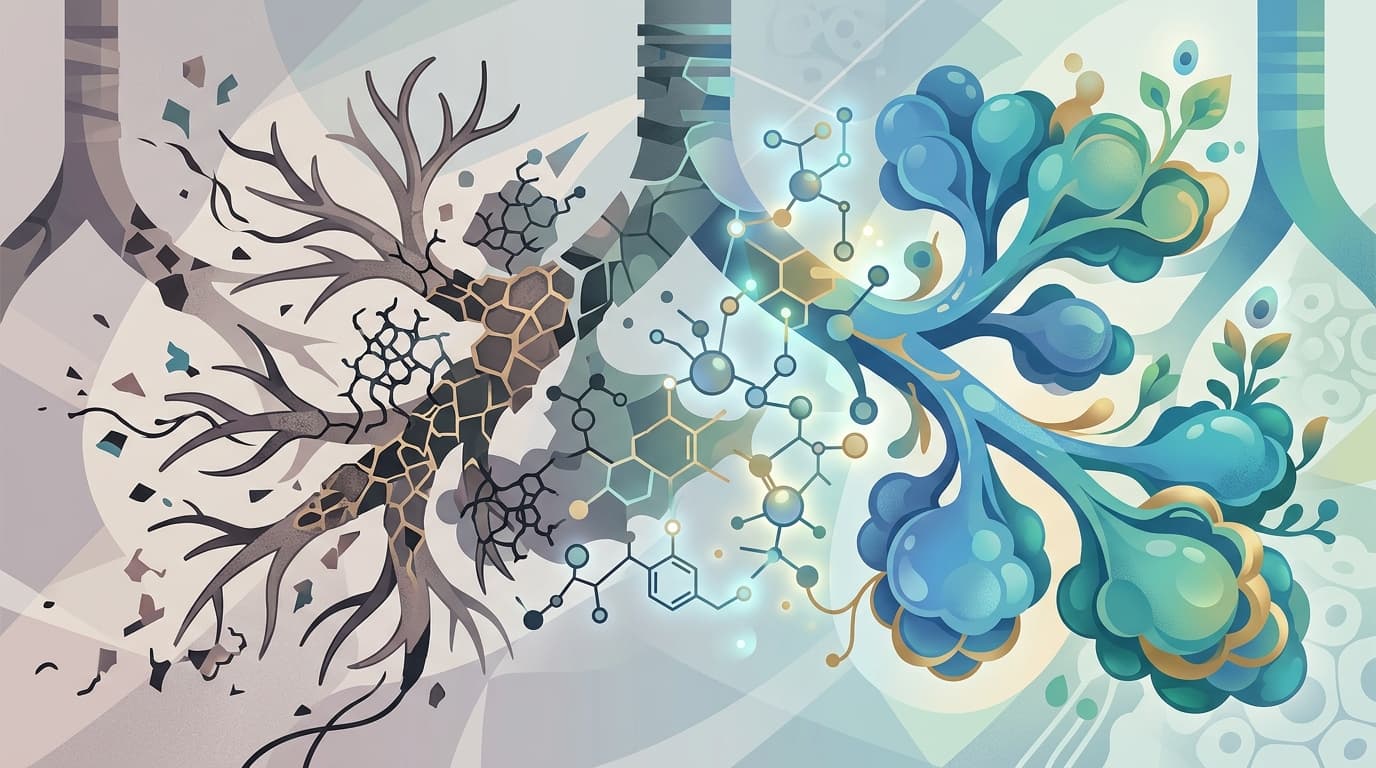
Imagine you're watching your house slowly fill with concrete. It starts in the corners, then creeps into the hallways, and eventually you can barely breathe in your own living room. That's roughly what idiopathic pulmonary fibrosis (IPF) does to your lungs: scar tissue builds up, thickens the walls, and gradually suffocates the organ from the inside. Median survival after diagnosis ranges from two to five years.
For the past decade, the best drugs on the market have basically handed patients a slightly slower clock. They couldn't remove the concrete. They could only pour it a little less quickly.
Now a small San Diego company called Endeavor BioMedicines says it might have found a way to actually pull some of that concrete back out.
A Phase 2b That Has People Paying Attention
On October 8, Endeavor announced topline results from WHISTLE-PF, a Phase 2b trial of its oral drug taladegib (ENV-101) in 213 patients with IPF. The trial ran for 24 weeks, was randomized, double-blind, and placebo-controlled: the gold standard for clinical evidence.
The headline result? Taladegib met its primary endpoint, showing a statistically significant improvement in percent predicted forced vital capacity (ppFVC) compared to placebo. In plain English: patients on the drug had measurably better lung function than patients on a sugar pill.
That alone would be noteworthy. But the secondary endpoints are where things get really interesting.
Not Just Slowing Down, Actually Reversing
Endeavor reported that taladegib improved several imaging-based biomarkers of fibrosis severity. Using high-resolution CT scans (think of them as detailed 3D maps of the lung), doctors measured things like total lung capacity, the percentage of lung tissue showing signs of disease, and the percentage showing outright fibrosis.
All of those markers moved in the right direction. Patients on taladegib didn't just decline more slowly; a pre-specified analysis showed sustained improvement from baseline in lung function over the 24-week period.
Get tomorrow's biotech intelligence before your competitors.
Join thousands of biotech professionals who start their day with our free, daily briefing.
Let that sink in. In a disease where "slowing the decline" has been the ceiling of ambition for years, this drug appeared to push the needle backwards. FierceBiotech framed taladegib as potentially the first drug to reduce lung fibrosis while increasing total lung capacity.
There was also a numerical improvement on a quality-of-life questionnaire (the Living with Pulmonary Fibrosis survey), though that measure wasn't powered for statistical significance. On the safety front, serious adverse event rates were balanced between the drug and placebo groups, which is exactly what you want to see.
The Hedgehog in the Room
So how does taladegib work? The answer involves a signaling pathway with one of biology's most delightful names: the Hedgehog pathway.
The Hedgehog (Hh) pathway is critical during embryonic development. It helps cells figure out where to go and what to become. In healthy adults, it's mostly quiet, like a construction crew that finishes the house and goes home.
But in IPF, the Hedgehog pathway gets switched back on. Injured lung cells start pumping out a signal called SHH, which tells nearby cells to transform into myofibroblasts: the cellular equivalent of rogue contractors who keep pouring concrete long after the renovation is done. These myofibroblasts produce excess scar tissue, resist normal cell death, and create a self-reinforcing loop with another major fibrosis driver called TGF-β.
Taladegib works by blocking a receptor called Smoothened (SMO) on the Hedgehog pathway, essentially cutting the phone line between the injured cells and the rogue contractors. Without the signal, the hope is that the fibrotic maintenance program breaks down and the body can start cleaning up the mess.
It's an elegant idea, but there's a caveat worth mentioning. Some animal studies have shown that blocking Hedgehog signaling didn't prevent fibrosis in certain models, suggesting that timing and disease stage matter a lot. The fact that Endeavor is seeing positive signals in human patients, though, is a genuinely encouraging sign that they may have gotten the biology right.
Why IPF Is Such a Brutal Market (and Opportunity)
IPF is one of those diseases that makes even seasoned pulmonologists feel helpless. Median survival after diagnosis ranges from two to five years. The scarring is progressive, irreversible (until maybe now), and there's no cure short of a lung transplant, which only a small fraction of patients can receive.
The two drugs that have defined IPF treatment for years are pirfenidone and nintedanib. Both are oral antifibrotics that slow the rate of lung function decline. They don't stop it. They definitely don't reverse it. And they come with side effects that many patients struggle to tolerate.
In 2025, a third approved drug joined the mix: nerandomilast (brand name Jascayd), from Boehringer Ingelheim. But the fundamental limitation remains the same. Every approved IPF therapy is playing defense, trying to slow the clock rather than turn it back.
That's why Endeavor's data, if it holds up in larger trials, could be genuinely paradigm-shifting. We're not talking about a marginal improvement. We're talking about a potential category change from "disease management" to "disease reversal."
A Crowded Pipeline, but Few Like This
Endeavor isn't the only company chasing better IPF treatments. The pipeline is packed. One 2026 landscape analysis counted 150 unique IPF programs in development, with 98 of them being small molecules. Over 80 companies are in the hunt.
The biggest names in the late-stage race include Bristol Myers Squibb (with BMS-986278, an LPA1 antagonist in Phase 3), Pliant Therapeutics (bexotegrast, an integrin inhibitor in Phase 2/3), and Celea Therapeutics (deupirfenidone, a next-gen pirfenidone designed for better tolerability). GSK, Mediar Therapeutics, and even AI-drug-discovery darling Insilico Medicine all have late-stage or mid-stage IPF programs running.
But almost every one of these competitors is still working within the "slow the decline" framework. Different targets, different mechanisms, same fundamental goal: reduce the rate of lung function loss.
Endeavor's Hedgehog approach occupies a distinct lane. If taladegib truly reverses fibrosis rather than just putting the brakes on it, the competitive dynamics shift dramatically. It's the difference between selling a better umbrella and selling a machine that stops the rain.
What We Don't Know Yet
Before anyone gets too excited, some important caveats. Endeavor has released topline data, not the full dataset. We don't yet have exact effect sizes, p-values, dose-response curves, or subgroup breakdowns. The company said detailed results will be presented at a future medical meeting, which means the data will face serious scrutiny from independent experts before the picture is complete.
Twenty-four weeks is also a relatively short window for a chronic, progressive disease. The key question going forward: does the improvement last? Does it compound? Or does it plateau? A Phase 3 trial over 52 weeks or longer will be essential to answer those questions.
And then there's the broader biological question. The Hedgehog pathway's role in fibrosis is context-dependent. What works at one stage of disease may not work at another. Endeavor has clearly found something promising in this patient population, but the translation from Phase 2b to Phase 3 has humbled many a biotech before.
The Bottom Line
Endeavor BioMedicines is a clinical-stage company, founded in 2018 by John Hood and Miguel de los Rios, that has been quietly building toward this moment. Their bet on the Hedgehog pathway was always a bit unconventional. Most of the IPF world was focused on other mechanisms. But unconventional bets are what move medicine forward.
If these Phase 2b results hold up in confirmatory trials, taladegib could become the first IPF drug that doesn't just manage the disease but actually fights back against it. For the roughly three million people worldwide living with IPF, that's not incremental progress. That's a different conversation entirely.
The full data presentation is still to come, and the road to approval is long. But for the first time in a long time, the IPF story has a new word in it: reversal.
And that word changes everything.
4 min read
Roche Is Hiring a Chinese Startup to Invent Its Next Cancer Drug
Roche signed a deal worth up to $1 billion with Defand Therapeutics, a two-year-old Chinese startup with zero clinical trials, to discover molecular glue cancer drugs. It's Roche's fourth China partnership since August, and it signals a radical shift in how big pharma thinks about drug discovery.