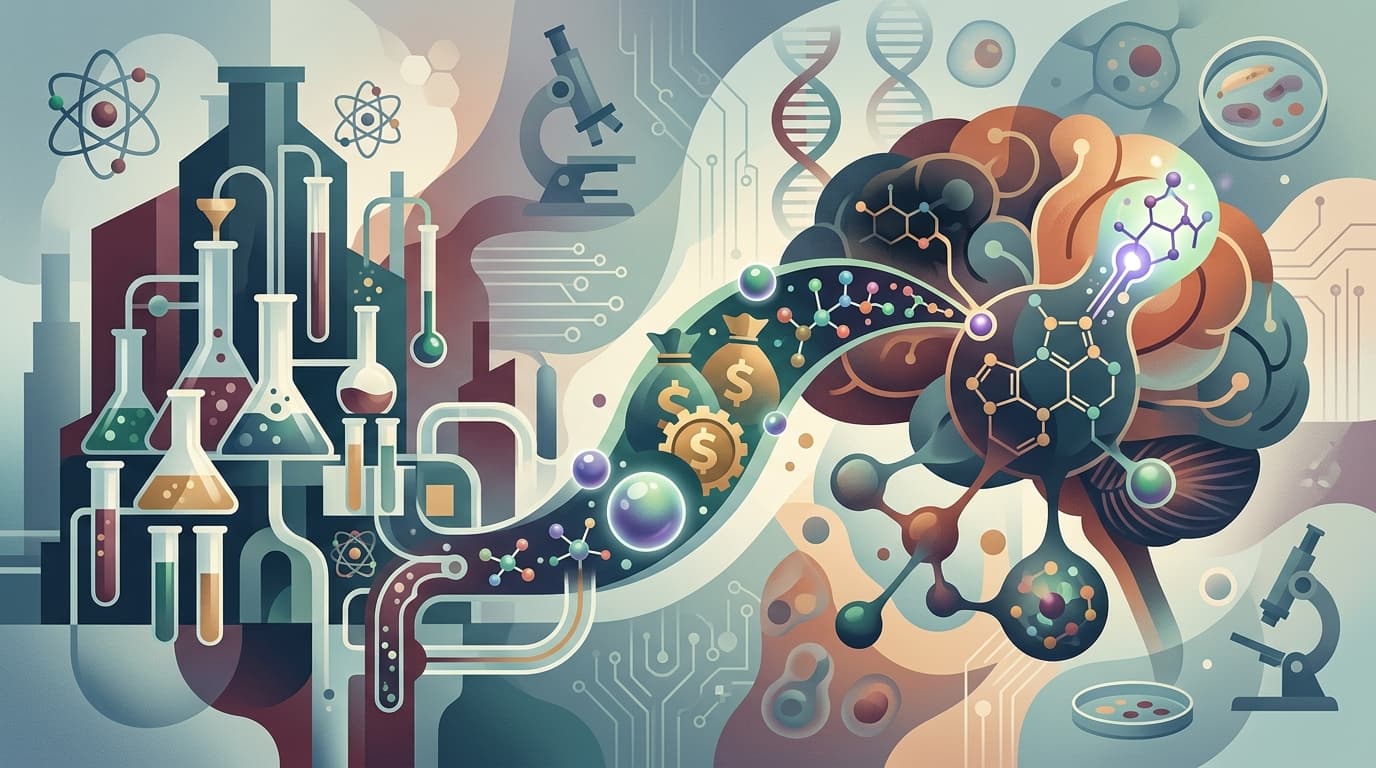

Eli Lilly is spending up to $3.8 billion to acquire AtaiBeckley, a psychedelic-medicine company with a nasal spray for treatment-resistant depression. It's the largest pharma acquisition ever for a psychedelic-mechanism drug, and Wall Street says it changes everything for the field.
For years, Big Pharma treated psychedelics like a dinner guest who shows up barefoot. Interesting, maybe, but not someone you'd invite inside. Eli Lilly just handed that guest the keys to the house.
Lilly announced it's acquiring AtaiBeckley, a clinical-stage company developing psychedelic-derived therapies for depression, in a deal worth up to $3.8 billion. That's $2.8 billion in cash upfront, plus another $1 billion tied to milestones. It's being called the largest Big Pharma acquisition ever focused specifically on psychedelic-mechanism therapeutics.
And it changes the game for an entire field that, until recently, most pharma executives wouldn't touch.
The crown jewel is BPL-003, an intranasal spray based on a compound called 5-MeO-DMT. It's a short-acting psychedelic designed to treat treatment-resistant depression (TRD), the roughly 30% of depression cases where standard antidepressants simply don't work. Think of TRD as the boss level of mood disorders: millions of patients, very few good options.
BPL-003 already has FDA Breakthrough Therapy designation, which is the agency's way of saying "this looks promising enough that we'll fast-track it." The drug cleared Phase 2 with flying colors, meeting all primary and secondary endpoints in a dose-finding study. A single nasal spray produced antidepressant effects within one to two days and held for at least eight weeks.
The practical appeal is hard to overstate. A treatment session lasts about two hours, compared to six to eight hours for psilocybin-based therapies. Patients spray, experience a brief psychedelic session under clinical supervision, and go home the same day. Two pivotal Phase 3 trials, called ReConnection-1 and ReConnection-2, are already underway as of Q2 2026, with results expected by early 2029.
Lilly also picks up VLS-01, a DMT-based buccal film (a thin strip that dissolves in the cheek) in Phase 2 for TRD. It's earlier-stage, but it gives Lilly a second shot on goal in the same space.

GSK beat Q2 estimates, then dropped a $2.5 billion restructuring bomb designed to save £1.9 billion a year by 2029. The real story? It's all about surviving the 2028 patent cliff on its blockbuster HIV drug, and GSK just doubled its Phase 3 trial starts to get there.

Join thousands of biotech professionals who start their day with our free, daily briefing.
For shareholders of AtaiBeckley, the math works out to $6.75 per share in cash, plus up to $2.50 per share through a Contingent Value Right (CVR). That's essentially a promise: hit certain milestones, get more money.
Those milestones are tied to specific clinical and regulatory events:
The deal represents roughly a 40% premium over AtaiBeckley's 30-day average trading price. No financing condition is attached; Lilly is paying from its own coffers. Closing is expected before the end of September 2026.
Some outlets are calling this the largest-ever Big Pharma mental health deal. That's true if you define the category narrowly around psychedelic-mechanism assets. In the broader CNS and psychiatry space, it's solidly mid-tier.
For context: Johnson & Johnson paid $14.6 billion for Intra-Cellular Therapies in 2025. Bristol Myers Squibb dropped roughly $14 billion on Karuna Therapeutics. AbbVie spent $8.7 billion on Cerevel. Those were mega-deals for traditional psychiatric drugs targeting schizophrenia and mood disorders.
At $3.8 billion, Lilly's bet is smaller in absolute dollars. But it's arguably bolder. Those other acquisitions involved well-understood pharmacology. Lilly is buying into psychedelics, a class of drugs that most of corporate America was afraid to even discuss five years ago.
Lilly has been on a neuroscience spending spree. It bought Centessa Pharmaceuticals for $6.3 billion to get into sleep disorders. It scooped up SiteOne Therapeutics for up to $1 billion to build a non-opioid pain franchise. It inked deals with AlzeCure and AC Immune to bolster its Alzheimer's portfolio. The company completed 39 business development transactions in 2025 alone, deploying over $4 billion.
But depression? That was a notable gap. Lilly has talked publicly about "innovative approaches" to major depressive disorder, and it's exploring whether its blockbuster weight-loss drugs (the incretin class) might have brain benefits. Yet it had no late-stage depression asset to point to.
AtaiBeckley fills that hole with a Phase 3 candidate, an FDA fast-track designation, and a mechanism of action that could redefine how we treat the toughest cases of depression.
Analysts are reading the deal as a turning point for psychedelic medicine broadly, not just for Lilly.
Stifel's Paul Matteis called the transaction "highly validating for the psychedelic space" and flagged it as positive for peers like Compass Pathways and Definium Therapeutics. Jefferies' Andrew Tsai predicted that psychedelics will "garner even more mindshare" as placebo-controlled data accumulates and regulatory momentum builds. Barclays' Emily Field said the acquisition aligns with Lilly's neuroscience expansion and offers upside in depression, one of pharma's largest addressable markets. BMO Capital Markets noted the deal gives Lilly "differentiated exposure in psychiatry" and pointed to increasing regulatory support for the category.
The subtext is clear: if Eli Lilly, a company worth hundreds of billions, is willing to write a check this large for a psychedelic drug, the stigma is officially lifting.
AtaiBeckley itself is a young company. It was formed in November 2025 when ATAI Life Sciences (a publicly traded psychedelic-medicine pioneer founded in 2018) merged with Beckley Psytech (a UK-based psychedelic company founded in 2019). Shareholders approved the combination with 98% of votes in favor. The merged entity redomiciled to the U.S. in December 2025, becoming a Delaware corporation headquartered in New York.
Barely eight months later, Lilly came knocking with a multi-billion-dollar offer. That timeline tells you something about how fast this space is moving.
The Phase 2 data for BPL-003 was genuinely striking. In one cohort, two-thirds of patients saw their depression scores cut by more than half within just two days of a single dose. Some maintained that improvement for nearly three months. In the open-label extension, 63% of patients met response criteria after a second dose. For a population that, by definition, hasn't responded to existing treatments, those numbers turn heads.
Plenty. Phase 3 trials fail all the time, even with strong Phase 2 data. The placebo effect in depression studies is notoriously large, which makes it harder for active drugs to show statistical separation. Then there's the DEA rescheduling question: BPL-003 is based on a controlled substance, and regulatory approval alone won't be enough. The drug needs to be rescheduled before it can be widely prescribed, a process with its own bureaucratic timeline.
Lilly structured the deal to hedge against these risks. A full $1 billion of the purchase price is contingent on clinical and regulatory milestones being met. If BPL-003 or VLS-01 stumble, Lilly's total outlay stays at $2.8 billion.
But the signal has been sent. Whether BPL-003 ultimately wins approval or not, the Overton window for this entire drug class just shifted dramatically.
The barefoot guest isn't just inside the house. He's sitting at the head of the table.
Pfizer just recalled lots of the only drug recommended to treat syphilis in pregnant women, compounding a shortage that's already lasted years. With congenital syphilis cases at historic highs, public health officials are calling it a preventable tragedy in slow motion.