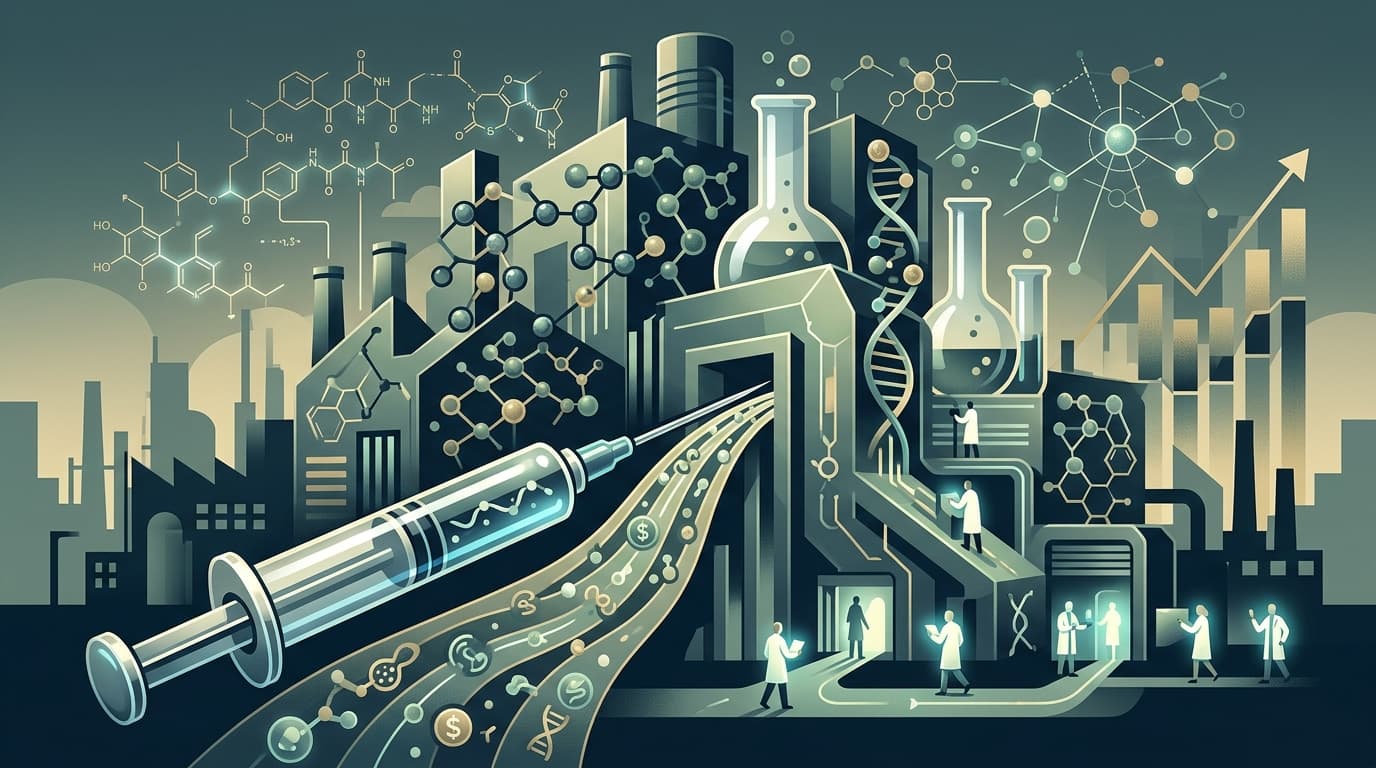
Eli Lilly Just Dropped $750M on a Factory. The Reason? A Pen.
Eli Lilly dropped $750 million on a manufacturing deal for a pen. Not a drug, not a molecule: a pen. But when GLP-1 demand is this insatiable, the company that can actually deliver wins.
Imagine a restaurant with a two-year waitlist. The food is incredible, the reviews are glowing, and customers are literally begging to get in. Your only problem? You can't cook fast enough.
That's basically Eli Lilly's situation right now. And the company just wrote a $750 million check to fix it.
The Pen That Launched a Billion-Dollar Problem
Lilly's obesity and diabetes drugs, Zepbound and Mounjaro, are among the hottest pharmaceuticals on the planet. Both use tirzepatide, a dual GIP and GLP-1 receptor agonist (a drug that mimics gut hormones to control blood sugar and crush appetite). Patients inject themselves once a week using a device called the KwikPen, a compact, pre-filled pen that holds a full month of treatment in a single unit.
The KwikPen is elegant. It's simple. And Lilly cannot make enough of them.
So the company partnered with Resilience, a biomanufacturing contractor, on a joint $750 million investment to massively expand KwikPen production at a facility in the Cincinnati, Ohio area. The expansion will create at least 400 new jobs, pushing Resilience's Ohio workforce past 1,400. Full operations are expected by early 2027.
This isn't a small bet. It's Lilly essentially saying: we see no ceiling on demand, and we refuse to be the company that can't deliver.
Why Lilly Can't Just Flip a Switch
If you've ever wondered why drug companies can't simply "make more," here's a useful analogy. Pharmaceutical manufacturing is less like turning up the volume on a speaker and more like building an entirely new concert hall. You need specialized equipment, sterile environments, regulatory inspections, validated processes, and trained workers. That process takes years, not months.
Lilly has been pouring money into this problem at a staggering pace. Since 2020, the company has committed more than $18 billion to manufacturing expansions across the U.S. and Europe. Its flagship site in Lebanon, Indiana alone has received in total investment and is expected to start producing tirzepatide API (the active ingredient) by late 2026, with operations scaling through 2028.
Get tomorrow's biotech intelligence before your competitors.
Join thousands of biotech professionals who start their day with our free, daily briefing.
$9 billion
Other projects include plants in Concord, North Carolina and Limerick, Ireland, plus an acquired injectable facility in Pleasant Prairie, Wisconsin that was expected to begin production by the end of 2025. Lilly has said it aimed to produce at least 50% more sellable doses of tirzepatide than it made in 2023.
All of that, and the company still needs more capacity. That tells you everything about how enormous GLP-1 demand has become.
Enter Resilience: The CDMO With a Wild Origin Story
Resilience isn't your typical contract manufacturer. The company was founded in 2020, right in the teeth of the pandemic, with the explicit goal of strengthening America's pharmaceutical supply chain. Think of a CDMO (contract development and manufacturing organization) as a hired kitchen: pharma companies design the recipes, and CDMOs cook the food at scale.
Resilience came out swinging. It launched with an $800 million initial investment, backed by venture heavyweights ARCH Venture Partners and 8VC. A $625 million round followed in 2022. Then in 2023, the U.S. Department of Defense and Development Finance Corporation kicked in $410 million in long-term financing, signaling that the government viewed biomanufacturing resilience as a national security priority.
All told, the company has raised over $2 billion since its founding. In 2025, it secured up to $825 million in additional debt financing from Oak Hill Advisors to support its strategy.
But Resilience's path hasn't been perfectly smooth. Reports in 2025 indicated the company was winding down six facilities as part of a streamlining effort, consolidating around core sites in Cincinnati and Toronto. That's a classic startup move: expand aggressively, then contract to where you're strongest.
The Lilly partnership predates this latest investment. The two companies started working together in 2023, and Resilience has already helped produce more than 150 million doses in vial and pre-filled syringe formats. This $750 million expansion takes that relationship to a different level entirely, shifting from "helpful partner" to "critical infrastructure."
The KwikPen: Small Device, Massive Stakes
Let's talk about what's actually being manufactured here. The Zepbound KwikPen is a four-dose, single-patient-use pen designed for weekly self-injections. Patients jab themselves in the abdomen, thigh, or upper arm. Zepbound comes in six dosage strengths ranging from 2.5 mg to 15 mg, with self-pay pricing starting at $299 per month for the lowest dose through Lilly's direct channel.
The KwikPen also delivers Lilly's insulin products, including Humalog and its mix formulations, for diabetes patients. So the manufacturing expansion doesn't just serve the obesity market; it supports Lilly's broader injectable portfolio.
That dual purpose matters. Lilly isn't building capacity for a single product that might cool off. It's investing in a delivery platform that underpins multiple blockbusters across two massive therapeutic areas.
The GLP-1 Supply Chain: Better, But Not Fixed
Remember the GLP-1 shortage headlines from 2023 and 2024? The situation has improved considerably. The FDA removed Mounjaro and Zepbound from its drug shortage list after Lilly demonstrated that its supply could meet current and projected U.S. demand.
Novo Nordisk, Lilly's main GLP-1 rival, has also made progress. Most Ozempic and Wegovy presentations are now listed as available, though some starter Wegovy doses still had limited availability in recent reports.
But "better" doesn't mean "solved." Analysts have warned that fluctuating demand could still create temporary tightness for specific dose strengths. When you're selling a drug to a patient population that numbers in the tens of millions, even small mismatches between supply and demand create real problems.
This is why Lilly keeps investing. The company isn't just solving today's shortage. It's building for a market that, according to Morgan Stanley, could more than double to $190 billion globally by 2035. Broader insurance coverage, new oral formulations, and expanded indications could all push GLP-1 adoption higher than current forecasts.
Lilly's CDMO Strategy: Bridge and Build
The Resilience deal fits a clear pattern in Lilly's playbook. The company uses CDMOs as a bridge while its own massive facilities come online.
Beyond Resilience, reporting from 2024 linked Lilly to contract manufacturers including Catalent for tirzepatide production. BSP Pharmaceuticals was also reportedly involved in fill/finish work (the final step where the drug gets loaded into its delivery device). Lilly hasn't confirmed all of those names publicly, saying only that it uses "an extensive portfolio of external contract manufacturers."
The strategy makes sense. Building a pharmaceutical plant from scratch takes three to five years. Using CDMOs lets Lilly capture demand now while its Lebanon, Indiana megafactory and other owned sites ramp up over the next couple of years. Once the internal capacity is fully online, CDMOs could shift to overflow and surge capacity.
It's the pharmaceutical equivalent of renting extra kitchen space for the holiday rush while your new restaurant is under construction.
The Bull Case and the Bear Case
Most analyst commentary on the Resilience deal has been straightforward: this is a necessary move to protect market share in the hottest drug category in a generation. More domestic capacity should improve supply reliability and align Lilly with U.S. policy preferences for resilient medicine supply chains.
The bull case writes itself. GLP-1 demand keeps climbing, Lilly's manufacturing network scales to meet it, and the company dominates a $190 billion market.
The bear case is more subtle but worth considering. A $750 million fixed investment concentrated in obesity and diabetes products becomes a drag if competition intensifies or pricing pressure weakens demand. Lilly isn't the only company chasing this market; Novo Nordisk, Amgen, Viking Therapeutics, and others all have GLP-1 programs at various stages. If oral GLP-1 drugs eventually reduce the need for injectables, all that KwikPen capacity could become less valuable.
That said, betting against GLP-1 demand right now feels a bit like betting against smartphones in 2010. The trajectory is clear, even if the exact shape of the market is still forming.
The Bottom Line
Eli Lilly's $750 million investment in Resilience isn't glamorous. It's not a flashy acquisition or a splashy clinical trial result. It's a factory deal for a pen.
But it might be one of the most important moves Lilly makes this year. In pharma, the company that can actually deliver the drug wins. Brilliant science means nothing if patients can't get the medicine. Lilly has spent over $18 billion to make sure that doesn't happen, and this Resilience partnership is the latest piece of that puzzle.
The obesity drug revolution isn't constrained by demand. It's constrained by the ability to fill pens, inspect vials, and ship boxes. Lilly just bet three quarters of a billion dollars that it can solve that problem faster than anyone else.
4 min read
A Seal in South Australia Just Became a Pandemic Warning Sign
Australia just confirmed H5N1 bird flu in a local mammal for the first time: a long-nosed fur seal found on a South Australian beach. It's a quiet milestone with loud implications for pandemic preparedness, and it signals the virus is finding new footholds in the Southern Hemisphere.