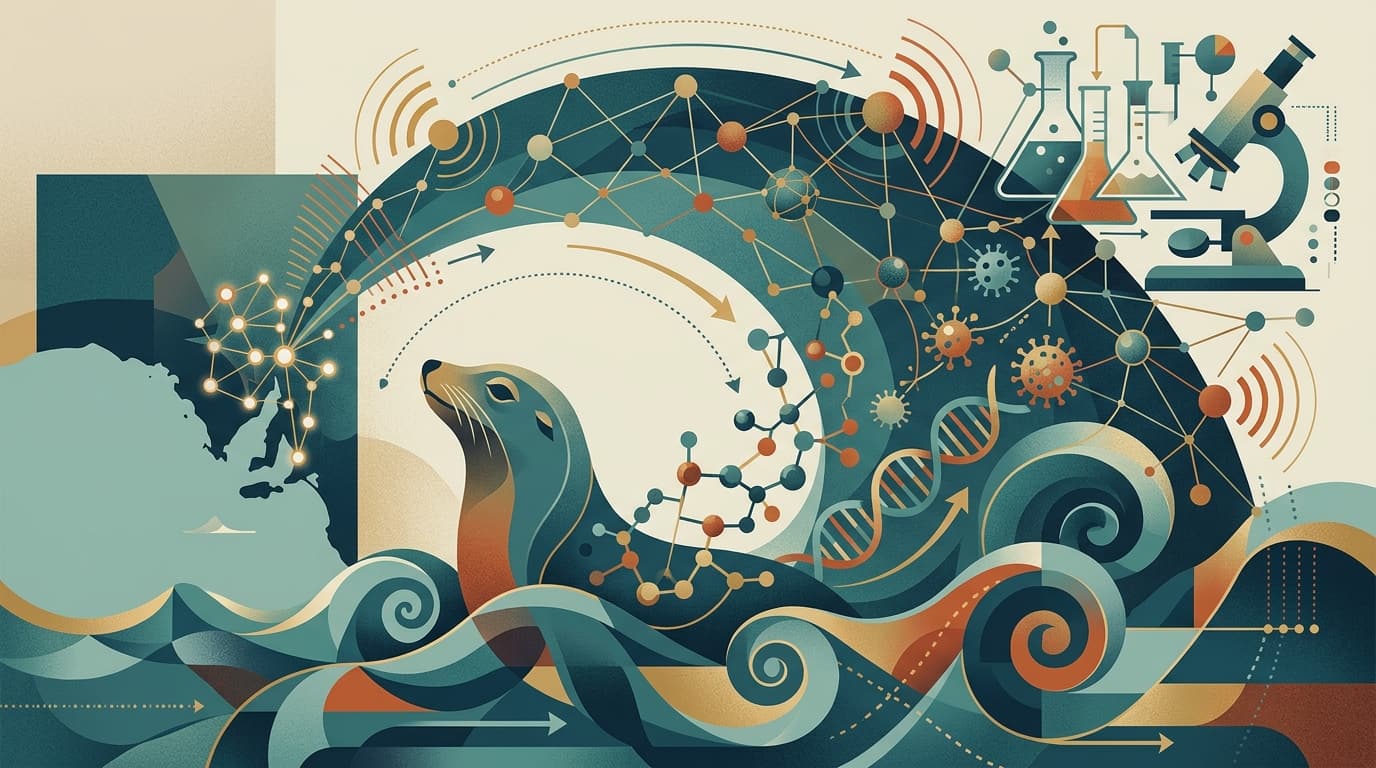

Australia just confirmed H5N1 bird flu in a local mammal for the first time: a long-nosed fur seal found on a South Australian beach. It's a quiet milestone with loud implications for pandemic preparedness, and it signals the virus is finding new footholds in the Southern Hemisphere.
A long-nosed fur seal washed up on a beach in South Australia. By itself, that's not unusual. Seals wash up on Australian coastlines all the time. But this seal carried something that had never been found in an Australian mammal before: H5N1 bird flu.
The confirmation, announced on August 23, marks a quiet but significant escalation in the global story of avian influenza. Australia, a continent that has stayed remarkably insulated from the worst of the bird flu pandemic sweeping the world, just lost a layer of protection.
The animal was found at Beachport, a small coastal town about 310 kilometers south of Adelaide. Federal and state authorities sent samples to CSIRO's Australian Centre for Disease Preparedness, the country's top biosecurity lab, which confirmed the result.
This isn't Australia's first brush with H5N1 in 2026. Back in June, the virus showed up in a wild brown skua (a seabird) in Western Australia. That was concerning, but birds catching bird flu is, well, expected. It's in the name. A mammal catching it is a different conversation entirely.
Think of it this way: if bird flu spreading among birds is like a rumor circulating in one friend group, the jump to mammals is that rumor crossing into a completely different social circle. It means the virus is finding new doors to walk through.
The reason scientists pay such close attention to mammalian infections is simple. Humans are mammals. Every time H5N1 successfully infects a mammal, it gets a chance to practice replicating in cells that look a lot more like ours than a bird's do.
Globally, H5N1 clade 2.3.4.4b (the strain currently circling the planet) has spilled into more than 20 mammalian species since 2020: cats, foxes, minks, harbor seals, sea lions. The list keeps growing. Scientists watch for specific genetic changes, particularly mutations in a gene called PB2, that help the virus replicate more efficiently in mammalian cells. These mutations have already appeared in a Texas dairy farm worker, a bobcat in Kansas, and red foxes in the Netherlands.

Taiho and Cullinan just dropped positive Phase 3 lung cancer data that puts them on a collision course with J&J's Rybrevant franchise. The full numbers aren't out yet, but Wall Street is already raising its eyebrows.


Join thousands of biotech professionals who start their day with our free, daily briefing.

None of that has translated into sustained human-to-human spread. Not yet. Health agencies, including the CDC, have repeatedly said they're not seeing the full set of changes that would signal easy transmission between people. But every new mammalian host is another roll of the dice.
Australia has been something of a fortress when it comes to bird flu. The country has never had an H5N1 outbreak in its poultry. Its history of highly pathogenic avian influenza is limited to H7 subtypes, a different branch of the family tree, and those outbreaks were contained and eradicated.
The only Australian human H5N1 case happened in 2024, when a child was infected overseas and recovered fully after returning home. No local transmission followed.
This geographic isolation has been a genuine advantage. Australia sits at the end of migratory flyways rather than at the crossroads of them, which has slowed the virus's arrival. But the June seabird detection and now the August seal case suggest that buffer is eroding. The virus has arrived, and it's not just passing through the skies; it's settling into the local wildlife.
Australian experts are calling for intensified surveillance of marine mammals and resident bird populations. The logic is straightforward: if the virus is in seals, it could already be in other coastal wildlife that hasn't been tested yet. International experts have emphasized that monitoring resident (non-migratory) species is especially important because they can act as a reservoir, keeping the virus circulating locally even after migratory birds move on.
The good news is that Australian authorities still assess the risk to humans as low. There have been no human infections of this clade in Australia. The immediate priority isn't a public panic response; it's strengthening the surveillance net and speeding up genomic sequencing to track whether the virus is changing as it spreads among local wildlife.
On the vaccine front, Australia's preparedness leans heavily on CSL and its subsidiary Seqirus, which maintain a pandemic influenza manufacturing platform. CSL has said it could begin releasing an adapted H5N1 vaccine within approximately 18 weeks of strain selection and scale to national supply over approximately six months after a pandemic declaration. The platform uses established egg-based or cell-based manufacturing, not the newer mRNA approach.
For mRNA options, the most advanced pandemic flu program belongs to Moderna, which is developing an H5/H7 bird flu vaccine. However, expanded U.S. government funding for the program was canceled in May 2025, and Moderna continues development with other support. Australia doesn't appear to have a domestic mRNA bird flu candidate, which means the country's readiness depends largely on CSL's existing infrastructure.
Zoom out and Australia's seal case fits into a pattern that's been building for two years. H5N1 is no longer just a poultry problem or a wild bird problem. It's a mammal problem, spreading across continents and species with a persistence that keeps pandemic preparedness experts up at night.
The genotype that dominated North American bird populations (called D1.1) expanded rapidly across multiple migratory flyways in 2024. European lineages showed up in Africa by 2025. And now the Southern Hemisphere's most isolated major landmass has its first mammalian case.
None of this means a pandemic is imminent. The virus still lacks the full toolkit for efficient human spread, and that's a crucial distinction. But the trend line is moving in the wrong direction. Each new mammalian species, each new continent, each new genetic tweak narrows the gap between "low risk" and "elevated concern."
A sick seal on a quiet South Australian beach won't make most people's news feeds. But in the world of pandemic preparedness, it's the kind of signal that gets phone calls made and surveillance budgets reviewed. The virus is knocking on doors it hasn't knocked on before. The question is whether we'll be ready if one of them opens.
Moderna and Merck just delivered the first-ever positive Phase 3 result for an mRNA cancer vaccine, sending Moderna's market cap soaring by $45 billion in a single day. The personalized melanoma vaccine could reshape oncology and rewrite Moderna's post-COVID narrative.