
The Novo Nordisk Foundation just made its largest donation ever: $861 million over a decade to turn Denmark's BioInnovation Institute into a European biotech powerhouse. The catch? It's not just about drugs anymore.
Novo Nordisk made roughly $25 billion selling weight-loss and diabetes drugs last year. The foundation that controls Novo Nordisk just decided to spend a chunk of that windfall on something unusual: turning Copenhagen into the biotech equivalent of Silicon Valley.
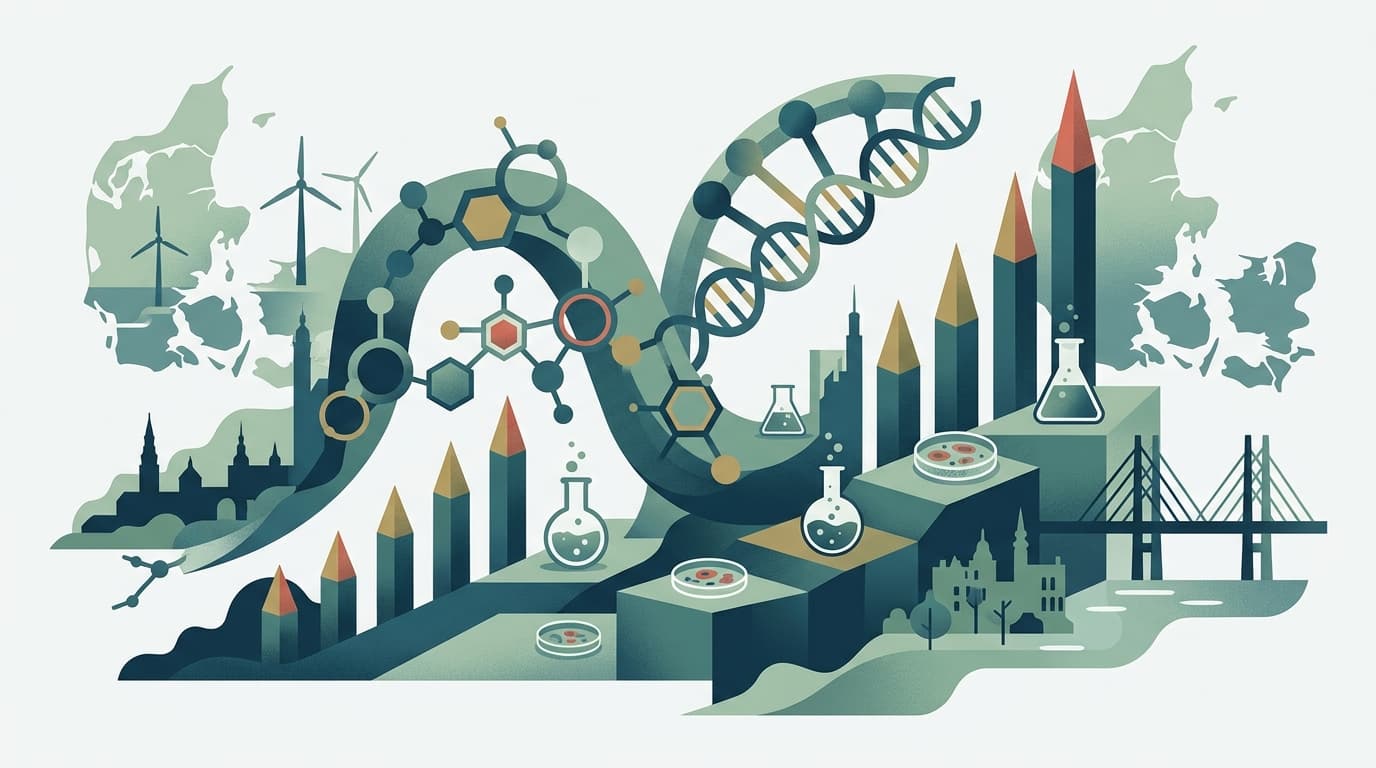
The Novo Nordisk Foundation committed up to $861 million over the next decade to Denmark's BioInnovation Institute (BII), a startup incubator that helps scientists turn lab discoveries into actual companies. It's the foundation's largest single donation ever, and it lands at a moment when Europe is openly panicking about losing the biotech race to the United States.
Think of it like this: if building a biotech company is like climbing Everest, BII is the base camp. It gives scientists funding, lab space, business coaches, and connections to investors. The foundation just upgraded that base camp into a five-star resort.
BII launched in 2018 as a life sciences incubator in Copenhagen. Since then, it's supported over 142 startups and helped put 21 products on the market. Companies that went through BII's programs raised roughly five times more capital than what BII initially gave them, a solid return for what's technically a nonprofit.
The institute currently supports about 20 startups per year. With this new funding, that number jumps to 30 or even 40 annually. Over a decade, we're talking hundreds of new biotech and deep-tech companies flowing out of Copenhagen.
This new commitment represents a massive scaling of the total investment. It's the difference between running a nice incubator and building an institution that can reshape an entire continent's innovation pipeline.
The most interesting wrinkle? BII is expanding way beyond traditional biotech. The new funding explicitly covers artificial intelligence and quantum computing, areas that seem unrelated to drug development until you realize they're becoming inseparable from it.

BioMarin closed its $270 million Inozyme acquisition on July 1st. Five days later, the drug failed its key Phase 3 bone-healing endpoint despite hitting its biochemical target. The ultra-rare disease bet just got a lot riskier.


Join thousands of biotech professionals who start their day with our free, daily briefing.
BII has already launched an AI Lab that gives early-stage AI startups non-dilutive funding (meaning they don't give up equity), access to datasets, computing power, and technical mentorship. There's also a Quantum Lab focused on quantum computing, quantum communication, and quantum sensing, built in collaboration with NATO's defense innovation arm, DIANA.
The logic is convergence. AI is already revolutionizing drug discovery and protein design. Quantum computing could crack molecular simulations that classical computers can't touch. By housing all three disciplines under one roof, BII is betting that the next generation of biotech breakthroughs won't come from biology alone; they'll come from biology plus computation.
Europe has a well-documented problem. Its universities produce world-class science, but that science often dies in the lab or gets commercialized in Boston instead of Berlin. The pharmaceutical industry has been sounding alarms about Europe lagging behind other regions in life sciences competitiveness for years.
The Novo Nordisk Foundation is essentially trying to patch this gap with money and infrastructure. BII CEO Jens Nielsen has framed the funding as positioning Denmark as "a leading epicenter for science-driven innovation." Foundation CEO Mads Krogsgaard Thomsen said the goal is ensuring "even more science is translated into new companies, jobs and solutions benefiting people and our planet."
It's an ambitious vision. But when you're backed by the profits from the world's most successful obesity drug, ambition is affordable.
To put the $861 million in context: Howard Hughes Medical Institute committed $500 million to AI-powered biomedical research in 2024. Columbia received a $400 million gift for biomedical research infrastructure the same year. The Parker Institute added $125 million for cancer translation.
BII's new funding frame sits near the top of this list, and it's notable because it's not just supporting research. It's funding the messy, expensive, often-neglected middle ground between a scientific discovery and a functioning company. That translational space is where most promising science goes to die, and the Novo Nordisk Foundation is building a decade-long bridge across it.
There's a legitimate concern here, though. Denmark's innovation economy is becoming remarkably dependent on a single foundation, which itself depends on a single company's stock price. If Novo Nordisk's GLP-1 drugs face unexpected competition or safety issues, the fountain of philanthropic capital could slow to a trickle.
The foundation's grantmaking has already surged from DKK 3.9 billion in 2018 to nearly DKK 10.1 billion in 2024, fueled by Novo Nordisk's booming profits. That's great when business is good. But building an entire national innovation strategy on one company's success is a bit like putting your retirement savings into a single stock: thrilling on the way up, terrifying on the way down.
The real test won't be how many startups BII creates. It'll be how many survive and scale. Can Copenhagen-born biotech companies reach late-stage clinical trials and global markets without relocating to Cambridge, Massachusetts? Can BII become a truly pan-European platform rather than a Nordic-centric accelerator with European collaborations?
The next few years will tell us whether this is a transformational bet or an expensive experiment. Either way, Denmark just staked nearly a billion dollars on the idea that Europe's biotech future doesn't have to be built in America. For a small country of six million people, that's one hell of a power move.
Immunovant's FcRn inhibitor failed two Phase 3 trials in thyroid eye disease, costing $39 million to shut down. The failure isn't just one company's problem; it's exposing the limits of an entire drug class that Wall Street thought could conquer all of autoimmunity.