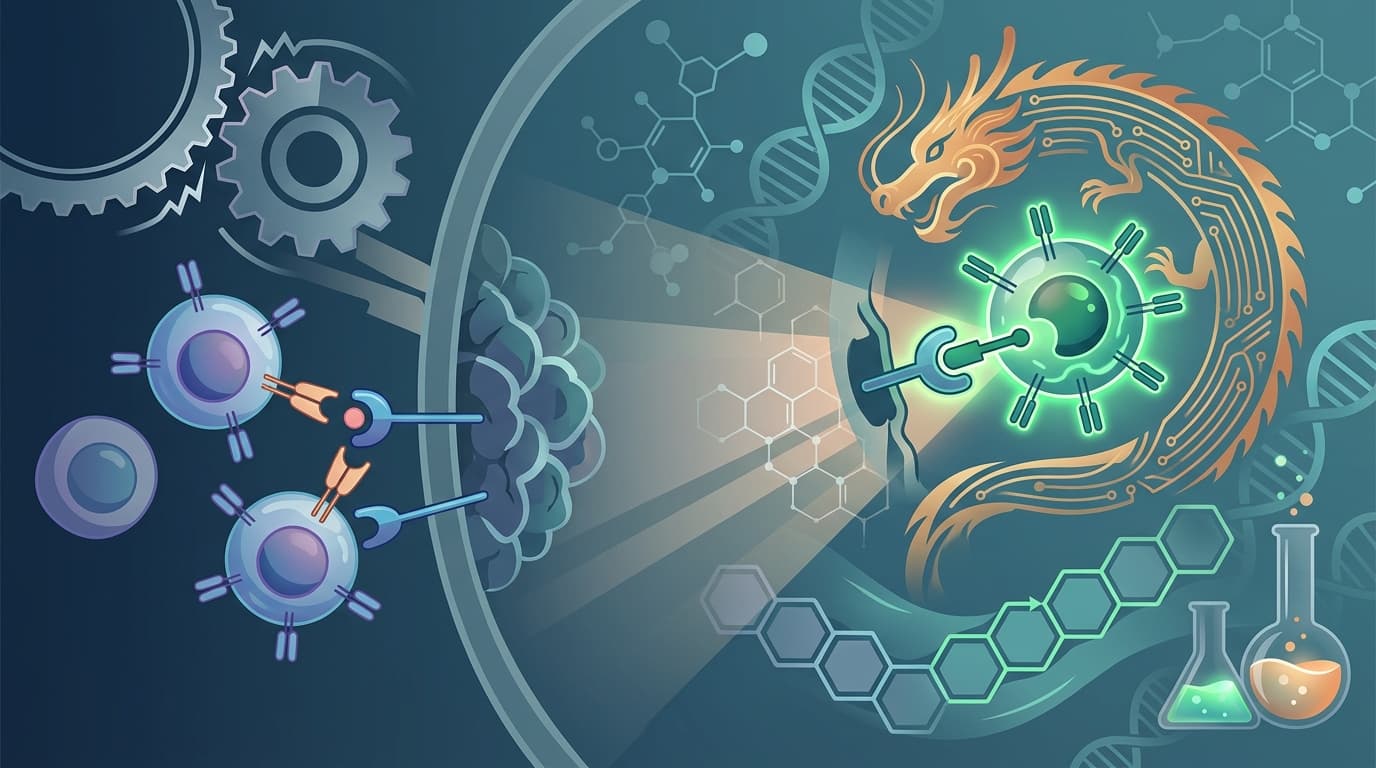
For a decade, CAR-T therapy crushed blood cancers but couldn't touch solid tumors. A Chinese biotech just became the first company in the world to change that, and the implications go way beyond stomach cancer.
For a decade, CAR-T cell therapy has been the golden child of cancer treatment. It revolutionized blood cancers, sending leukemia and lymphoma patients into remissions that felt almost miraculous. But solid tumors? Those dense, fortress-like masses that make up the vast majority of cancers? They chewed up CAR-T cells and spit them out.
Until now.
On June 22, China's National Medical Products Administration (NMPA) accepted the New Drug Application for satricabtagene autoleucel (satri-cel, also known as CT-041), a CAR-T therapy made by Shanghai-based CARsgen Therapeutics. It's intended for advanced stomach and gastroesophageal junction cancer. And it's poised to become the first CAR-T cell therapy ever approved for a solid tumor, anywhere in the world.
That's not a typo. The biggest breakthrough in cell therapy's decade-long war against solid tumors didn't come from Novartis, Gilead, or Bristol Myers Squibb. It came from a Chinese biotech most Western investors have never heard of.
The Wall That Nobody Could Climb
To understand why this matters, you need to know why CAR-T has been stuck.
CAR-T therapy works by extracting a patient's own immune cells, genetically engineering them to recognize cancer, then infusing them back in. Think of it like training a squad of snipers to hunt a very specific target. In blood cancers, the targets are clear: proteins like CD19 sit on virtually every cancer cell and nowhere else important. Easy pickings.
Solid tumors are a different beast entirely. Imagine those same snipers trying to storm a medieval castle. The walls are thick (dense tumor tissue blocks immune cells from getting in). The air is toxic (the tumor microenvironment starves T-cells of oxygen and nutrients). The enemy keeps changing uniforms (cancer cells can stop displaying the protein the CAR-T cells are trained to find). And some friendly villagers wear the same uniform as the enemy, creating "on-target, off-tumor" collateral damage.
About 25% of all CAR-T clinical trials globally now target solid tumors. Hundreds of attempts. Years of work. Zero approvals, until this week.
Get tomorrow's biotech intelligence before your competitors.
Join thousands of biotech professionals who start their day with our free, daily briefing.
What CARsgen Actually Proved
Satri-cel targets a protein called Claudin18.2, which is found on certain stomach cancer cells. CARsgen didn't just run a small, single-arm study and call it a day. They ran something the field had never seen before: the first-ever randomized controlled trial of CAR-T therapy in solid tumors.
The pivotal trial (CT041-ST-01) enrolled patients with advanced stomach cancer who had already failed at least two rounds of treatment. Half got satri-cel; half got whatever their doctor thought was best. The results, published in The Lancet, told a compelling story.
Patients on satri-cel saw their median progression-free survival nearly double: 3.25 months versus 1.77 months for standard care. Overall survival improved too, stretching to 7.92 months compared to 5.49 months. The response rate was 30% in the CAR-T group versus just 4% in the control arm.
Now, let's be honest: those numbers aren't going to make anyone pop champagne at first glance. A few extra months of survival sounds modest. But context matters enormously here. These are patients who have exhausted their options. In late-line stomach cancer, anything that moves the needle is significant. And the sevenfold difference in response rates tells you this therapy is doing something real.
The Side Effects: Expected, But Intense
CAR-T comes with baggage, and satri-cel is no exception. Nearly 95% of patients experienced cytokine release syndrome (CRS), the inflammatory storm that happens when CAR-T cells go to work. The good news: only about 4-5% of cases were severe. The better news: zero cases of neurotoxicity (called ICANS), which plagues some blood cancer CAR-T products.
The trade-off is serious blood count drops. Almost every patient saw severe drops in lymphocytes and white blood cells, a consequence of the chemotherapy given before infusion to make room for the engineered cells. It's manageable in experienced centers, but it's not a casual outpatient experience.
Why China, and Why It Matters
This is where things get geopolitically interesting. No Western solid-tumor CAR-T program has made it past early-phase trials. Most are still in Phase 1. Meanwhile, China has been rapidly expanding its approved CAR-T portfolio, accounting for a significant share of the global total.
CARsgen isn't some overnight sensation, either. Founded in 2014, the company launched the world's first Claudin18.2 CAR-T trial back in 2017. They raised over $275 million across funding rounds before going public on the Hong Kong Stock Exchange in 2021. They have manufacturing facilities in both Shanghai and Research Triangle Park, North Carolina, with a Phase 1b trial already running in North America.
The company has also lined up partnerships with Moderna (to combine satri-cel with an mRNA cancer vaccine) and Dispatch Bio (an oncolytic virus platform), both aimed at making CAR-T work even better in solid tumors. These aren't the moves of a company content with a single niche approval.
What This Means for Everyone Else
Western regulators and companies are watching closely. Several solid-tumor CAR-T programs are advancing through FDA pathways, but none are close to approval. The closest Western parallel isn't even CAR-T; it's a TCR therapy called afami-cel, approved for synovial sarcoma, which proved that engineered T-cells can get regulatory green lights for solid tumors.
For the broader cell therapy industry, satri-cel's NDA acceptance does something invaluable: it de-risks the entire concept. Investors who wrote off solid-tumor CAR-T as science fiction now have a real-world regulatory precedent taking shape. Companies sitting on Claudin18.2 programs, or similar targets in pancreatic and biliary cancers, suddenly have validation that the biology works.
CARsgen expects to treat its first commercial patients following approval. Pricing details are expected imminently.
The Bigger Picture
Let's zoom out. Satri-cel isn't going to cure stomach cancer. The survival gains, while meaningful, are measured in months, not years. The manufacturing process remains complex and expensive. And success against Claudin18.2-positive gastric cancer doesn't guarantee CAR-T will work against lung, colon, or breast tumors with entirely different biological challenges.
But breakthroughs rarely arrive as finished products. They arrive as proof that something once thought impossible is, in fact, possible. Penicillin didn't cure every infection on day one. The first successful organ transplant didn't mean everyone could get a new kidney next week.
What happened on June 22 in China was this: a wall that stood for over a decade finally got a crack in it. The race to widen that crack just got a lot more crowded, and a lot more interesting.
Deals & M&A4 min read
Eli Lilly Just Spent $6.3 Billion to Fix a Problem You Didn't Know It Had
Eli Lilly is paying up to $7.8 billion for Centessa Pharmaceuticals and its experimental sleep disorder drugs. It's the biggest signal yet that the GLP-1 king is building a second empire, and the orexin agonist race just got a lot more interesting.