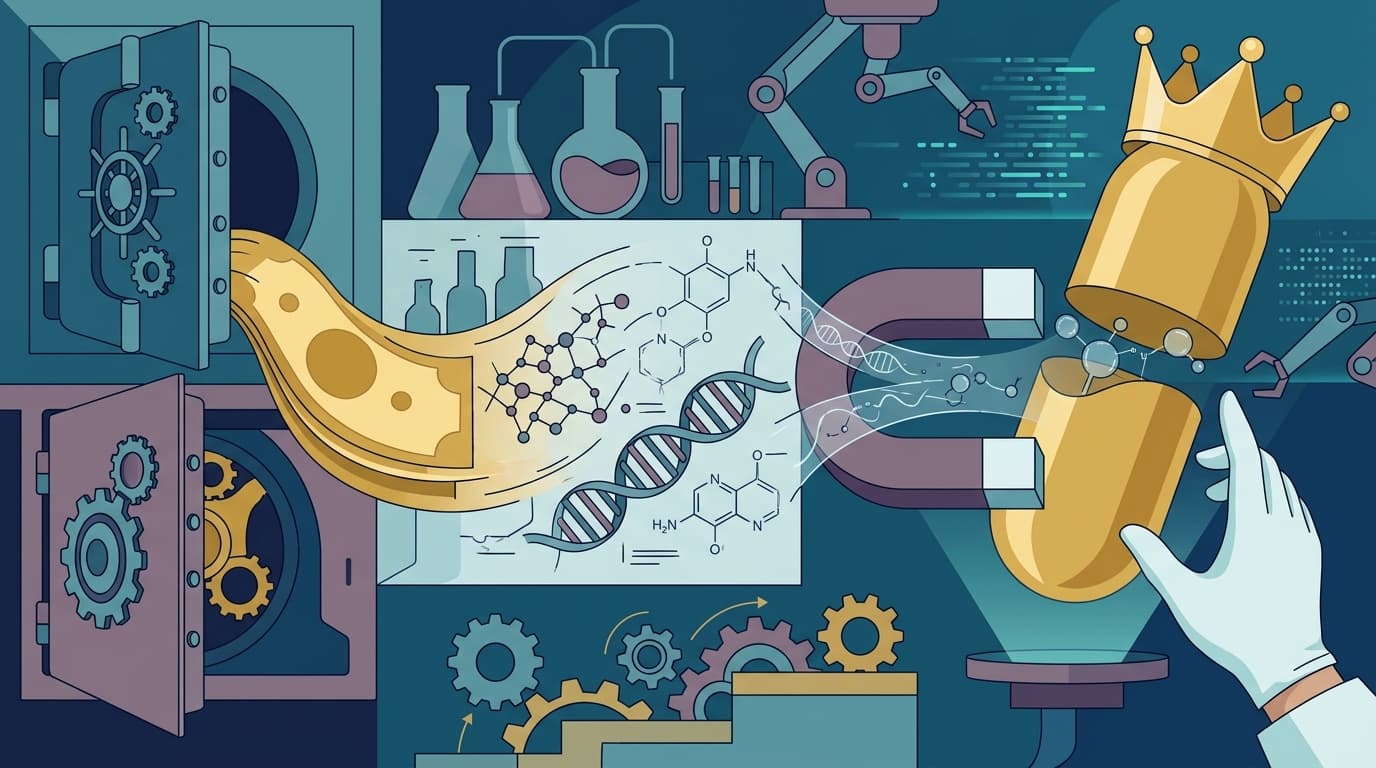
Merck Just Spent $6.7 Billion on a Drug Most People Have Never Heard Of
Merck is dropping $6.7 billion on a CML drug still in early trials, and Wall Street can't decide if it's a heist or a gamble. With Keytruda's $25 billion patent cliff looming in 2028, the deal reveals just how aggressively Big Pharma's biggest player is scrambling to reinvent itself.
Merck has a $25-billion-a-year problem. It's called Keytruda, and it's about to go off-patent.
That sounds backwards. How can the best-selling cancer drug on Earth be a problem? Because when your biggest moneymaker loses patent protection in late 2028, every generic drugmaker on the planet lines up to clone it. And Merck knows the clock is ticking.
So on Tuesday, Merck announced it would acquire Terns Pharmaceuticals for $6.7 billion in cash, paying $53 per share for a company most investors outside of hematology circles have barely heard of. The prize: an experimental pill called TERN-701 that treats chronic myeloid leukemia (CML), a blood cancer that affects roughly 10,000 new Americans every year.
The deal tells you everything about where Merck's head is right now. And it raises a fascinating question: is $6.7 billion a steal, or a gamble?
The Keytruda Clock
To understand why Merck is writing these kinds of checks, you need to understand the panic behind the curtain.
Keytruda (pembrolizumab) is the world's top-selling cancer drug. It pulled in over $25 billion in 2023 alone. It treats dozens of tumor types. It's basically Merck's entire personality at this point.
But its core U.S. patent expires in December 2028. That's roughly two and a half years from now. When that happens, biosimilar competitors (think: generic versions of biological drugs) will flood the market, and Keytruda's revenue will start to crater.
Analysts estimate that nearly half of Merck's 2024 pharmaceutical revenue is at risk from patent expirations hitting between 2025 and 2029, with Keytruda as the single biggest piece. This isn't a pothole; it's a sinkhole.
Merck isn't sitting still, of course. They've launched Keytruda Qlex, a subcutaneous (under-the-skin) version with its own patent protection stretching into the 2030s and beyond. They're targeting 30 to 40 percent of U.S. Keytruda patients to switch to Qlex by 2028. That buys time, but it doesn't solve the fundamental math problem.
Get tomorrow's biotech intelligence before your competitors.
Join thousands of biotech professionals who start their day with our free, daily briefing.
Which is why Merck has gone on an acquisition spree: Verona Pharma for ~$10 billion (respiratory), Cidara Therapeutics for ~$9.2 billion (infectious disease), Harpoon Therapeutics (cancer immunotherapy). And now Terns, at $6.7 billion, to plant a flag in blood cancer.
So What Exactly Did Merck Buy?
Terns Pharmaceuticals is essentially a one-asset company, and that asset is TERN-701.
Here's the plain English version: CML is a blood cancer caused by a mutant protein called BCR-ABL1. Think of this protein as a broken "on" switch that tells white blood cells to multiply nonstop. For 20+ years, doctors have treated CML with pills called tyrosine kinase inhibitors (TKIs) that block this switch.
The first-generation drug, imatinib (brand name Gleevec), was a genuine miracle of modern medicine. It turned CML from a death sentence into a manageable chronic disease. But here's the catch: a significant portion of patients either stop responding to these drugs or can't tolerate the side effects. Their cancer finds workarounds, like a burglar who keeps picking new locks.
That's where TERN-701 comes in. It's what's called an allosteric inhibitor, meaning it doesn't attack the same spot on the protein as traditional TKIs. Instead, it binds to a completely different pocket on the molecule (called the myristoyl pocket). If traditional CML drugs are trying to jam the front door lock, TERN-701 sneaks around to the back entrance.
There's already one approved drug in this class: asciminib, made by Novartis. But TERN-701 appears to work even in patients who've already tried and failed asciminib, which is a big deal in a disease where running out of treatment options is a real risk.
The Data That Caught Merck's Eye
TERN-701 is still in a Phase 1/2 trial called CARDINAL, so we're talking about relatively early data. But the numbers are eye-catching.
At the ASH (American Society of Hematology) conference in December 2025, Terns presented updated results from 63 patients. Among 38 who were evaluable for efficacy, 74% achieved a major molecular response (MMR) by 24 weeks. In cancer-speak, MMR means the amount of disease in the blood dropped to extremely low levels. Getting three-quarters of previously treated patients to that milestone in just six months is genuinely impressive.
Even deeper responses showed up: 36% of patients hit deep molecular response at the recommended doses, suggesting the drug wasn't just controlling the disease but hammering it down to barely detectable levels.
Perhaps most importantly, these results held up in heavily pretreated patients, including those who'd already tried asciminib and other drugs. Terns' data showed "significant molecular responses" even in patients with high disease burden and multiple prior lines of therapy.
On the safety side, no dose-limiting toxicities were observed at any dose tested (up to 500 mg daily). Most side effects were mild. No patients in the dose-escalation phase had to stop treatment or reduce their dose because of adverse events. No concerning blood pressure signals. No alarming liver enzyme spikes.
The FDA has already granted TERN-701 Breakthrough Therapy Designation, which is essentially the agency's way of saying: "We think this could be something special; let's fast-track the conversation."
The Price Tag Debate
Wall Street's reaction has been split, which makes this story fun.
The $53-per-share offer represents about a 31% premium to Terns' 60-day average price and a 42% premium to its 90-day average. On the surface, that looks generous. Mizuho Securities called it an "excellent outcome for shareholders," especially given Terns' historically depressed stock price.
But several biotech-specialist analysts are crying foul.
Leerink Partners didn't mince words, saying the deal price "vastly underestimates the potential for TERN-701." Their model projects over $1 billion in annual sales by 2032 and peak sales of roughly $6.2 billion per year by 2040. If those numbers are even in the ballpark, Merck is paying $5.7 billion (net of Terns' cash on hand) for a drug that could generate multiples of that.
William Blair initially suggested the price was low enough that a rival bidder might swoop in. They've since backed off that prediction, but they still maintain the deal "underestimates the potential" and project blockbuster-level sales by 2032.
On Merck's side, the big investment banks are largely supportive. Guggenheim reiterated a Buy rating with a $140 price target. Barclays called it "Overweight" with the same target. BofA Securities held at Buy with a $132 target. The consensus: Merck got a good asset at a fair price, with meaningful upside if the clinical story holds.
Merck's stock actually traded up on the news, which tells you the market believes the buyer, not the seller, is getting the better end of this deal.
The Bigger Picture: Merck's Hematology Bet
TERN-701 doesn't exist in a vacuum. Look at what Merck has been quietly assembling in blood cancer, and a pattern emerges.
They now have nemtabrutinib (a BTK inhibitor for B-cell cancers), zilovertamab vedotin (an antibody-drug conjugate targeting ROR1), bomedemstat (an epigenetic drug for myeloproliferative neoplasms), and MK-1045 (a T-cell engager for B-cell cancers). Add TERN-701 for CML, and Merck suddenly has a legitimate hematology franchise covering multiple blood cancer types with multiple different drug modalities.
This isn't random shopping. It's a deliberate portfolio play. Instead of trying to find one drug to replace Keytruda's $25 billion (which is basically impossible), Merck is building a collection of assets that, together, could generate enough revenue to soften the landing.
Think of it like a retirement portfolio. You wouldn't put your entire 401(k) into one stock. Merck is diversifying, spreading its bets across oncology, hematology, respiratory, infectious disease, and vaccines.
What Happens Next
The deal is structured as a tender offer: Merck needs more than 50% of Terns shareholders to agree to sell, followed by a short-form merger to sweep up the rest. Closing is expected in Q2 2026, pending regulatory clearance under Hart-Scott-Rodino antitrust review.
If it falls through, there are breakup fees baked in: $235 million from Terns if they walk, $270 million from Merck if antitrust blocks it.
Merck plans to book the deal as an asset acquisition, taking a one-time $5.8 billion charge (about $2.35 per share) in 2026. That's a big hit to the income statement, but it's a non-cash accounting event, not a reflection of the deal's long-term economics.
Meanwhile, the CARDINAL trial continues. Dose-expansion cohorts are running at 320 mg and 500 mg daily, and a new cohort targeting patients with specific resistance mutations (including the notoriously difficult T315I mutation) kicked off in January 2026. If the data continues to hold, expect Merck to push aggressively toward a pivotal Phase 3 trial.
The $6.7 billion question is whether TERN-701 lives up to its early promise. If it does, this deal could look like one of the smartest moves of the Keytruda transition era. If the clinical story stumbles, it becomes another expensive lesson in the risks of buying drugs before they're proven.
Either way, it's a fascinating window into what happens when the world's biggest drug company stares down a patent cliff and decides to go shopping.
Deals & M&A5 min read
Servier Just Dropped $2.65 Billion on a Drug That Doesn't Exist Yet
French pharma giant Servier is paying up to $2.65 billion for a muscular dystrophy drug that hasn't even finished its pivotal trial. The bet: that protecting fragile muscles from damage, rather than fixing the underlying genetic defect, could become the backbone of treatment.