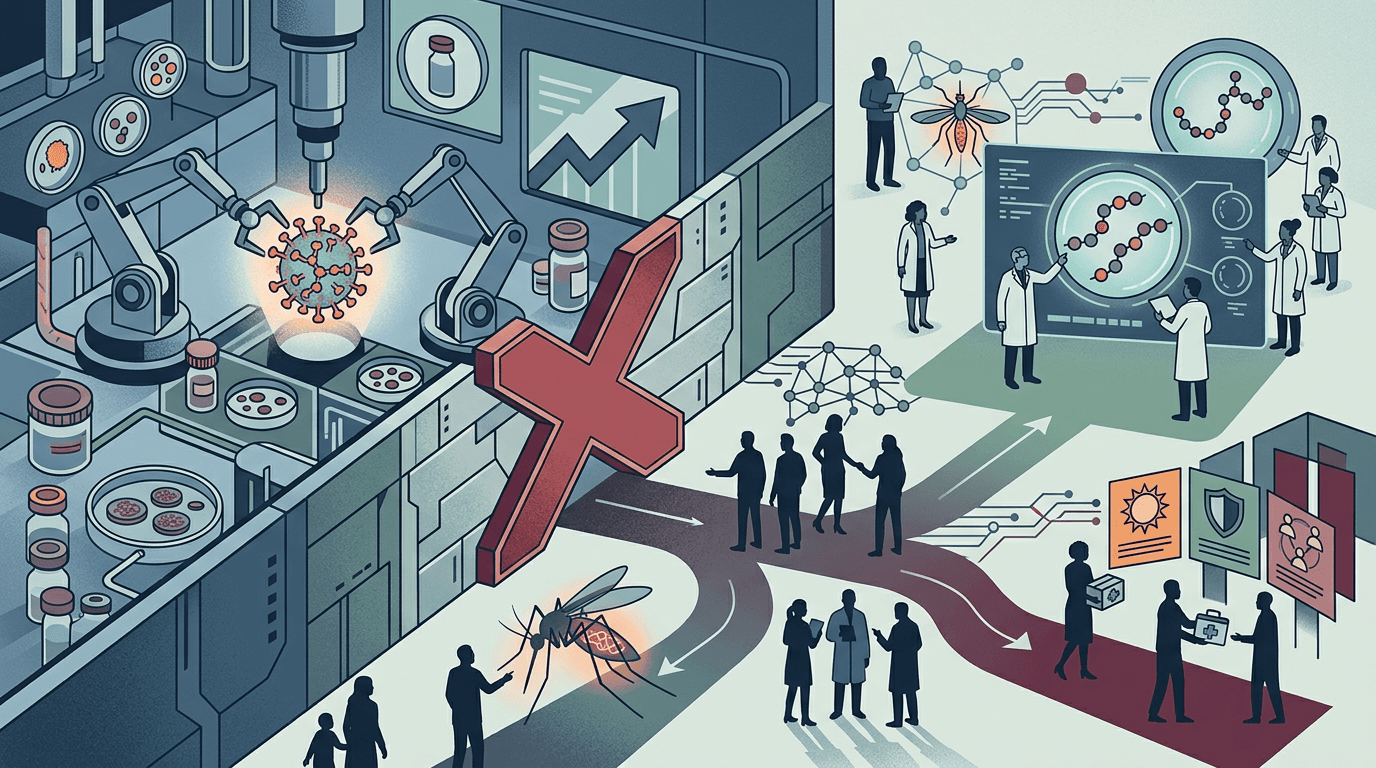

Valneva pulled the world's only approved chikungunya vaccine from the U.S. after it was found to cause the very disease it was supposed to prevent. With the virus spreading northward and no replacement on American shelves, the withdrawal exposes a gaping hole in tropical disease preparedness.
Imagine you finally get a fire extinguisher for your kitchen. The only one on the market. Then it gets recalled because it sometimes starts fires of its own.
That's roughly what happened with IXCHIQ, the world's first and only FDA-approved chikungunya vaccine. Valneva, the French-Austrian biotech behind it, has officially withdrawn the product from the U.S. market, leaving zero approved options for a mosquito-borne virus that's creeping northward. The move caps a brutal year-long regulatory saga that raises an uncomfortable question: can vaccines for "neglected" tropical diseases ever survive commercially in America?
IXCHIQ earned FDA approval in November 2023 under the accelerated pathway, meaning it was greenlit based on a surrogate marker (antibody levels) rather than proof that it actually prevented disease in the real world. That distinction matters, because the confirmatory studies never got finished.
The vaccine was built on a live, attenuated version of the chikungunya virus. Think of it like training your immune system with a weakened sparring partner. The problem? The sparring partner wasn't as weak as everyone thought.
By May 2025, the FDA and CDC recommended pausing IXCHIQ in people 60 and older after reports of serious neurological and cardiac events. By August, the FDA had reviewed 32 serious adverse event reports, including 21 hospitalizations and 3 deaths. Of those reports, 26 were consistent with chikungunya-like illness caused by the vaccine itself. In two cases, lab tests confirmed the vaccine strain of the virus was directly responsible.
The FDA didn't mince words: under most plausible scenarios, the vaccine's risks outweighed its benefits. On August 22, 2025, the agency suspended IXCHIQ's license entirely, ordering Valneva to stop shipping immediately.
Faced with a suspended license and mounting safety concerns, Valneva could have fought to reinstate IXCHIQ. Instead, the company chose to fold its hand. In January 2026, it voluntarily withdrew both its marketing application and its clinical trial application from the FDA. No ongoing trials were administering the vaccine at that point, and a newly reported serious adverse event overseas had triggered yet another clinical hold.

China just added semaglutide to its essential medicines list, making it the second GLP-1 drug prioritized for the world's largest diabetes population. With 233 million patients, expiring patents, and a wave of domestic competitors, the move could reshape the global GLP-1 market in ways Novo Nordisk and Eli Lilly didn't plan for.


Join thousands of biotech professionals who start their day with our free, daily briefing.

The financial toll has been significant. Valneva posted a net loss of €115.2 million in 2025, compared to just €12.2 million the year before (though 2024 was flatted by a one-time €90.8 million gain from selling IXCHIQ's Priority Review Voucher). In Q1 2026, IXCHIQ contributed a mere €1.6 million in sales, and the company slashed its full-year revenue guidance, trimming product sales expectations to €135–150 million from an earlier €145–160 million range.
Valneva is now restructuring, targeting a 25–35% cut in total operating expenses and pinning its survival hopes on a Lyme disease vaccine being developed with Pfizer.
Chikungunya might sound exotic, but it's becoming less so by the year. The virus, spread by Aedes mosquitoes, causes debilitating joint pain that can last months. In 2025 alone, the Americas reported over 315,000 cases and 171 deaths.
In the U.S., imported cases more than doubled from 199 in 2024 to 466 in 2025. And for the first time since 2019, a locally acquired case turned up in downstate New York, where the Aedes albopictus mosquito has established a foothold. That's not Florida or Texas; that's the tristate area.
Climate change is widening the welcome mat. Warmer temperatures extend the mosquito season and push vector habitats northward. The risk envelope for chikungunya in the U.S. is expanding, even as the only approved countermeasure has been pulled off the shelf.
IXCHIQ's collapse exposes a deeper problem that haunts the entire category of neglected tropical disease vaccines. The economics are brutal: the people who need these vaccines most are overwhelmingly poor, global procurement prices hover around $2–3 per dose, and U.S. demand is limited to travelers and military personnel.
In the American market, commercial success hinges on ACIP (the Advisory Committee on Immunization Practices), whose recommendations essentially determine whether insurers will cover a vaccine. A narrow, risk-based recommendation ("consider for certain travelers") translates to tiny volumes. Without broad ACIP support, federal procurement, or stockpile contracts, the math simply doesn't work.
That's not a market failure you can optimize your way out of. It's a structural impossibility without public funding, philanthropic backing, or advance purchase commitments.
The good news: IXCHIQ wasn't the only horse in this race, just the first across the finish line.
Bavarian Nordic's Vimkunya, a virus-like particle (VLP) vaccine, is now the second licensed chikungunya vaccine globally. Unlike IXCHIQ, it uses a non-replicating platform, which sidesteps the "vaccine causes the disease" problem entirely. It could become the default option for travelers and at-risk populations.
Behind it, Bharat Biotech and the International Vaccine Institute are running Phase 2/3 trials of an inactivated vaccine (BBV87) across Colombia, Panama, Thailand, Guatemala, and Costa Rica, with India likely to be the first country to license it. Moderna has an mRNA candidate (mRNA-1388) in Phase 1 that showed 100% seroconversion at the highest dose, and Oxford is developing an adenoviral vector approach similar to the platform behind its COVID vaccine.
So the pipeline exists. But "exists" and "available" are very different things, especially for endemic countries that lack regulatory pathways, financing mechanisms, and delivery infrastructure.
Valneva's chikungunya story is a cautionary tale wrapped in a public health gap. A genuinely needed vaccine made it all the way to market, only to be undone by the very biology it was designed to fight. The live virus was too hot; the commercial market was too cold.
What's left is a disease that's spreading, a pipeline that's years from filling the gap in the U.S., and a reminder that "approved" doesn't mean "safe" and "needed" doesn't mean "profitable." Bavarian Nordic's VLP vaccine offers the best near-term hope, but until chikungunya preparedness gets the kind of funding and political attention reserved for pandemic threats, we're essentially watching a slow-motion problem with no fire extinguisher in sight.
Samsung Bioepis just posted the first-ever Phase 3 data for a Keytruda copycat, and it matched the $32 billion original on every measure. With at least ten companies racing to build biosimilar versions of the world's best-selling drug, the countdown to cheaper cancer immunotherapy has officially begun.