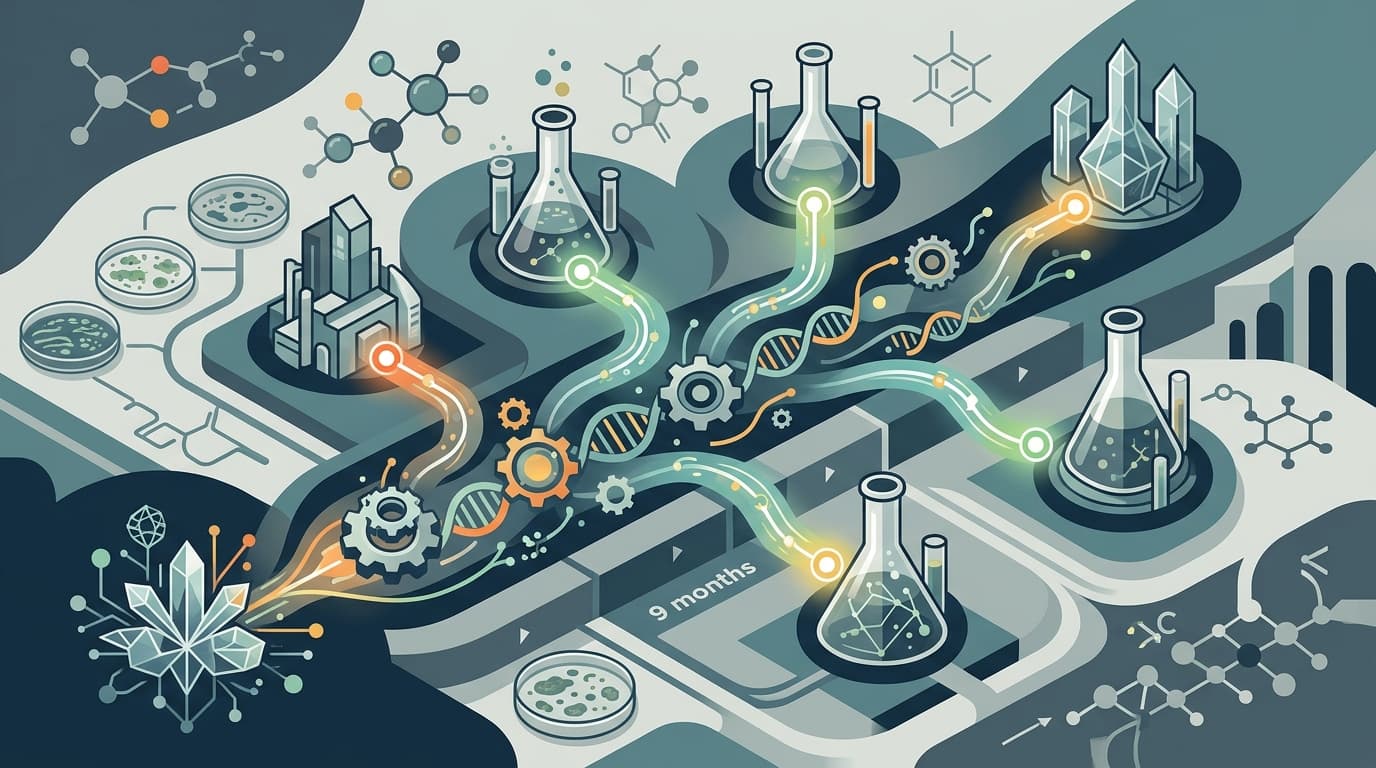

An AI startup just convinced six of the world's biggest pharma companies to partner up in nine months flat. Chai Discovery's secret weapon? Its protein-folding models actually work when you test them in real labs, not just on screens.
Imagine pitching your product to six of the toughest buyers on earth, and every single one signs on the dotted line within nine months. That's basically what Chai Discovery just pulled off.
The AI startup, which builds models that predict how proteins fold and interact, announced a collaboration with GSK in October 2026. That makes GSK the sixth major pharma company to partner with Chai this year, joining Eli Lilly, Pfizer, Novartis, argenx, and Bristol Myers Squibb. Six partners. Nine months. In an industry that usually moves at the speed of a glacier with a regulatory hold.
So what convinced GSK to sign? Something refreshingly old-school: the science actually worked in the lab.
AI in drug discovery has a credibility problem. Plenty of startups can generate impressive-looking predictions on a screen. Fewer can produce molecules that hold up when you actually make them and test them in a real lab.
GSK ran Chai's models through that exact gauntlet. The company tested Chai's AI-generated designs across a panel of diverse drug targets, and the results were striking: the models produced binders to every single target tested. Not most. Not a handful. All of them.
What makes this even more impressive is that Chai's models worked "zero-shot," meaning they weren't specifically trained on GSK's targets beforehand. Think of it like a chef who's never seen your kitchen, never tasted your ingredients, but still cooks a perfect meal for every guest at the table. That's the kind of generalization pharma companies dream about.
GSK's SVP of R&D technologies confirmed the designs showed strong binding affinities, which is the molecular equivalent of a lock fitting snugly into its key. That wet-lab validation is what turned a technology evaluation into a full collaboration.
Protein folding is one of biology's hardest puzzles. Proteins are long chains of amino acids that twist and curl into complex 3D shapes, and that shape determines what the protein does. If you're designing a drug to block a specific protein, you need to know what it looks like.

Life Biosciences just shared the first-ever human data for a cellular reprogramming therapy, and two of three glaucoma patients showed vision improvements. It's tiny and early, but this could be the moment aging biology stopped being theoretical.


Join thousands of biotech professionals who start their day with our free, daily briefing.
Google's DeepMind cracked this open with AlphaFold, which became a sensation in 2020. Chai Discovery takes that concept further. Its core model, Chai-1, doesn't just predict protein shapes; it handles proteins, small molecules, DNA, RNA, and sugar molecules all in one unified system. It's like upgrading from a calculator that only does addition to one that handles the entire equation.
The platform can also work without something called multiple-sequence alignments (essentially, databases of related protein sequences that older tools depend on). Skipping that step makes predictions faster and opens the door to novel proteins that don't have close relatives in existing databases.
Chai has released its core model as open-source software, which helped build credibility in the scientific community. But the commercial products, including newer versions like Chai-2 and Chai-3, are where the pharma partnerships come in. These newer models appear to go beyond just predicting structures into actually designing new therapeutic molecules from scratch.
The pace of Chai's dealmaking tells its own story. Lilly signed first in January 2026, getting AI models for novel biologics discovery plus a custom model trained on Lilly's own proprietary data. Pfizer followed in June with a license agreement that included early access to Chai-3. Then came a summer rush: Novartis and argenx both signed in July, followed by BMS in August and now GSK in October.
That's not a trickle of interest. That's a stampede.
Financial terms for the GSK deal weren't disclosed, which is typical for these platform-access collaborations. But the trajectory of Chai's fundraising tells you how the market is valuing the company. It raised $30 million in its first round, then $130 million in a Series B that valued it at roughly $1.3 billion. Its Series C brought in $400 million at a $3.8 billion valuation. In less than two years, the company nearly tripled in value.
The biotech industry has been burned by AI hype before. Flashy computational results that crumble the moment someone puts on gloves and runs a real experiment. That's why what GSK did matters: they didn't just look at Chai's predictions on a computer. They synthesized the molecules, tested them against actual targets, and found that the designs held up.
This pattern (compute first, validate in the lab, then sign the deal) is becoming the new standard. Microsoft and Astellas have used AI to prioritize which drug candidates to test physically. Other labs have independently synthesized AI-designed proteins and confirmed they work. The industry is increasingly treating AI as a sophisticated filter that narrows down a massive universe of possibilities before human scientists take over.
But confirmation of binding is still early-stage validation. Finding a molecule that sticks to a target is step one. Making it into an actual drug that's safe, effective, and manufacturable is a marathon that takes years. None of Chai's pharma-partnered programs have reached the clinic yet, and the real test will be whether AI-designed candidates can survive the brutal attrition of clinical trials.
This deal fits neatly into GSK's broader AI strategy. The company has built what it describes as one of the largest in-house AI teams in biopharma, based in London. It has partnerships with Tempus for AI-enabled precision medicine, with Cerebras for AI computing infrastructure, and with major genomic databases like UK Biobank and FinnGen.
GSK's stated goal is to double its developmental success rates by combining human genetics with AI. That's ambitious, considering the pharmaceutical industry's historical failure rate hovers around 90% from early development to approval. Even a modest improvement would be worth billions in saved R&D costs.
Sell-side analyst sentiment on GSK remains mixed overall, but the company's business development activity, including deals like this one, has drawn some positive attention.
Chai Discovery's six-partner streak isn't just a good sales quarter for a startup. It's a signal that AI protein-structure tools are crossing the threshold from "interesting experiment" to "core infrastructure." When half a dozen of the world's largest drugmakers independently decide the same technology is worth integrating into their pipelines, that's not hype. That's adoption.
The question now is whether these partnerships produce drug candidates that actually reach patients. Because in biotech, the only validation that truly counts isn't in the lab or on a balance sheet. It's in the clinic.
FDA review documents rattled Revolution Medicines investors by hinting its pancreatic cancer drug works better in some patients than others. Meanwhile, Zealand Pharma's obesity drug delivered solid results that would've been impressive five years ago, but in the age of GLP-1 blockbusters, "solid" doesn't cut it.