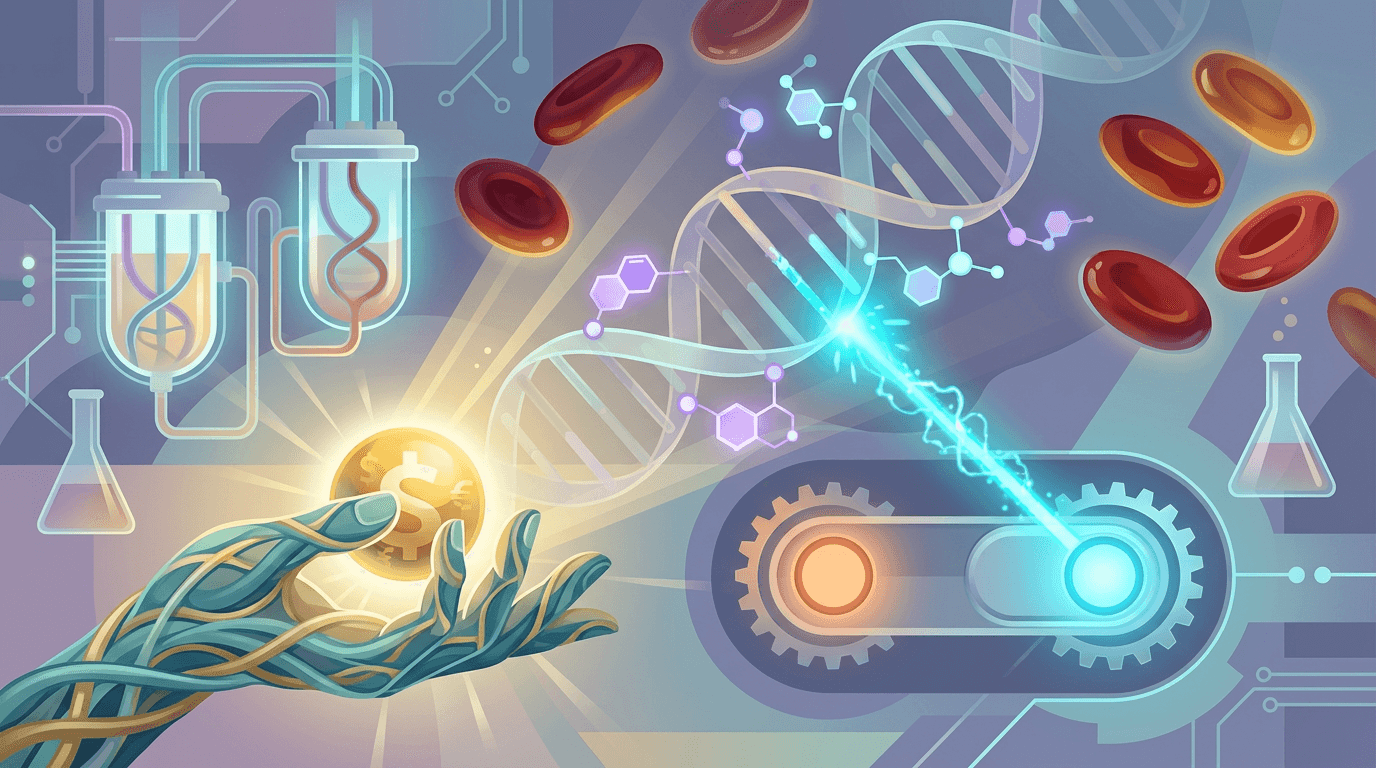

CellCentric just raised $220 million (oversubscribed) for a single oral cancer drug that works through epigenetics, not immunotherapy. With investors like Fidelity and RA Capital fighting to get in, the Cambridge spin-out is betting it can crack multiple myeloma after everything else fails.
Most biotech companies spend years scraping together $50 million here, $30 million there. CellCentric just pulled in $220 million in a single round, and investors were fighting to get in. The Series D was oversubscribed, meaning more money showed up than the company even wanted to take.
The target? Multiple myeloma, a blood cancer that kills roughly 12,000 Americans every year and remains stubbornly incurable. But CellCentric isn't building another CAR-T therapy or bispecific antibody. They're going after the disease with something entirely different: a pill that flips off cancer's epigenetic switches.
Think of your DNA as a recipe book. Epigenetics is the system that decides which recipes get cooked. In multiple myeloma, certain "master chefs" (proteins called p300 and CBP) keep reading the wrong recipes over and over, cranking out cancer-promoting genes like MYC and IRF4.
CellCentric's drug, inobrodib, is a first-in-class oral pill that kicks those master chefs off the cookbook. It blocks a specific pocket on p300/CBP (the bromodomain), displacing them from the DNA without destroying them entirely. The result: cancer cells lose their growth instructions.
The drug emerged from the University of Cambridge's Gurdon Institute, where Professor Azim Surani pioneered research on how cells inherit instructions beyond DNA. That academic insight became a company, and that company just became one of the best-funded private biotechs in oncology.
Venrock Healthcare Capital Partners led the round. The investor lineup reads like an oncology VC all-star team: Fidelity Management & Research, Sofinnova Partners, HBM Healthcare, RA Capital Management, Forbion, and Pfizer all participated. Existing backers doubled down alongside the newcomers.
The $220 million Series D gives CellCentric runway through 2029. That's enough to run pivotal trials without needing a pharma partner or rushing toward an IPO.

The FDA is letting Amgen and AstraZeneca share live clinical trial data with regulators as patients enroll, not after trials end. It could cut drug development timelines by 20-40%, and it's the biggest change to how trials work in six decades.


Join thousands of biotech professionals who start their day with our free, daily briefing.

CEO Will West put it bluntly: "We had a lot of term sheets that we turned down from smaller funds." The company chose investors who could support long-term independence, not just write checks.
The data helps explain the enthusiasm. At the American Society of Hematology (ASH) meeting in December 2025, CellCentric presented Phase 2 results showing 60% overall response rates in heavily pretreated patients. These were people who had already failed bispecific antibodies and anti-BCMA therapies, the current cutting-edge treatments. That 60% figure is roughly double the historical response rate for the comparison regimen in similar patients.
Peter Kolchinsky, managing partner at RA Capital, called it out directly: "Preliminary data indicates it is safe and well-tolerated when combined with current therapies, opening up the possibility for its use across various treatment lines. This is what significant advancement looks like."
The safety profile matters enormously here. About 70% of myeloma patients are treated in community oncology settings (local clinics, not major academic hospitals). An oral drug with manageable side effects can reach those patients far more easily than IV infusions or cell therapies that require specialized centers.
Multiple myeloma is one of the most crowded markets in oncology. CAR-T therapies like cilta-cel are showing impressive progression-free survival rates. Bispecific antibodies (teclistamab, elranatamab, talquetamab) keep piling up approvals. ADCs are coming next.
So why does inobrodib have a lane?
Because all those flashy immunotherapies eventually stop working. Roughly half of patients relapse after bispecific antibodies, and a third never respond at all. Once you've burned through BCMA-targeting and GPRC5D-targeting options, the playbook gets thin. That's exactly where inobrodib sits: the "what comes next" slot that nobody else has filled with a convenient oral option.
The drug also works through a completely different mechanism. It doesn't rely on T-cells (which can become exhausted after repeated immunotherapy) or require manufacturing infrastructure. It's a pill. You take it at home.
CellCentric launched its pivotal Phase 2 trial, DOMMINO-1, in March 2026. It tests inobrodib at 20mg combined with pomalidomide and dexamethasone in heavily pretreated patients. A Phase 3 trial (DOMMINO-2) is expected to begin in the second half of 2026.
The FDA has already granted Fast Track and orphan drug designations. Recent draft guidance from the agency suggests that deep responses (complete remission and MRD negativity) could support accelerated approval, which would shorten CellCentric's path to market considerably.
With the funding secured through 2029, the company has options. But the whole point of raising this much money was to avoid being forced into a deal from a position of weakness.
CellCentric's raise sits comfortably among the largest single-asset oncology financings of the past year. For context, Treeline Biosciences raised $200 million, Dispatch Bio pulled in $216 million, and Callio Therapeutics secured $187 million. But those companies have multiple programs; CellCentric bet everything on one drug.
That's either brilliant focus or concentrated risk, depending on how DOMMINO-1 reads out. If the pivotal data in 2027 confirms what the Phase 2 showed, CellCentric will have built a billion-dollar company around a single epigenetic insight from Cambridge. If it doesn't, significant investor capital will have funded an expensive lesson about the gap between early signals and registration-quality evidence.
For now, the smart money is literally on the table. And in biotech, $220 million worth of conviction from Venrock, Fidelity, and RA Capital is about as loud a signal as you'll hear before a pivotal readout.
Madrigal Pharmaceuticals just paid up to $1 billion for a gene-silencing drug to pair with its blockbuster MASH therapy Rezdiffra. It's the third major deal in a year as the company races to build an unbeatable liver disease franchise before Novo Nordisk and others crash the party.