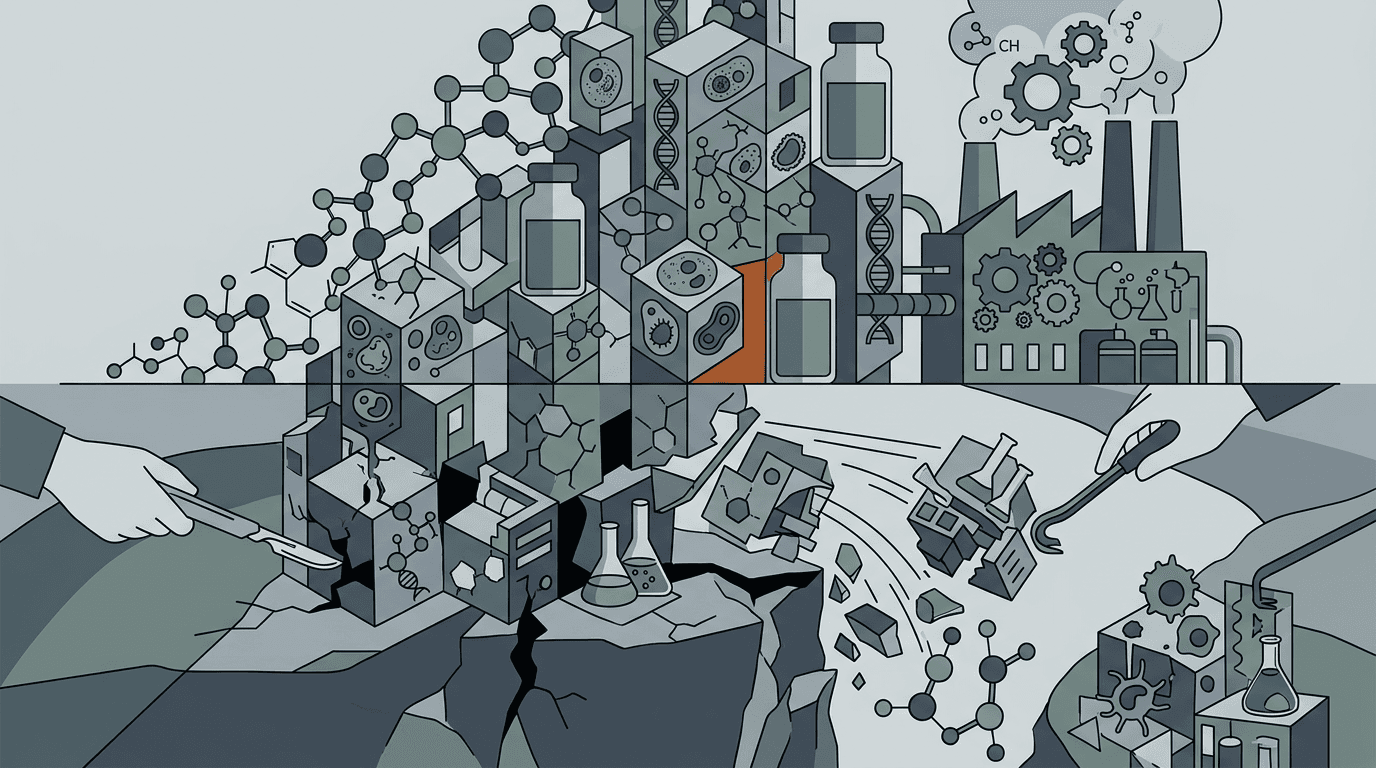

BioNTech is shuttering four manufacturing sites and cutting 1,860 jobs as it dismantles its COVID vaccine empire. The company is betting everything on becoming an oncology powerhouse by 2030, armed with €16.8 billion in cash and 15 Phase III cancer trials.
Two years ago, BioNTech's Marburg plant was one of the largest mRNA manufacturing facilities on Earth, a monument to pandemic-era urgency. On Monday, the company announced it's shutting that plant down.
Marburg isn't alone. BioNTech is closing sites in Idar-Oberstein and Tübingen (both in Germany) plus a Singapore facility it bought from Novartis less than four years ago. The total damage: up to 1,860 jobs eliminated, with closures wrapping up by the end of 2027.
This is the biotech equivalent of buying a mansion during a housing boom, then listing it three years later at a loss. Except the "housing boom" was a global pandemic, and the mansion produced mRNA vaccines.
The numbers tell the story of a company in free fall, at least on the revenue line. In 2022, BioNTech pulled in roughly €17.3 billion in revenue. By 2024, that figure had collapsed to €2.75 billion. The company's 2026 guidance? A range of €2.0 to €2.3 billion, which actually came in below what Wall Street expected.
First quarter 2026 was particularly ugly: just €118 million in revenue, a 35% drop from the same period last year. CFO Ramón Zapata pointed to "seasonal demand" for COVID vaccines, which is a polite way of saying almost nobody's lining up for boosters anymore.
The company is now losing money. Its Q1 2026 net loss widened to €531.9 million. And all that manufacturing capacity built for a world desperate for vaccines? It's been sitting idle. Zapata said the excess capacity would persist for at least 24 months if left untouched. So BioNTech decided to touch it.
The restructuring reads like a liquidation of pandemic-era acquisitions:
Idar-Oberstein, home to about 500 employees, makes cell therapy products and clinical-stage mRNA. It's been part of BioNTech since 2009. Gone by end of 2027.
Marburg, with roughly 450 employees and that massive eight-suite production complex, was the crown jewel of COVID manufacturing. Gone by end of 2027.

The FDA is letting Amgen and AstraZeneca share live clinical trial data with regulators as patients enroll, not after trials end. It could cut drug development timelines by 20-40%, and it's the biggest change to how trials work in six decades.


Join thousands of biotech professionals who start their day with our free, daily briefing.

Tübingen, acquired through BioNTech's 2024 purchase of CureVac assets, will also close by end of 2027.
Singapore, a facility BioNTech snapped up from Novartis in 2022 to serve Asia-Pacific markets, shuts down even sooner: Q1 2027.
BioNTech is handing COVID vaccine production responsibilities to its partner Pfizer by year-end 2026. It's also exploring selling the sites outright. The target: €500 million in annual savings by 2029.
So where does this leave a company that once seemed destined to ride mRNA vaccines forever? In a word: cancer.
BioNTech is pouring everything into becoming what CEO Ugur Sahin called "a fully integrated multiproduct oncology company by 2030." The pipeline is enormous. More than 25 Phase II and III oncology trials are running right now, and the company plans to have 15 Phase III programs active by year-end 2026 (up from just two in early 2025).
The R&D budget reflects this ambition. BioNTech guided R&D spending of €2.0 to €2.2 billion in 2025, which consumes the vast majority of its revenue. That's like a restaurant spending more on ingredients than it makes selling food. The bet is that the dishes coming out of the kitchen will eventually be worth it.
Key programs include pumitamig (a bispecific antibody partnered with Bristol Myers Squibb in a deal worth up to $11 billion), individualized mRNA cancer vaccines for pancreatic and colorectal cancers, and antibody-drug conjugates targeting multiple tumor types. BioNTech expects six to seven late-stage data readouts in 2026, with five potentially supporting regulatory filings.
BioNTech isn't restructuring in a vacuum. The entire mRNA vaccine industry is going through its post-pandemic hangover:
Moderna announced roughly 800 layoffs (10% of staff) and is chasing $1.5 billion in annual savings by 2027. CureVac cut 30% of its global workforce in 2024 and essentially handed its vaccine programs to GSK through a licensing deal. Every company that scaled up for a once-in-a-century health emergency is now discovering what happens when that emergency fades.
BioNTech's cuts are the largest in absolute terms. But unlike CureVac, which effectively exited the vaccine business, BioNTech still has a massive cash pile (€16.8 billion at the end of Q1 2026) and a pipeline deep enough to justify investor patience.
Analysts are cautiously optimistic. The consensus rating sits at Buy, with an average 12-month price target around $133. Truist upgraded BioNTech to Strong Buy in March 2026, citing a "valuation dislocation" given the cash reserves.
The $1 billion share buyback BioNTech announced alongside the restructuring is being read as a confidence signal. When a company buys its own stock while cutting costs, it's telling the market: we think we're undervalued, and we're putting our money where our mouth is.
But risks remain. Co-founders Sahin and Türeci are departing by end of 2026, creating a leadership vacuum at a critical moment. U.S. vaccine policy uncertainty could further erode the COVID franchise. And those 15 Phase III oncology trials? Any one of them could fail, turning an ambitious pivot into an expensive detour.
BioNTech is making the most dramatic bet in recent biotech history. It's dismantling the infrastructure that generated billions during COVID and redirecting everything toward cancer. The company has the cash to survive several years of losses while it waits for oncology approvals. Whether it has the right drugs is the multi-billion-euro question.
The next 18 months will tell us if this is a visionary pivot or an expensive identity crisis. Either way, 1,860 people are losing their jobs because the world stopped needing what they were making. That's the brutal math of biotech: yesterday's miracle is tomorrow's excess capacity.
Madrigal Pharmaceuticals just paid up to $1 billion for a gene-silencing drug to pair with its blockbuster MASH therapy Rezdiffra. It's the third major deal in a year as the company races to build an unbeatable liver disease franchise before Novo Nordisk and others crash the party.