BMS Just Found a Way to Make Myeloma's Best Drug Class Even Better
BMS's next-gen myeloma drug mezigdomide just doubled progression-free survival in a phase 3 trial of heavily pretreated patients. The ASCO 2026 data validate CELMoDs as a potent new drug class that could reshape how we treat one of blood cancer's toughest enemies.
Lenalidomide (brand name: Revlimid) is one of the most successful cancer drugs ever made. For two decades, it has been the backbone of multiple myeloma treatment, generating tens of billions in revenue for its makers and keeping countless patients alive longer. But cancer has a nasty habit of learning to ignore the drugs we throw at it, and a growing number of myeloma patients are now resistant to lenalidomide and its close cousin pomalidomide.
So what do you do when cancer outgrows your best weapon? You build a bigger one.
The Upgrade Nobody Was Sure Would Work
At ASCO 2026, Bristol Myers Squibb unveiled phase 3 results for mezigdomide, a drug that belongs to a new class called CELMoDs (cereblon E3 ligase modulators). Think of CELMoDs as lenalidomide's juiced-up successor: they work through the same basic machinery inside cells but grip the target protein significantly harder. That extra grip matters, because it means CELMoDs can still kill myeloma cells even when lenalidomide can't get a foothold anymore.
The concept has been promising for years. But "promising" in biotech is like "great personality" on a dating profile; it doesn't mean much until you see the real thing. What BMS showed at ASCO was the real thing.
In the SUCCESSOR-2 trial, patients with relapsed or refractory multiple myeloma (meaning their cancer had come back or stopped responding to prior treatment) were randomized to receive either carfilzomib plus dexamethasone alone, or carfilzomib plus dexamethasone with mezigdomide added on top. The question was simple: does the extra drug make a meaningful difference?
The Numbers That Made Oncologists Lean Forward
The answer was a resounding yes. Patients on the mezigdomide combo went a median of 18 months before their disease progressed. The control group? Just 8.3 months. That's more than double.
To put it in statistical terms, adding mezigdomide cut the risk of disease progression or death by 52%, with a hazard ratio of 0.48 and a p-value under 0.0001. For the non-statisticians: that p-value essentially means the result wasn't a fluke. If this were a basketball game, the winning team wouldn't just be ahead; they'd be up by 30 in the fourth quarter.
Get tomorrow's biotech intelligence before your competitors.
Join thousands of biotech professionals who start their day with our free, daily briefing.
The depth of response was equally striking. About 75–80% of patients on mezigdomide responded to treatment, compared to roughly 53% on the control arm. And the complete response rate (meaning no detectable cancer left by standard tests) nearly tripled: 26.7% versus 8.9%.
BMS's head of late-stage hematology/oncology development called the results "incredibly exciting," and it's hard to argue with the enthusiasm.
What Makes CELMoDs Different (Without a PhD)
To understand why these results matter so much, you need a quick primer on how this drug class works.
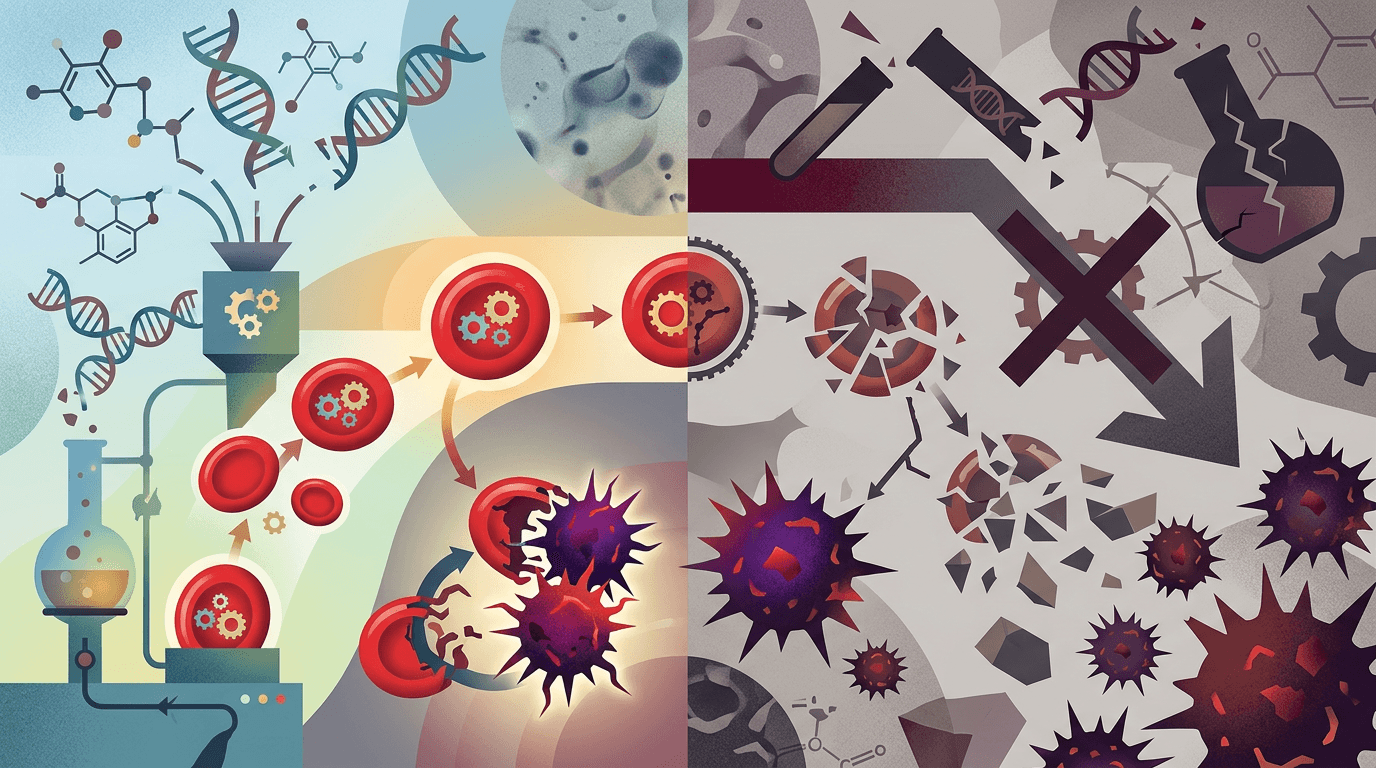
Inside every cell sits a protein called cereblon. Cereblon is part of the cell's garbage disposal system: it tags other proteins for destruction. Drugs like lenalidomide hijack cereblon, reprogramming it to destroy two specific proteins called Ikaros and Aiolos that myeloma cells need to survive. Remove those proteins and the cancer cell dies. It's an elegant trick, and it works beautifully (for a while).
The problem is that cancer cells eventually figure out how to reduce their cereblon levels, starving the drug of its molecular partner. Lenalidomide needs a certain amount of cereblon to do its job. When levels drop, the drug stops working. It's like trying to use a key on a lock that keeps getting smaller.
CELMoDs solve this by binding cereblon much more tightly. Even when cancer cells dial down their cereblon, these next-gen drugs can still latch on and get the job done. They also degrade Ikaros and Aiolos more efficiently, which translates to more potent tumor killing and stronger immune activation. Same concept, sharper execution.
A Seriously Sick Patient Population
What makes the SUCCESSOR-2 data especially compelling is who was in the trial. These weren't newly diagnosed patients with fresh-out-of-the-box myeloma. The median patient had already been through two prior lines of therapy. Over 92% had been exposed to all three major drug classes (proteasome inhibitors, IMiDs, and anti-CD38 antibodies). Nearly 86% were refractory to an anti-CD38 antibody, and about 76% were refractory to lenalidomide.
In other words, these patients had already burned through most of the standard playbook. The fact that mezigdomide still delivered a doubling of progression-free survival in this population is what turns a good result into a potentially practice-changing one.
The benefit held up across subgroups too, including elderly patients and those with high-risk disease features like extramedullary myeloma (cancer that has spread beyond the bone marrow).
The Toxicity Trade-Off
No free lunch in oncology. Adding a potent drug to an existing regimen generally means more side effects, and mezigdomide was no exception.
Neutropenia (dangerously low white blood cell counts) hit 61% of patients on the mezigdomide arm versus just 9% on the control. Grade 3–4 infections were also more common: 34% versus about 16%. Grade 3 or 4 treatment-related adverse events (the serious ones) occurred in roughly 84% of mezigdomide patients compared to 57% on the control.
Those numbers sound alarming in isolation, but oncologists who treat myeloma are deeply familiar with managing these kinds of toxicities. BMS described the safety profile as "consistent with prior reports" and "very well manageable." No new, unexpected safety signals emerged. For a drug that doubled PFS in heavily pretreated patients, most clinicians will view that trade-off as acceptable.
BMS Is Building a Cereblon Empire
Mezigdomide isn't the only CELMoD in BMS's stable. The company also has iberdomide, a slightly less potent but still next-gen cereblon modulator that's even further along in development. Iberdomide is currently under FDA review with a decision expected on August 17, 2026, based on positive phase 3 results from its own trial (EXCALIBER-RRMM) showing benefit when combined with daratumumab.
The two drugs are designed to pair with different treatment partners, which gives BMS the potential to rebuild its entire myeloma franchise around targeted protein degradation. This is critical strategic territory: Revlimid and Pomalyst (the company's legacy IMiDs) are hemorrhaging revenue to generic competition. CELMoDs are the replacement plan. External analysts project mezigdomide alone could reach roughly $1.5 billion in annual sales by 2031 if both phase 3 trials succeed.
The second pivotal trial, SUCCESSOR-1, is testing mezigdomide against pomalidomide in a slightly different combination. A positive result there would likely trigger a regulatory filing.
Where CELMoDs Fit in a Crowded Landscape
Multiple myeloma treatment in 2026 is a battlefield. Patients can now receive proteasome inhibitors, anti-CD38 antibodies, CAR-T cell therapy, bispecific antibodies, and traditional IMiDs, often in complex multi-drug regimens that shift depending on what the cancer has already seen.
CAR-T therapies like Carvykti offer stunning depth of response, sometimes producing long, treatment-free remissions. Bispecific antibodies provide an "off-the-shelf" alternative to CAR-T's complex manufacturing process. Both are powerful, but both come with serious logistical hurdles: hospitalization requirements, manufacturing delays (for CAR-T), chronic dosing schedules (for bispecifics), and unique toxicities like cytokine release syndrome.
CELMoDs occupy a different niche entirely. They're oral pills that can be prescribed in community oncology settings, not just academic medical centers. They slot naturally into the combination regimens that oncologists already know how to manage. They don't require leukapheresis, manufacturing queues, or inpatient monitoring for cytokine storms.
That accessibility is a massive advantage. In a world where most myeloma patients live nowhere near a CAR-T center, an oral drug that doubles PFS in second-line disease could become the default backbone of treatment for the largest slice of the patient population.
Perhaps most intriguingly, CELMoDs aren't just competitors to bispecifics and CAR-T; they could be partners. Early-phase trials are already exploring mezigdomide combined with bispecific antibodies, and the immunomodulatory boost from CELMoDs could theoretically enhance T-cell-directed therapies. Imagine pairing a sharper sword with better armor.
The Bottom Line
For years, the myeloma field has been waiting to see whether CELMoDs could live up to their preclinical promise in a rigorous, large-scale trial. SUCCESSOR-2 delivers that proof. A 52% reduction in the risk of progression, a doubling of median PFS, and high response rates, all in heavily pretreated patients who had already exhausted most standard options.
BMS now has two CELMoDs approaching the market: one under FDA review, the other with a clean phase 3 win. If the rest of the data holds up, the company could own the next generation of myeloma's most important drug class, essentially replacing its own blockbuster legacy with something even better.
The era of CELMoDs has officially arrived. And for patients running out of options, that's not just exciting. It's everything.
Clinical & Regulatory5 min read
AstraZeneca's Boldest Bet: Filing for Approval After Failing the Test
AstraZeneca is pushing two drugs toward approval despite Phase 3 failures, betting that subgroup data and supplemental analyses can overcome the biggest hurdle in drug development. The outcome could redefine what "enough evidence" means for the entire industry.