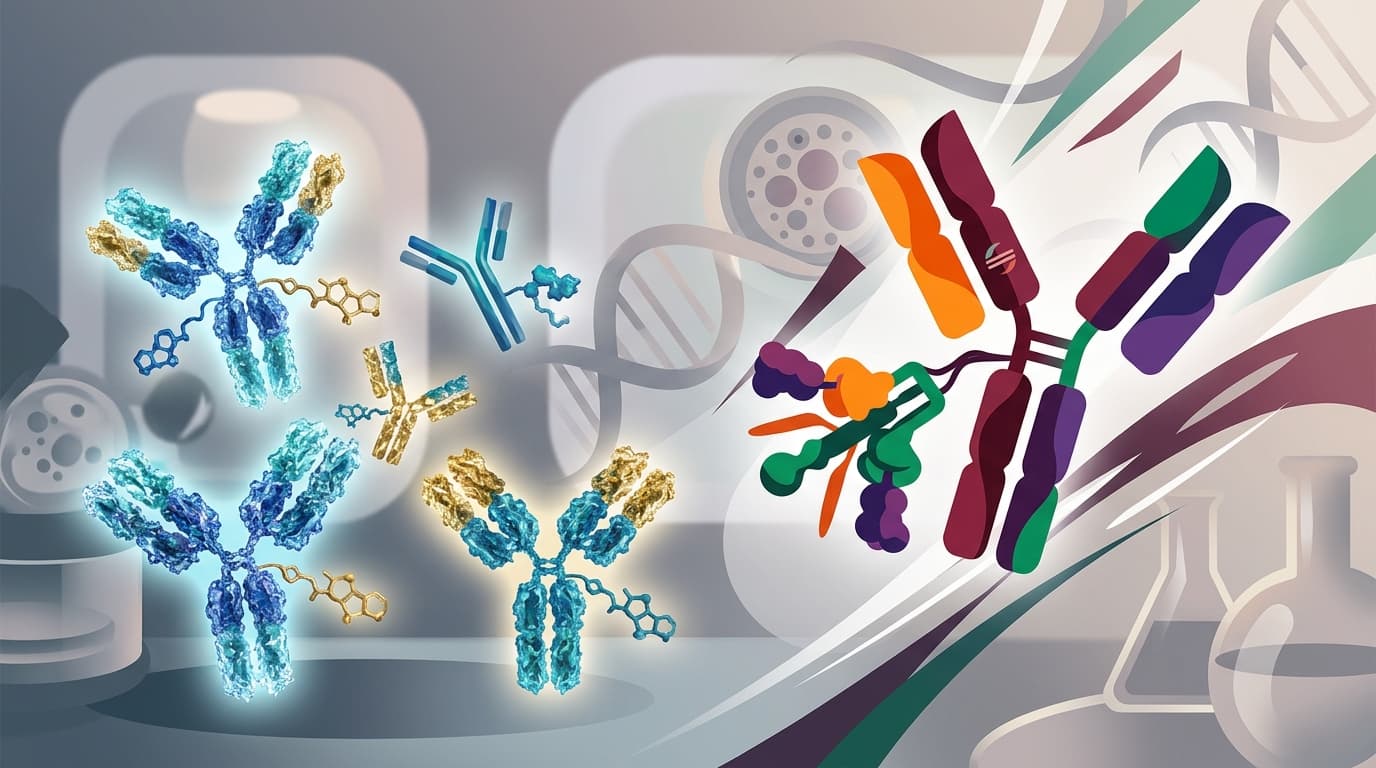

BMS unveiled Phase 3 data on a bispecific ADC that targets EGFR and HER3 instead of TROP2, posting striking survival results in triple-negative breast cancer. The data could reshape the competitive dynamics of the entire ADC landscape and put Gilead and AstraZeneca's TROP2 franchises on defense.
Everyone in oncology has been obsessing over TROP2. It's the hot target, the "it" antigen, the thing every major pharma company wants to slap onto an antibody-drug conjugate. Gilead built a franchise around it with Trodelvy. AstraZeneca and Daiichi Sankyo have been racing to expand it with datopotamab deruxtecan.
Then Bristol-Myers Squibb walked into ASCO 2026 and said: what if you don't need TROP2 at all?
BMS's weapon is called izalontamab brengitecan (iza-bren), and it's unlike anything currently on the market. Instead of targeting TROP2, it goes after two different receptors: EGFR and HER3. Both are proteins that sit on the surface of tumor cells and help them grow. By grabbing onto both at once, the drug essentially locks onto cancer cells with two hands instead of one.
That dual grip matters. Think of it like a rock climber using two anchor points instead of one. If the rock crumbles under one hand, you've still got the other. In cancer terms, tumors are notoriously messy; they don't all express the same proteins evenly. A bispecific ADC can catch cells that a single-target drug might miss.
Once the drug latches on, it delivers a topoisomerase-1 inhibitor (a type of chemotherapy payload that damages cancer cell DNA from the inside). It's the same class of payload that TROP2 drugs use, just delivered through a completely different front door.
BMS announced positive Phase 3 data from China in triple-negative breast cancer (TNBC), one of the hardest cancers to treat because it lacks the usual drug targets. The results were striking.
Patients on iza-bren lived a median of 15.9 months, compared to 12.5 months on standard chemo. That's a 40% reduction in the risk of death. For a cancer this aggressive, that kind of improvement gets people's attention fast.
The progression-free survival numbers were even more dramatic. Patients went 8.5 months without their cancer worsening, versus just 3.1 months on chemo. That translates to a 71% reduction in the risk of progression. In plain English: the drug kept cancer in check nearly three times longer than the alternative.

Legend Biotech just showed it can build CAR-T cells inside a patient's body with a single injection, no factory required. The early data are stunning, the implications are enormous, and the race to replace today's six-week manufacturing nightmare just got very real.

Join thousands of biotech professionals who start their day with our free, daily briefing.
BMS also showed Phase 3 results in esophageal squamous cell carcinoma, where iza-bren cut the risk of death by 36%, extending median survival from 7.2 to 9.8 months.
Here's what makes this uncomfortable for Gilead, AstraZeneca, and Daiichi Sankyo. Iza-bren just posted competitive survival numbers in TNBC, a tumor type where TROP2 drugs have been the go-to option for later-line treatment. And it did so by targeting completely different biology.
That creates a strategic problem. If a non-TROP2 drug can match or rival TROP2 ADC outcomes, then the entire value proposition of the TROP2 class gets questioned. Doctors and payers will inevitably ask: why commit to TROP2 targeting when a bispecific ADC hitting EGFR and HER3 delivers similar (or better) results?
The safety profile adds another layer. Interstitial lung disease (ILD), a serious inflammatory lung condition, is the boogeyman of ADC therapy. Iza-bren showed an all-grade ILD rate of just 1.4% in the TNBC trial. That's notably low for the ADC class and could be a major selling point, especially if BMS pushes into lung cancer, where ILD risk makes oncologists particularly cautious.
The drug isn't without downsides. Grade 3 or higher blood count drops were common: low platelets hit 52.7% of patients, and anemia affected 46.9%. Those are meaningful toxicities. But they're manageable ones, the kind oncologists are used to handling with dose adjustments and supportive care.
Iza-bren isn't a one-tumor wonder in BMS's playbook. The company already has FDA Breakthrough Therapy Designation for the drug in previously treated EGFR-mutant non-small cell lung cancer. Global Phase 2/3 trials are running in bladder cancer and first-line TNBC. BMS is clearly building a multi-tumor franchise around this single asset.
And they're not stopping at monotherapy. BMS leadership has signaled interest in novel-novel combination strategies, pairing precision-targeted ADCs with immune-boosting bispecifics. That approach could be potent. It's the oncology equivalent of a one-two punch: the ADC poisons the tumor while the bispecific rallies the immune system.
The ADC market is projected to balloon from roughly $15.6 billion in 2025 to over $70 billion by 2031. TROP2 drugs were supposed to be a cornerstone of that growth. Trodelvy and Dato-DXd have been positioning themselves across breast, lung, and other solid tumors, with topoisomerase-1 ADCs already accounting for more than half of all ADC revenue.
But iza-bren's data introduce a genuinely different competitive dynamic. This isn't another TROP2 "me too" drug fighting for share within the same target class. It's an entirely different approach that could siphon patients away from TROP2 drugs if the data hold up in global populations.
Wall Street's reaction has been measured but interested. Analysts describe BMS as "quietly building its next growth cycle," with iza-bren as a central pillar. The consensus: the data are strong, but investors want to see mature global results before fully pricing in a franchise-level opportunity. BMS still faces massive patent cliffs on Eliquis and legacy assets, so the pressure to turn pipeline into revenue is real.
The China data are compelling, but they're China data. The real test comes when BMS's global trials read out. Can iza-bren replicate these results in broader, more diverse patient populations? Can it eventually go head-to-head with TROP2 ADCs in randomized trials?
For now, the message from ASCO 2026 is clear: the assumption that TROP2 would dominate the ADC landscape is no longer safe. BMS just proved that you can hit different targets, deliver the same class of payload, and get results that make the entire field rethink its assumptions. The TROP2 incumbents aren't dethroned yet, but they're officially on notice.
Intellia just delivered the first successful Phase 3 trial for an in vivo CRISPR therapy, cutting hereditary angioedema attacks by 87% with a single infusion. The results could reshape how we think about treating genetic diseases forever.