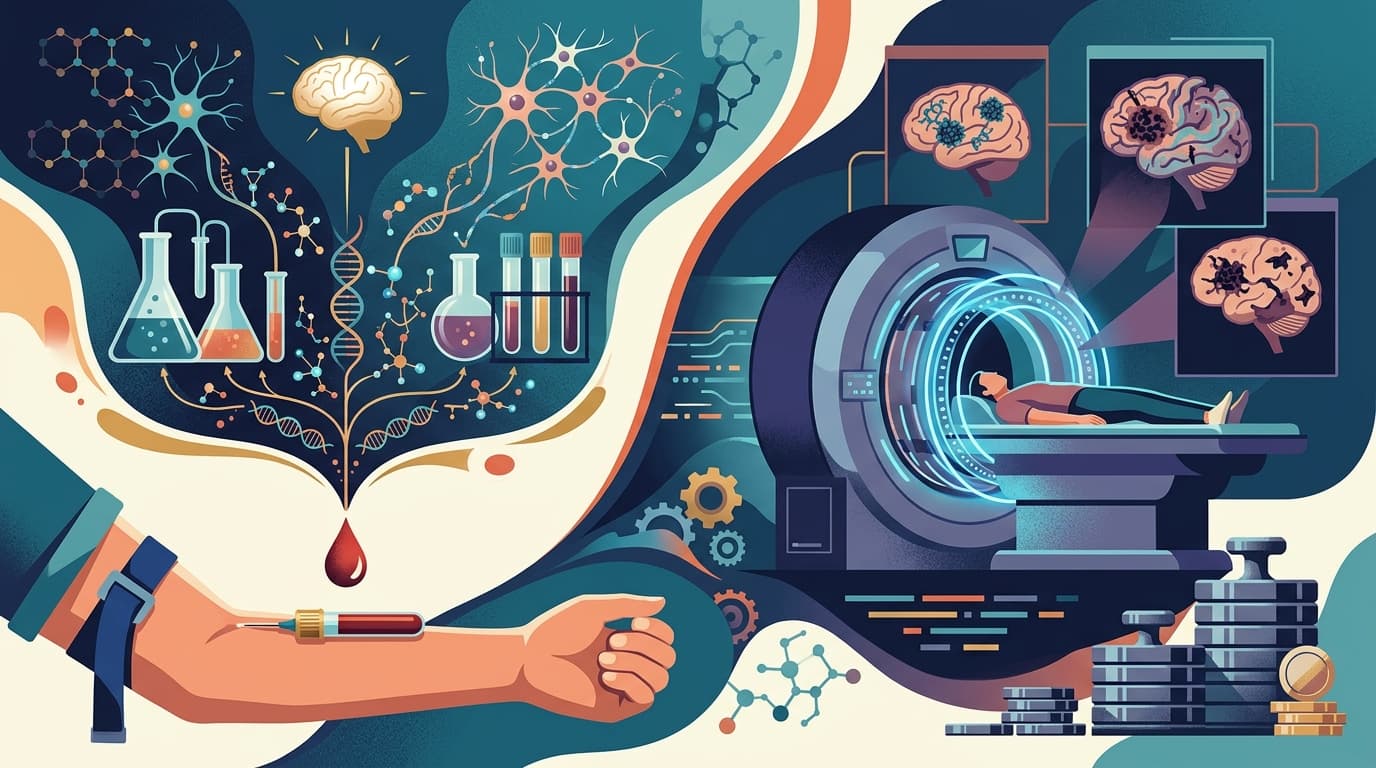
A $200 Blood Draw Could Replace a $3,000 Brain Scan for Alzheimer's
The FDA just cleared a blood test that can screen for Alzheimer's in adults as young as 40, potentially replacing expensive PET scans as the diagnostic front door. With two amyloid-targeting drugs now on the market and patients stuck in a diagnostic traffic jam, this could change everything about who gets treated and when.
The Waiting Room Problem
Imagine you're 45, and your memory has been slipping. You forget names. You lose your keys more than usual. Your doctor says, "Let's check for Alzheimer's." Then comes the bad news: the gold-standard test involves either a spinal tap or an expensive PET scan of your brain. The PET scan alone can run $3,000 or more, requires specialized equipment, and might not even be available in your city.
That bottleneck just got a lot smaller.
On August 20, the FDA cleared C2N Diagnostics' PrecivityAD2 blood test for evaluating Alzheimer's disease in adults as young as 40 who are showing signs of cognitive decline. It's the first FDA-cleared Alzheimer's blood test available for symptomatic patients that young, and it could fundamentally change how (and how quickly) millions of Americans get answers about what's happening in their brains.
What the Test Actually Does
PrecivityAD2 works like a smoke detector for Alzheimer's pathology. Instead of scanning your brain directly, it measures two key proteins in your blood: the amyloid beta 42/40 ratio and percent p-tau217. Think of amyloid beta as the sticky plaque that builds up in Alzheimer's brains, and p-tau217 as a signal flare that damaged neurons send out when that plaque is doing harm.
The test feeds both measurements into an algorithm that spits out an Amyloid Probability Score on a scale of 0 to 100. Score below 48? You're likely negative for the brain plaques associated with Alzheimer's. Score 48 or above? There's a meaningful chance those plaques are present.
How accurate is it? In a validation study of 583 patients with suspected Alzheimer's or cognitive impairment, PrecivityAD2 agreed with PET scan results 88% of the time. The test's overall diagnostic accuracy (measured by AUC, a standard metric) hit 0.94 out of 1.0. For context, that's roughly equivalent to the accuracy of a rapid strep test. Not perfect, but very good for a simple blood draw.
Get tomorrow's biotech intelligence before your competitors.
Join thousands of biotech professionals who start their day with our free, daily briefing.
C2N's previous version of the test was cleared for patients 55 and older. Dropping that age floor to 40 matters more than you might think.
Early-onset Alzheimer's, while less common, can strike people in their 40s and 50s. These patients often endure years of misdiagnosis because doctors don't expect Alzheimer's in someone that young. They get told it's stress, depression, or burnout. By the time a PET scan confirms the real culprit, years of potential intervention have been lost.
A blood test available at 40 gives clinicians a new tool to catch these cases early. It won't replace the full diagnostic workup (the FDA label is clear about that), but it can serve as a crucial first filter. Think of it as triage: the blood test sorts patients quickly so that scarce, expensive PET scans go to the people who truly need them.
The Treatment Funnel Gets Wider
This clearance doesn't exist in a vacuum. It lands at a moment when having an Alzheimer's diagnosis actually means something therapeutically.
Two amyloid-targeting drugs, Leqembi (lecanemab) and Kisunla (donanemab), are now on the market for patients with mild cognitive impairment or mild dementia caused by Alzheimer's. Both require confirmed amyloid pathology before a doctor can prescribe them. That confirmation has traditionally meant a PET scan or a lumbar puncture; neither is quick, cheap, or pleasant.
The result has been a frustrating paradox: drugs exist, but many eligible patients can't access them because they're stuck in a diagnostic traffic jam. PET scanners are concentrated in major medical centers, wait times can stretch for months, and insurance coverage remains inconsistent.
Blood tests like PrecivityAD2 could unclog that pipeline. A primary care doctor or memory clinic can order a blood draw, get results, and determine whether a patient should be fast-tracked to a specialist. The PET scan doesn't disappear from the process entirely; it may still be needed for borderline cases or payer requirements. But it no longer has to be the first gate every patient passes through.
The Competitive Scoreboard
C2N isn't the only player in this race. Fujirebio's Lumipulse test became the first FDA-cleared Alzheimer's blood test back in May 2025, and it's already being distributed through Labcorp, giving it massive reach. In validation studies, Lumipulse showed 92% positive predictive value and 97% negative predictive value using a dual cut-point approach.
So why does C2N's clearance still matter? Two reasons. First, the age range: Lumipulse's cleared population starts older, while PrecivityAD2 now covers adults down to 40. Second, competition is healthy in a market this important. More cleared tests mean more options for doctors, more leverage for payers negotiating pricing, and more pressure on everyone to improve.
The real winner here isn't one company. It's the category itself. Two years ago, a blood test for Alzheimer's sounded like science fiction. Now there are two FDA-cleared options on the market.
The Reimbursement Question (A.K.A. Who Pays?)
A test is only useful if patients can afford it, and this is where things get interesting.
C2N announced that Anthem established coverage for PrecivityAD2 in July 2026, which is a significant early win on the commercial insurance side. But the elephant in the room is Medicare. Alzheimer's is overwhelmingly a disease of older adults, and Medicare covers the majority of them. As of right now, there's no confirmed national Medicare coverage determination for PrecivityAD2.
Historically, diagnostic adoption follows the money. If Medicare issues a favorable coverage decision, expect blood-based Alzheimer's testing to become as routine as cholesterol panels for patients with cognitive complaints. Without it, uptake will likely stay concentrated among commercially insured patients and well-resourced health systems.
C2N also noted that the FDA-cleared version of PrecivityAD2 will become available "in the coming months," meaning the test currently on the market is still operating as a lab-developed test under CLIA regulations. The transition to a fully FDA-cleared product should boost physician confidence and, crucially, make the reimbursement conversation easier.
The Bigger Picture
C2N Diagnostics has been working toward this moment for almost two decades. Founded in 2007 by researchers David Holtzman and Randall Bateman at Washington University in St. Louis, the company has raised roughly $95 million from a mix of investors including Samsung, Eisai, and the Michael J. Fox Foundation. Early NIH grants totaling nearly $2 million helped move the technology from lab bench to clinical validation.
That patient, methodical build is now paying off in a market that barely existed five years ago. The Alzheimer's Drug Discovery Foundation called the clearance a step toward "precision medicine" and earlier, more accurate detection.
For patients and families navigating the terrifying uncertainty of cognitive decline, the promise is simple: a blood draw at your doctor's office might soon be the first step toward a real answer. No spinal tap. No expensive brain scan. Just a vial of blood and a score that tells your doctor what to do next.
That's not science fiction anymore. That's Tuesday morning at the clinic.
Deals & M&A4 min read
BMS Just Hired a Robot to Design Its Next Blockbuster Antibody
Bristol Myers Squibb just partnered with a two-year-old AI startup to redesign how it discovers antibodies. Chai Discovery has already landed Eli Lilly, Novartis, and Pfizer as partners, and its AI models are posting hit rates that make traditional screening look ancient.