BMS Just Hired a Robot to Design Its Next Blockbuster Antibody
Bristol Myers Squibb just partnered with a two-year-old AI startup to redesign how it discovers antibodies. Chai Discovery has already landed Eli Lilly, Novartis, and Pfizer as partners, and its AI models are posting hit rates that make traditional screening look ancient.
The $231 Million Startup That Got Big Pharma's Attention
Two years ago, Chai Discovery didn't exist. Now it's designing antibodies for one of the largest pharmaceutical companies on the planet.
Bristol Myers Squibb announced a collaboration with Chai Discovery this week to use the startup's AI platform for therapeutic antibody discovery. Financial terms weren't disclosed, which in pharma-speak usually means "we're not ready to brag about the price tag yet." But the signal is loud and clear: BMS is betting that machine learning can do what traditional lab work does, only faster.
The partnership gives BMS access to Chai's AI models to hunt for antibody candidates across its portfolio. The goal, according to the announcement, is to build a "continuously learning discovery system." Translation: BMS doesn't just want a one-time assist. It wants an AI engine that gets smarter with every experiment.
From Zero to Unicorn in 18 Months
Chai Discovery's rise has been almost absurdly fast. Founded in 2024 by Joshua Meier (ex-OpenAI, ex-Meta), Jack Dent (ex-Stripe), Matthew McPartlon, and Jacques Boitreaud, the company went from seed stage to unicorn in roughly a year and a half.
The fundraising trajectory tells the story. A $30 million seed round in 2024, led by Thrive Capital and OpenAI. A $70 million Series A in August 2025. Then a $130 million Series B in December 2025 that valued the company at $1.3 billion. By early 2026, total funding had reached $231 million. More recently, reports indicate Chai closed a $400 million Series C, pushing its war chest even higher.
OpenAI was one of Chai's earliest backers, which makes sense when you look at Meier's background. He cut his teeth building large language models before pivoting to biology. The thesis: if you can train AI to predict the next word in a sentence, you can train it to predict how proteins fold and interact. Same math, wildly different stakes.
Get tomorrow's biotech intelligence before your competitors.
Join thousands of biotech professionals who start their day with our free, daily briefing.
What Chai Actually Does (Without the Jargon)
Think of antibody discovery like online dating. Traditionally, pharma companies screen millions of molecular "profiles" looking for a match with their target protein. It's slow, expensive, and most candidates ghost you after the first date.
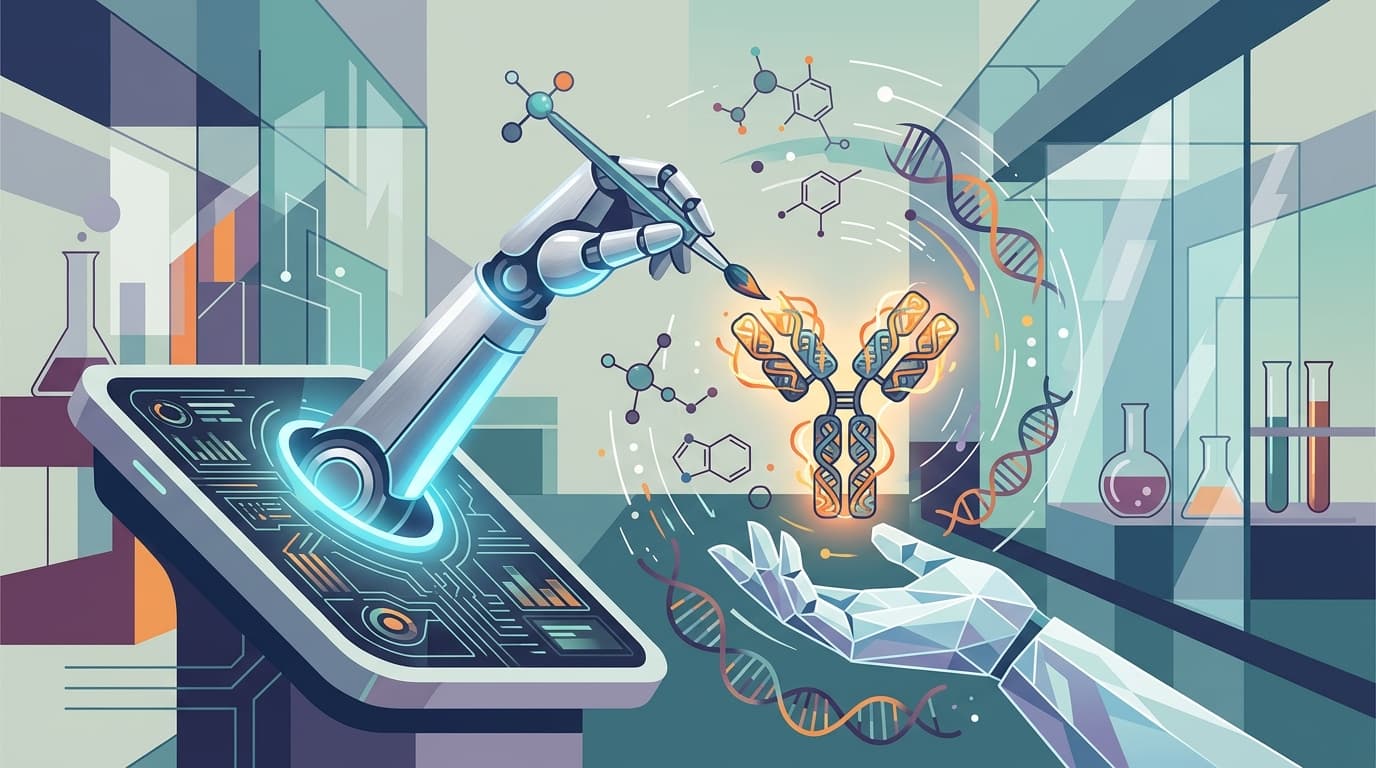
Chai's approach skips the swiping. Its AI models generate brand-new antibody designs from scratch, optimized for a specific target. The company calls this "de novo antibody design," which just means creating candidates that never existed in nature.
The results have been turning heads. Chai's second-generation model, Chai-2, reportedly achieved a near-20% hit rate on designed antibodies. For context, traditional screening campaigns often celebrate single-digit success rates. A 20% hit rate is like batting .200 in a league where most players are hitting .050.
Chai also released Chai-1, an open-source model for predicting molecular structures, which helped establish credibility in the computational biology community before the company started monetizing its platform through pharma partnerships.
BMS Has Been on an AI Shopping Spree
This isn't BMS's first date with artificial intelligence. The company has been steadily layering AI into its R&D infrastructure over the past two years, and the Chai deal fits a clear pattern.
In early 2024, BMS partnered with VantAI on a deal worth up to $674 million in milestones, focused on using generative AI to discover molecular glue drugs (small molecules that force two proteins to stick together). That same year, it signed a deal with AI Proteins worth up to $400 million to develop therapeutic miniproteins.
On the hardware side, BMS built an AI Center of Excellence with NVIDIA, deploying a DGX SuperPOD (essentially a supercomputer optimized for AI workloads) in March 2024. In 2026, it announced plans to expand that infrastructure with NVIDIA's next-generation systems.
Add it all up and the picture is striking. BMS isn't just experimenting with AI; it's wiring the technology into its entire discovery operation. The VantAI deal targets small molecules. AI Proteins covers miniproteins. Now Chai handles antibodies. Each partnership addresses a different modality, like hiring specialists for every position on the field.
Why Antibodies, Why Now
BMS is staring down a wall of patent expirations on key revenue drivers. The company has been transparent about its strategy: use acquisitions and partnerships to reload the pipeline with next-generation medicines, targeting 10+ new drugs and 30+ new indications by 2030.
Antibodies are central to that plan. BMS's recent moves include acquiring rights to an in vivo CAR-T program, co-developing a bispecific antibody with BioNTech, and building out its oncology and immunology portfolios.
But here's the bottleneck: designing antibodies the traditional way takes years. You immunize animals, screen libraries, optimize candidates, test for manufacturability. Every step has failure points. If AI can compress even a portion of that timeline, the payoff is enormous. Not just in money saved, but in time recaptured.
The Bigger Picture: AI Antibody Design Goes Mainstream
Chai isn't operating in a vacuum. The AI-driven antibody discovery space has exploded, with companies like Generate Biomedicines, AbCellera, BigHat Biosciences, Antiverse, and EVQLV all competing for pharma partnerships. One market projection pegs this sector growing from $471.5 million in 2024 to $3.0 billion by 2034.
When major pharma companies are turning to AI startups for antibody design, that's not a pilot program anymore. That's a platform.
The skeptic's case is worth mentioning too. AI-designed candidates still need to survive the gauntlet of preclinical testing, manufacturing, and clinical trials. Computational predictions don't always translate to real-world biology. These collaborations add R&D complexity and cost, and the true payoff won't be clear for years.
The Bottom Line
BMS's partnership with Chai Discovery is another brick in a wall that big pharma has been building since 2024: the systematic integration of AI into drug discovery, not as a novelty, but as core infrastructure.
The undisclosed deal terms make it hard to gauge the financial commitment. But the strategic signal is unmistakable. BMS is assembling an AI toolkit that spans small molecules, proteins, and now antibodies. Chai, barely two years old, just landed another blue-chip partner to validate its platform.
The real question isn't whether AI will change how antibodies are discovered. It's whether the companies betting on it now will be the ones that benefit most when the first AI-designed antibody actually reaches patients. That race is very much on.
Clinical & Regulatory4 min read
The $2.7 Million Shot That Replaces a Lifetime of Eating Cornstarch
The FDA just approved a $2.7 million one-time gene therapy for a rare metabolic disease that previously had zero approved treatments, only cornstarch eaten on a brutal round-the-clock schedule. Ultragenyx's Genglycos could rewrite the playbook for metabolic gene therapy.