
Biotech IPOs raised a record $1.7 billion in Q1 2026, but only a select few made it through the door. The public market has become an exclusive club where late-stage data and billion-dollar backing are the price of admission.
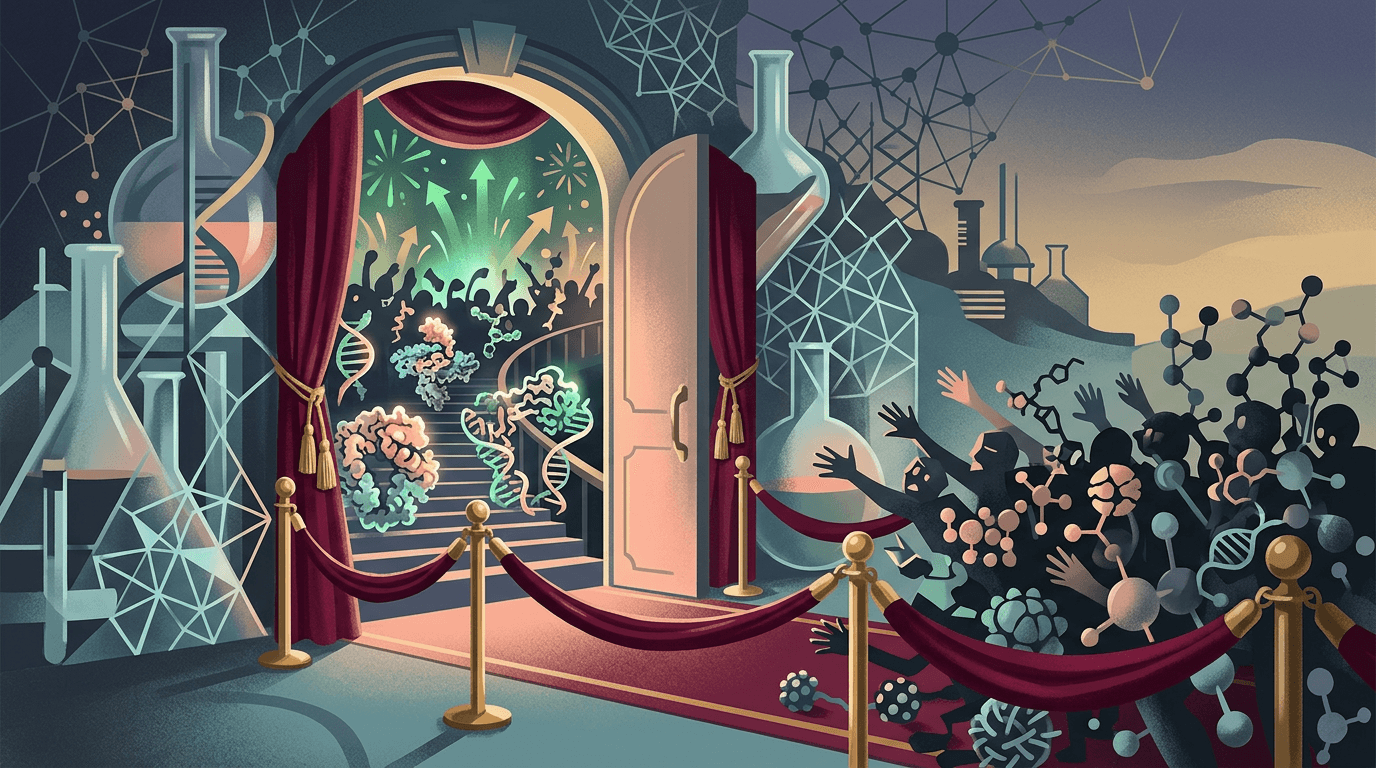
Imagine a nightclub that only lets in celebrities. The line outside is long, the bouncers are ruthless, and if you don't have a VIP pass (read: late-stage clinical data and a fat war chest), you're not getting through the door.
That's basically the biotech IPO market right now.
Q1 2026 saw just a handful of companies go public. But the ones that did? They raised a collective $1.7 billion, the highest quarterly total since the frenzied boom of 2021. The median deal size hit $287.5 million, more than double the same period last year. Fewer companies, way more money. It's not a comeback story. It's a bottle-service-only story.
Three IPOs accounted for the lion's share of that $1.7 billion, and each one crossed the $300 million mark. That hasn't happened since 2021, when biotech IPOs were flowing like cheap champagne at a tech launch party.
Generate Biomedicines led the pack, raising $400 million in late February by pricing 25 million shares at $16 each. The company uses machine learning and high-throughput experimentation to design protein therapeutics from scratch. Think of it as programming biology instead of discovering it by accident. Its lead candidate, GB-0895, is gunning for AstraZeneca's Tezspire in severe asthma, and the company claims ultra-high-affinity binding for GB-0895. Before going public, Generate had already locked up partnerships worth billions: $1.9 billion with Amgen and over $1 billion with Novartis. Flagship Pioneering (the venture firm behind Moderna) is a major shareholder, with Moderna CEO Stéphane Bancel and Nobel laureate Frances Arnold sitting on the board.
Eikon Therapeutics wasn't far behind at $381 million, upsized from an original target of about $273 million. Founded in 2019, Eikon uses super-resolution microscopy to watch immune signaling and DNA repair happening inside living cells in real time. It's like giving drug hunters a microscope that can zoom into a city and read license plates. The company has four clinical-stage cancer programs, including EIK1001 (a TLR7/8 immune activator already in Phase 2/3 trials for melanoma and lung cancer) that showed a 64% response rate in a Phase 2 lung cancer study. Eikon had raised over $1 billion privately before ever touching public markets.

A small biotech developing a promising liver disease treatment was killed not by bad science or a failed trial, but by a single FDA meeting cancellation. Kezar Life Sciences' collapse reveals how regulatory delays are becoming an existential threat to the companies driving biomedical innovation.


Join thousands of biotech professionals who start their day with our free, daily briefing.
Aktis Oncology opened the year's IPO window on January 9, raising $318 million (upsized from roughly $210 million). Aktis builds targeted radiopharmaceuticals: tiny guided missiles that deliver alpha-emitting radiation directly to tumors while leaving healthy tissue alone. Its lead program targets Nectin-4, the same protein that Pfizer's blockbuster Padcev goes after, but with a radioactive twist. Eli Lilly was so enthusiastic it bought $100 million worth of shares at the IPO and had previously signed a collaboration deal worth $1.1 billion.
Notice a pattern? Every company that successfully IPO'd had three things in common: clinical-stage data, massive prior venture funding, and programs in red-hot therapeutic areas like oncology and immunology.
No preclinical company has gone public since 2024. Let that sink in. If your drug hasn't been tested in humans yet, the public market doesn't want to hear about it. Back in 2021, investors were basically buying lottery tickets. A lot of those tickets turned out to be worthless (many 2021 IPOs are down 60-80% from their debut), and the hangover has reshaped how Wall Street evaluates biotech risk.
Ben Zercher, a senior analyst at PitchBook, put it this way: "Product-focused companies built around clinically grounded programs are forming the backbone of the window, while larger platform-oriented issuers are testing how far investor appetite can extend beyond near-term validation."
Translation: show me the data or stay home.
Before you assume everything is rosy for the companies that made it through, there's a catch. Several of Q1's biggest IPOs are already trading below their offering prices. Generate Biomedicines closed its first day of trading at $12.65, down about 21% from its $16 IPO price, giving it a market cap of about $1.6 billion. Eikon has faced similar headwinds.
This creates an awkward dynamic. Investors are willing to write enormous checks to get these companies public, but then the stocks drift downward once they start trading. It's like paying full price for a concert ticket and then watching the band play to a half-empty arena.
Part of the explanation is macro. Geopolitical tensions, FDA leadership changes, and broader market volatility have made the first quarter choppy for everyone.
For the dozens of private biotechs sitting on the sidelines, the path forward looks narrow. The IPO window isn't really "open" in any traditional sense; it's more like a doggy door that only Great Danes can fit through.
Jonathan Norris, managing director at HSBC Innovation Banking, noted that optimism for a broader rebound has been "tempered by macro factors and FDA volatility." The IPO numbers simply haven't spiked the way people hoped.
Sofinnova Partners' Antoine Papiernik offered a sliver of hope, suggesting that as markets strengthen, smaller or earlier-stage offerings may eventually emerge. Analysts forecast 25 to 30 biotech IPOs for the full year. But even that optimistic scenario keeps the market far below the approximately 99 deals of the 2021 peak.
For smaller biotechs, M&A is increasingly the more realistic exit. Why fight through a hostile IPO market when a pharma giant with a patent cliff might pay a premium to acquire you outright?
Q1 2026 proved that the biotech IPO market is alive, just extremely selective. The companies that can raise $300 million or more are doing fine. Everyone else is pressing their nose against the glass.
This is a market that rewards maturity, partnerships, and clinical proof over promise and potential. If you're a biotech CEO eyeing the public markets, the message from Q1 is loud and clear: come with data, come with cash, or don't come at all.
Eli Lilly just got FDA approval for Foundayo, the first small-molecule obesity pill that you can take anytime, anywhere, no needles required. With $1.7 billion in projected first-year sales and a price that undercuts injectables by 85%, the GLP-1 wars just went oral.