One Letter in Your DNA Could Ruin Your Life. Beam Wants to Fix It.
The FDA just cleared Beam Therapeutics to test a gene therapy that fixes a single DNA "typo" causing PKU, a disease that forces patients into a lifetime of brutal dietary restriction. Base editing has never been tried in metabolic disease before, and this trial could reshape the field.
Imagine you can never eat a burger. Or cheese. Or eggs, chicken, fish, bread, nuts, or milk. Not because of an allergy or a lifestyle choice, but because a single misplaced letter in your DNA turns ordinary protein into a slow-acting poison for your brain.
That's life with phenylketonuria (PKU). And this week, the FDA gave Beam Therapeutics the green light to try fixing that one letter.
The Typo That Ruins Everything
PKU is a rare genetic disorder caused by mutations in the PAH gene, which makes an enzyme called phenylalanine hydroxylase. That enzyme's job is to break down phenylalanine (Phe), an amino acid found in basically every protein you eat. When PAH doesn't work, Phe builds up in the blood and damages the brain. Left untreated, it causes severe intellectual disability.
The fix since the 1950s? A brutally restrictive diet. We're talking lifelong avoidance of most normal food, supplemented with special medical formulas that taste about as good as you'd expect. Patients diagnosed at birth through newborn screening can avoid the worst outcomes, but the diet is, in the words of researchers, "onerous." Roughly 76 to 80 percent of surveyed PKU patients say their number one wish is a treatment that lets them eat more freely.
There are drugs on the market. BioMarin's sapropterin (Kuvan) works for about 25 to 50 percent of patients, mostly those with milder forms. Their other product, Palynziq, can dramatically lower Phe levels, but it comes with frequent injection-site reactions and a risk of anaphylaxis serious enough to require a restricted distribution program. Neither is a cure. Both still require careful monitoring.
So the unmet need is enormous, even in a rare disease that affects roughly 1 in 10,000 to 15,000 births. About 45,000 people live with PKU in Europe alone.
Enter the World's Most Precise Spell-Check
On June 18, 2026, Beam Therapeutics announced that the FDA cleared its Investigational New Drug (IND) application for , a gene therapy designed to correct PKU-causing mutations directly in the liver.
Get tomorrow's biotech intelligence before your competitors.
Join thousands of biotech professionals who start their day with our free, daily briefing.
BEAM-304
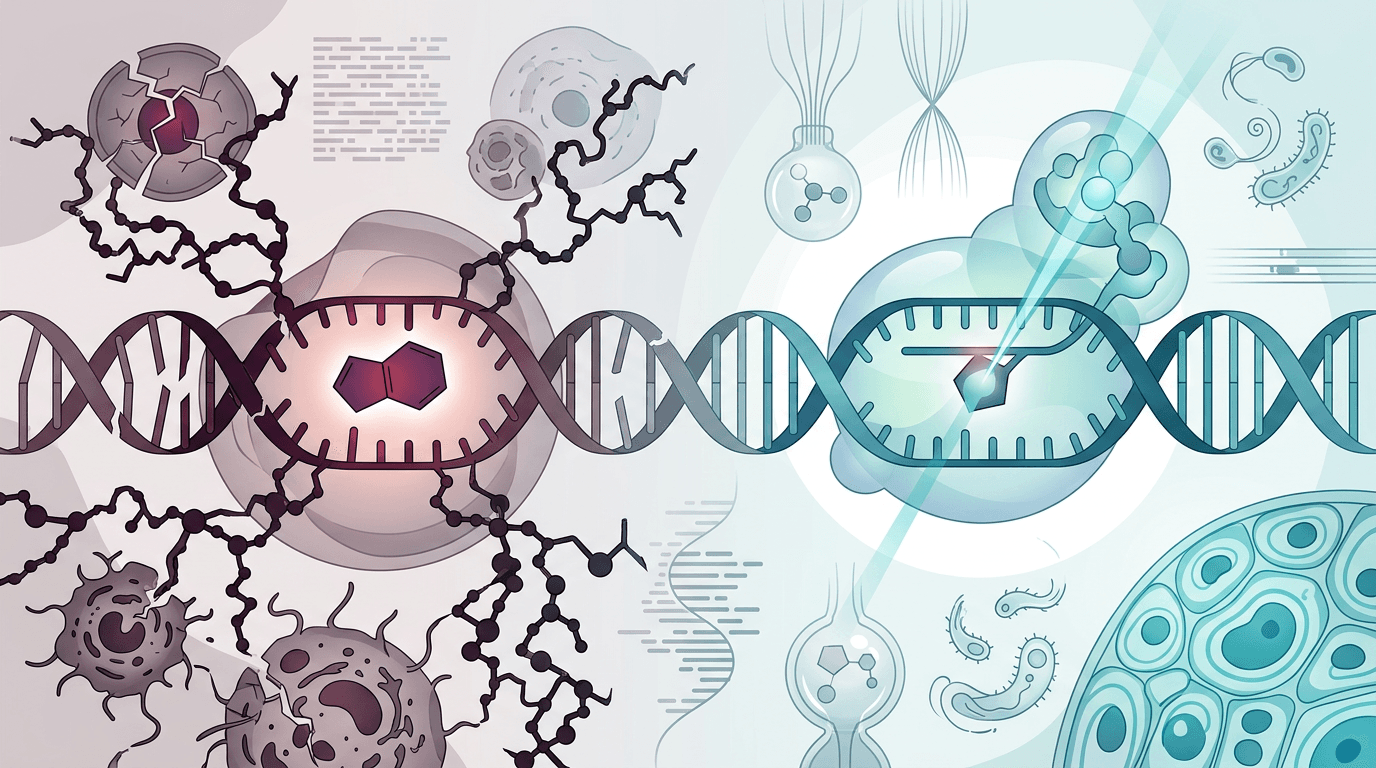
The technology is called base editing, and it works like molecular spell-check. Think of your DNA as a four-billion-letter document. Traditional CRISPR is like cutting out an entire sentence and hoping the cell pastes in the right replacement. Base editing is more like clicking on one wrong letter and changing it to the correct one, no cutting required.
That distinction matters. Standard CRISPR creates double-strand breaks in DNA, which the cell then has to repair. That repair process can introduce errors. Base editing uses a modified version of the CRISPR machinery to chemically convert one DNA letter into another without ever snapping the strand. It's cleaner, more precise, and potentially safer for correcting the kind of single-letter "typos" that cause diseases like PKU.
BEAM-304 uses a lipid nanoparticle (basically a tiny fat bubble, the same delivery tech behind mRNA COVID vaccines) to shuttle the base editor into liver cells via an IV infusion. Once inside, the editor finds the mutant PAH gene and fixes it. In mouse studies, Beam reported that the treatment normalized plasma phenylalanine levels at clinically relevant doses, with robust editing in the liver.
Why PKU Is the Perfect Test Case
Base editing has to prove itself somewhere, and PKU is a surprisingly smart choice.
First, the biology is straightforward: one gene, one enzyme, one measurable blood marker. You either lower Phe or you don't. There's no ambiguity in the readout.
Second, Beam is starting with the R408W mutation, one of two prevalent variants that together account for nearly half of U.S. PKU patients. That's a big slice of a rare disease, which helps with enrollment and commercial planning.
Third, the competition is beatable. When your alternatives are a lifetime of medical formula or a drug that can cause anaphylaxis, a one-time IV infusion that fixes the root cause looks pretty compelling.
The planned Phase 1/2 trial will be open-label and focused on safety, tolerability, and whether BEAM-304 actually reduces blood Phe in humans. It's early days, but the starting line matters.
Beam's Bigger Picture
BEAM-304 isn't Beam's only trick. The company is running a surprisingly deep pipeline across both blood diseases and genetic liver conditions.
Their most advanced program is risto-cel (formerly BEAM-101), an ex vivo base-edited stem cell therapy for sickle cell disease. That program is in a Phase 1/2 trial with 31 patients treated, and Beam is targeting a Biologics License Application (BLA) submission around late 2026. Interim data were published in The New England Journal of Medicine, making it the first base-editing clinical dataset in sickle cell.
On the liver side, BEAM-302 for alpha-1 antitrypsin deficiency achieved what Beam calls the first in vivo correction of a disease-causing mutation in humans. That's a landmark for the entire field, not just the company. Another liver program, BEAM-301 for glycogen storage disease, is also in Phase 1/2.
The PKU program adds a fourth clinical-stage asset and extends the platform into metabolic disease for the first time. Each new indication is essentially another data point proving that base editing works across different genes, organs, and delivery methods.
Beam also has partnerships reinforcing the thesis. Pfizer opted into an exclusive worldwide license for a liver-targeted candidate from a four-year collaboration that wrapped in late 2025. Apellis is working with Beam on complement-targeted base editing. And a strategic financing deal with Sixth Street provides non-dilutive capital to support the potential commercial launch of risto-cel.
The Caveats (Because There Are Always Caveats)
Let's be clear about where things stand. BEAM-304 has zero human data. Mouse models are encouraging, but the gap between rodent results and clinical proof of concept is littered with failed therapies.
Base editing as a modality has no regulatory approvals anywhere in the world yet. The first approved CRISPR therapy, Vertex and CRISPR Therapeutics' Casgevy, uses older Cas9 nuclease technology. Base editing still needs to cross that finish line, and industry watchers don't expect the first approval until 2026 or 2027 at the earliest.
From an investor perspective, Beam trades at a price-to-sales ratio around 20 with no profits, which means a lot of future success is already baked into the stock. Analysts have also flagged roughly $3.62 million in insider selling over recent months with no insider buying; that's not catastrophic, but it's not exactly a vote of confidence either.
Why This Matters Beyond Beam
The BEAM-304 IND clearance is a signal flare for the broader gene editing field. It tells us the FDA is comfortable letting base-editing therapies move into new disease areas, including metabolic conditions that require in vivo delivery to the liver. That's encouraging for every company working on similar approaches.
For PKU patients, the timeline is still long. Phase 1/2 trials take years, and approval (if it comes) is probably the better part of a decade away. But the fact that someone is seriously trying to fix the root cause of this disease, rather than managing its symptoms with yet another restrictive regimen, is meaningful.
One wrong letter. One potential fix. The clinical trial will tell us if the spell-check actually works.
5 min read
Lilly's $25 Billion Shopping Spree Just Found a Painkiller That Skips the Opioid Problem
Eli Lilly quietly scooped up 4E Therapeutics, a startup with a first-in-class painkiller that skips opioid receptors entirely. It's the latest move in a $20 billion+ acquisition spree, and it could reshape how we treat chronic pain.