

Avalyn Pharma wants to take two blockbuster lung disease drugs and reinvent how patients receive them. The company just filed for a $100 million IPO, betting that inhaling these medications beats swallowing them.
Imagine you've got two decent medications for a fatal disease, but patients can barely tolerate taking them. Now imagine someone figured out a way to deliver those same drugs directly where they're needed, skipping most of the nasty side effects. That's the pitch Avalyn Pharma is bringing to Wall Street.
The Boston-based biotech filed its S-1 registration statement with the SEC on April 8, aiming to list on Nasdaq under the ticker AVLN. The target: roughly $100 million to fund late-stage trials of inhaled drugs for pulmonary fibrosis, a progressive scarring of the lungs that affects over 200,000 Americans. Morgan Stanley, Jefferies, Evercore ISI, and Guggenheim Securities are running the books. No pricing date has been set.
But the real story isn't just another biotech IPO. It's a company betting it can reinvent two blockbuster drugs by changing how patients breathe them in.
Idiopathic pulmonary fibrosis, or IPF, is one of those diseases that makes you angry the more you learn about it. The lungs slowly scar over, making it harder and harder to breathe. Median survival after diagnosis is just three to five years. And the two drugs approved to slow it down (not cure it, just slow it) come with a catch.
Pirfenidone (sold as Esbriet) and nintedanib (sold as Ofev) both work as oral medications. They've become blockbusters, anchoring a market worth roughly $3.7 to $5.4 billion in 2026. But taking them by mouth means the drugs flood your entire body before reaching the lungs. The result: liver problems, stomach issues, nausea, and diarrhea that's bad enough to make some patients quit treatment entirely.
Think of it like watering your garden with a fire hose. Sure, the flowers get wet. But so does everything else, and half the yard is destroyed in the process.
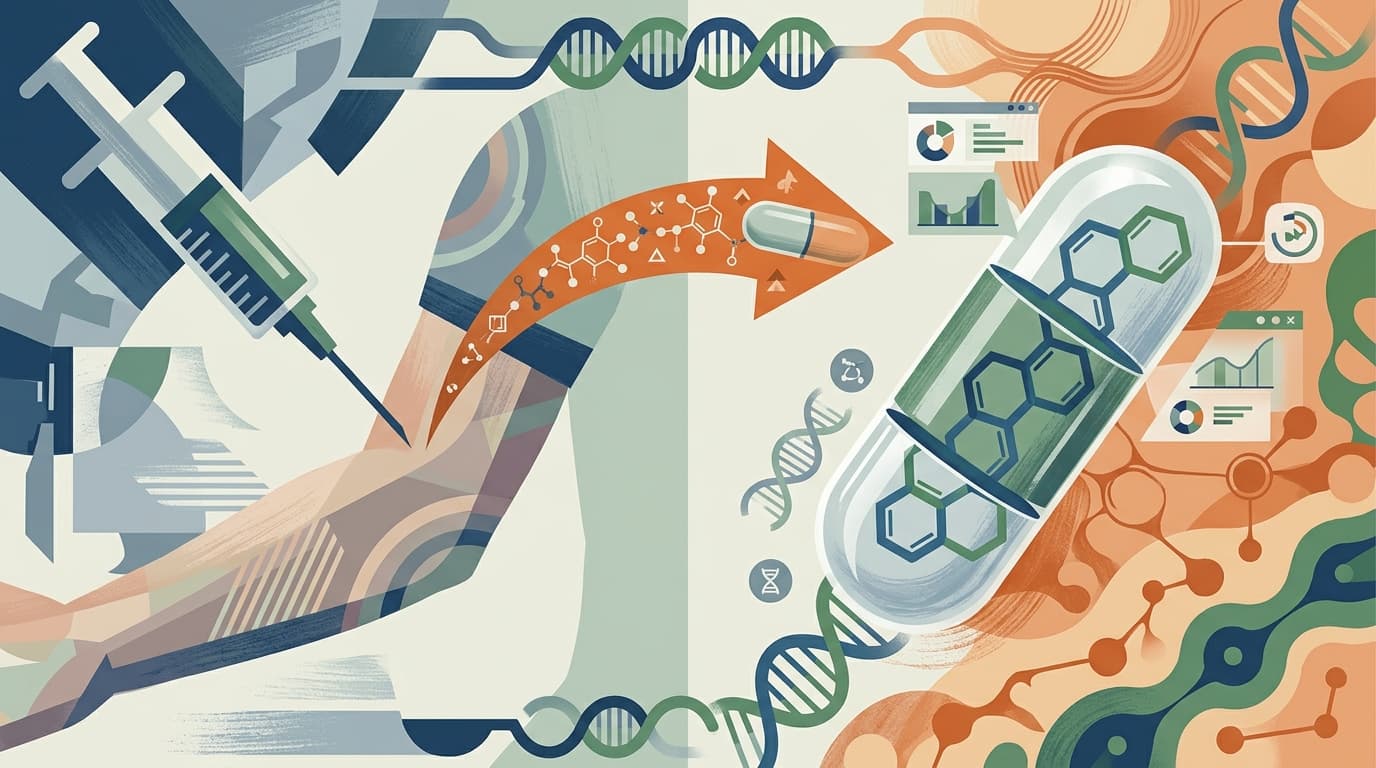
Avalyn's approach is deceptively simple. Take those same two proven molecules and reformulate them for inhalation using a specialized nebulizer (a device that turns liquid medicine into a fine mist). The drug goes straight to the lungs. Less goes everywhere else.

Biotech IPOs raised $1.7 billion in Q1 2026, the biggest quarter since 2021, with median deal sizes more than doubling. But the real story isn't just the money coming back; it's about which companies are getting funded and what Eli Lilly's aggressive shopping spree tells us about what's next.


Join thousands of biotech professionals who start their day with our free, daily briefing.
The pipeline has three candidates, each at a different stage:
AP01 is inhaled pirfenidone, currently in a Phase 2b trial called MIST for progressive pulmonary fibrosis. Earlier Phase 1b data (from a study called ATLAS) showed patients on the 100 mg twice-daily dose had near-stabilization of lung function over 48 weeks, with good tolerability. Full Phase 2b data should arrive by the end of 2027.
AP02 is inhaled nintedanib, which has completed Phase 1 testing in both healthy volunteers and IPF patients. A Phase 2 trial called AURA is underway, with the first patient dosed in March 2026.
AP03 is the ambitious one: a fixed-dose combination of both pirfenidone and nintedanib in a single inhaled treatment. It's still in preclinical work, but it tackles a real problem. Doctors know combining the two oral drugs could help more patients, but the stacked side effects make it impractical. An inhaled combo could change that math entirely.
Avalyn isn't exactly scraping by. The company entered 2026 with $138 million in cash, having raised over $300 million across venture rounds. That includes a $100 million Series D closed in July 2025. Investors include names like RiverVest, FPrime Capital, and Catalio Capital. The team is lean: just 51 employees, with 32 in R&D.
CEO Lyn Baranowski brings a track record that venture investors love. She previously served as COO at Altavant Sciences and was VP of Commercial Development at Pearl Therapeutics, which AstraZeneca bought for $1.15 billion. IPO proceeds would primarily fund the Phase 2b/3 program for AP01, the Phase 2/3 path for AP02, and early human testing for AP03.
Avalyn isn't the only company eyeing better IPF treatments. Bristol Myers Squibb, AbbVie, and United Therapeutics all have programs in the space, though the graveyard of failed IPF trials is long and sobering. Boehringer Ingelheim's BI 1015550 is another one to watch.
Leerink Partners analyst Faisal Khurshid described the recent IPF approval Jascayd as a "modest advance," underscoring just how high the bar remains. The financial rewards for cracking this disease, though, are enormous. Esbriet and Ofev became multi-billion-dollar franchises despite their tolerability headaches. An inhaled version that works as well (or better) with fewer side effects could capture significant share, especially since inhaled therapies are the fastest-growing segment in the IPF market, expanding at a 9.85% annual clip.
Avalyn is filing into what looks like a genuinely open IPO window for biotech. After a brutal 2025, early 2026 has been markedly different. At least six U.S. biotechs have priced offerings totaling roughly $1.77 billion, with some supersized deals: Generate:Biomedicines raised $400 million, Eikon Therapeutics pulled in $381 million, and Aktis Oncology upsized to $318 million.
Analysts are cautiously bullish on the trend. Michael Rachlin of FTI Consulting called 2026 a "more discerning IPO marketplace" that favors companies with "proven, later-stage assets." Ben Folwell at Evaluate projected 40 to 60 biotechs could go public this year if M&A momentum holds. A baseline estimate of 30 to 35 IPOs seems reasonable.
Avalyn fits the profile investors want right now: clinical-stage data, a clear path to Phase 3, and a reformulation strategy for drugs with proven biology. Over two-thirds of biotech IPOs since 2022 have involved Phase 2 or later programs, and Avalyn checks that box.
Avalyn's thesis is elegant in its simplicity. Don't invent a new molecule; just deliver proven ones more intelligently. If the clinical data holds up, inhaled versions of pirfenidone and nintedanib could meaningfully improve life for patients who currently have to choose between slowing their disease and tolerating brutal side effects.
The risk, of course, is that reformulation stories don't always pan out. Phase 2b and Phase 3 trials are where good ideas go to get stress-tested against reality. And the IPF space has humbled plenty of well-funded companies before.
But with $138 million in the bank, a top-tier investor syndicate, and an IPO market that's finally breathing again (pun very much intended), Avalyn has positioned itself for a real shot. We'll be watching for pricing details in the coming weeks.
Neurocrine Biosciences is spending $2.9 billion to acquire the only approved drug for a rare hunger disorder most people have never heard of. The deal says a lot about where biotech's biggest bets are heading.